Thank you for visiting SNEWPapers!
Sign up free
Literary
November 10, 1878
The Morning Star And Catholic Messenger
New Orleans, Orleans County, Louisiana
What is this article about?
Biographical account of Pope St. Martin (649-655), who opposed the Monothelite heresy, incurring Byzantine enmity. He faced assassination attempts, arrest, public humiliation in Constantinople, and banishment to Chersonese, dying in 655. He rejected Emperor Constans' compromising edict 'Type' on Christ's will.
Clipping
OCR Quality
98%
Excellent
Full Text
November 12.
ST. MARTIN, POPE.
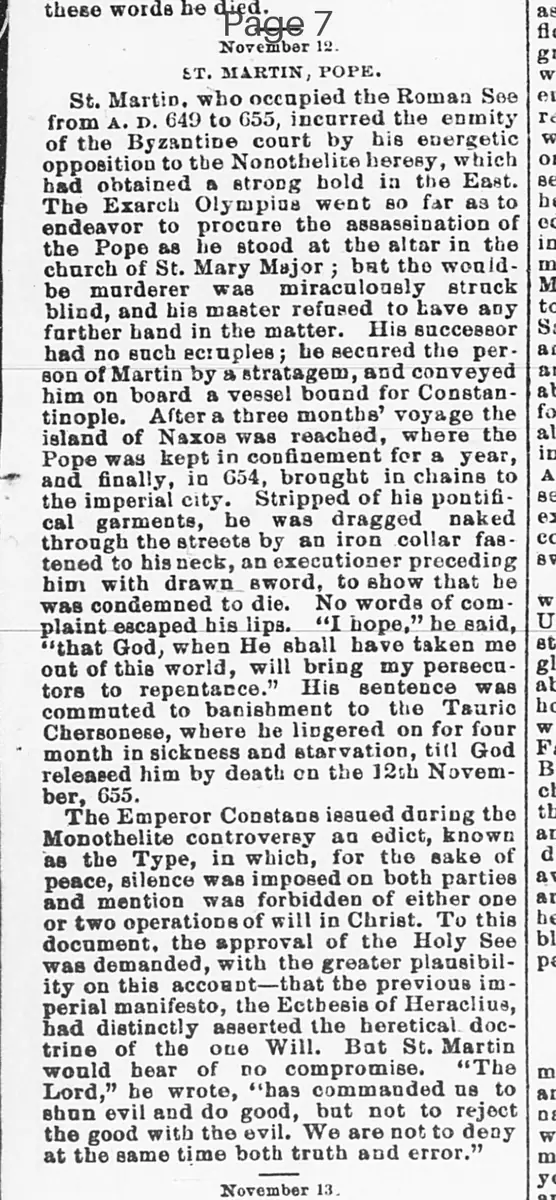
St. Martin, who occupied the Roman See from A. D. 649 to 655, incurred the enmity of the Byzantine court by his energetic opposition to the Monothelite heresy, which had obtained a strong hold in the East. The Exarch Olympius went so far as to endeavor to procure the assassination of the Pope as he stood at the altar in the church of St. Mary Major; but the would-be murderer was miraculously struck blind, and his master refused to have any further hand in the matter. His successor had no such scruples; he secured the person of Martin by a stratagem, and conveyed him on board a vessel bound for Constantinople. After a three months' voyage the island of Naxos was reached, where the Pope was kept in confinement for a year, and finally, in 654, brought in chains to the imperial city. Stripped of his pontifical garments, he was dragged naked through the streets by an iron collar fastened to his neck, an executioner preceding him with drawn sword, to show that he was condemned to die. No words of complaint escaped his lips. "I hope," he said, "that God, when He shall have taken me out of this world, will bring my persecutors to repentance." His sentence was commuted to banishment to the Tauric Chersonese, where he lingered on for four months in sickness and starvation, till God released him by death on the 12th November, 655.
The Emperor Constans issued during the Monothelite controversy an edict, known as the Type, in which, for the sake of peace, silence was imposed on both parties and mention was forbidden of either one or two operations or will in Christ. To this document, the approval of the Holy See was demanded, with the greater plausibility on this account—that the previous imperial manifesto, the Ecthesis of Heraclius, had distinctly asserted the heretical doctrine of the one Will. But St. Martin would hear of no compromise. "The Lord," he wrote, "has commanded us to shun evil and do good, but not to reject the good with the evil. We are not to deny at the same time both truth and error."
ST. MARTIN, POPE.
St. Martin, who occupied the Roman See from A. D. 649 to 655, incurred the enmity of the Byzantine court by his energetic opposition to the Monothelite heresy, which had obtained a strong hold in the East. The Exarch Olympius went so far as to endeavor to procure the assassination of the Pope as he stood at the altar in the church of St. Mary Major; but the would-be murderer was miraculously struck blind, and his master refused to have any further hand in the matter. His successor had no such scruples; he secured the person of Martin by a stratagem, and conveyed him on board a vessel bound for Constantinople. After a three months' voyage the island of Naxos was reached, where the Pope was kept in confinement for a year, and finally, in 654, brought in chains to the imperial city. Stripped of his pontifical garments, he was dragged naked through the streets by an iron collar fastened to his neck, an executioner preceding him with drawn sword, to show that he was condemned to die. No words of complaint escaped his lips. "I hope," he said, "that God, when He shall have taken me out of this world, will bring my persecutors to repentance." His sentence was commuted to banishment to the Tauric Chersonese, where he lingered on for four months in sickness and starvation, till God released him by death on the 12th November, 655.
The Emperor Constans issued during the Monothelite controversy an edict, known as the Type, in which, for the sake of peace, silence was imposed on both parties and mention was forbidden of either one or two operations or will in Christ. To this document, the approval of the Holy See was demanded, with the greater plausibility on this account—that the previous imperial manifesto, the Ecthesis of Heraclius, had distinctly asserted the heretical doctrine of the one Will. But St. Martin would hear of no compromise. "The Lord," he wrote, "has commanded us to shun evil and do good, but not to reject the good with the evil. We are not to deny at the same time both truth and error."
What sub-type of article is it?
Essay
What themes does it cover?
Religious
Political
What keywords are associated?
St Martin
Pope
Monothelite Heresy
Byzantine Persecution
Constans Edict
Type
Chersonese
Literary Details
Title
St. Martin, Pope
Subject
Opposition To The Monothelite Heresy
Form / Style
Hagiographical Prose Narrative
Key Lines
I Hope, That God, When He Shall Have Taken Me Out Of This World, Will Bring My Persecutors To Repentance.
The Lord, Has Commanded Us To Shun Evil And Do Good, But Not To Reject The Good With The Evil. We Are Not To Deny At The Same Time Both Truth And Error.