Thank you for visiting SNEWPapers!
Sign up free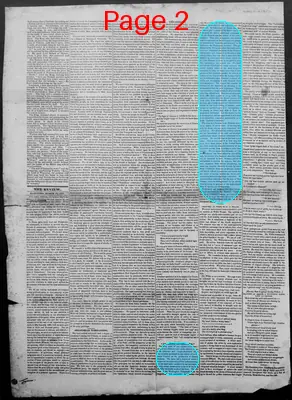
Editorial
March 17, 1828
The New England Weekly Review
Hartford, Hartford County, Connecticut
What is this article about?
Editorial critiques General Andrew Jackson's literacy, presuming he authored a poorly written anonymous note on 'secret assassins' and 'female character' published by the National Journal, amid partisan disputes with the Washington Telegraph.
Clipping
OCR Quality
95%
Excellent
Full Text
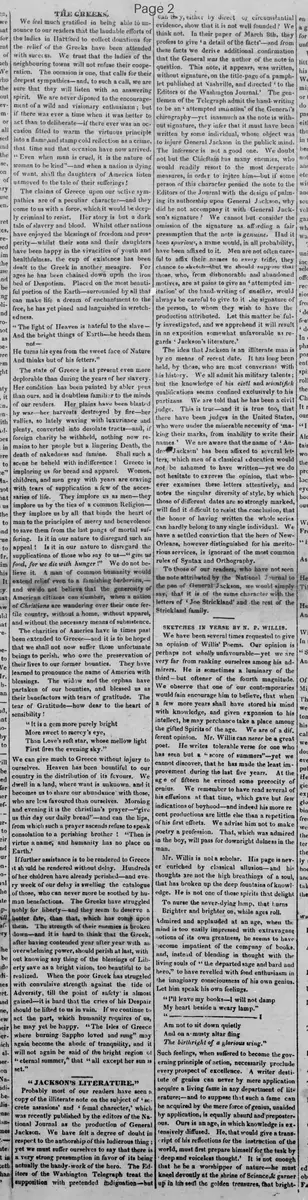
"JACKSON'S LITERATURE."
Probably most of our readers have seen a copy of the illiterate note on the subject of 'secret assassins' and 'female character,' which was recently published by the editors of the National Journal as the production of General Jackson. We have felt a degree of doubt in respect to the authorship of this ludicrous thing; yet we must suffer ourselves to say that there is a very strong presumption in favor of its being actually the handy-work of the hero. The Editors of the Washington Telegraph treat the supposition with pretended indignation—but
Can they, either by direct or circumstantial evidence, show that it is not well founded? We think not. In their paper of March 8th, they profess to give 'a detail of the facts'—and from these facts we derive additional confirmation that the General was the author of the note in question. This note, it appears, was written, without signature, on the title-page of a pamphlet published at Nashville, and directed 'to the Editors of the Washington Journal.' The gentlemen of the Telegraph admit the hand-writing to be an 'attempted imitation' of the General's chirography—yet inasmuch as the note is without signature, they infer that it must have been written by some individual, whose object was to injure General Jackson in the public mind. The inference is not a good one. We doubt not but the Chieftain has many enemies, who would readily resort to the most desperate measures, in order to injure him—but if some person of this character penned the note to the Editors of the Journal with the design of palming its authorship upon General Jackson, why did he not accompany it with General Jackson's signature? We cannot but consider the omission of the signature as affording a fair presumption that the note is genuine. Had it been spurious, a name would, in all probability, have been affixed to it. Men are not often careful to affix their names to every trifle, they chance to sketch—but we should suppose that those, who, from dishonorable and abandoned motives, are at pains to give an 'attempted imitation' of the hand-writing of another, would always be careful to give to it the signature of the person, to whom they wish to have the production attributed. Let this matter be fully investigated, and we apprehend it will result in an exposition somewhat unfavorable as regards 'Jackson's literature.'
The idea that Jackson is an illiterate man is by no means of recent date. It has long been held, by those, who are most conversant with his history. We all admit his military talents; but the knowledge of his civil and scientific qualifications seems confined exclusively to his partizans We are told that he has been a civil judge. This is true—and it is true too, that there have been judges in the United States, who were under the miserable necessity of 'making their marks, from inability to write their names.' We are aware that the name of 'Andrew Jackson' has been affixed to several letters, which men of a classical education would not be ashamed to have written—yet we do not hesitate to express the opinion, that whoever examines these letters attentively, and notes the singular diversity of style, by which those of different dates are so strongly marked, will find it difficult to resist the conclusion, that the honor of having written the whole series can hardly belong to any single individual. We have a settled conviction that the hero of New-Orleans, however distinguished for his meritorious services, is ignorant of the most common rules of Syntax and Orthography.
To those of our readers, who have not seen the note attributed by the National Journal to the pen of General Jackson, we would simply say, that it is of the same character with the letters of 'Joe Strickland' and 'the rest of the Strickland family.'
Probably most of our readers have seen a copy of the illiterate note on the subject of 'secret assassins' and 'female character,' which was recently published by the editors of the National Journal as the production of General Jackson. We have felt a degree of doubt in respect to the authorship of this ludicrous thing; yet we must suffer ourselves to say that there is a very strong presumption in favor of its being actually the handy-work of the hero. The Editors of the Washington Telegraph treat the supposition with pretended indignation—but
Can they, either by direct or circumstantial evidence, show that it is not well founded? We think not. In their paper of March 8th, they profess to give 'a detail of the facts'—and from these facts we derive additional confirmation that the General was the author of the note in question. This note, it appears, was written, without signature, on the title-page of a pamphlet published at Nashville, and directed 'to the Editors of the Washington Journal.' The gentlemen of the Telegraph admit the hand-writing to be an 'attempted imitation' of the General's chirography—yet inasmuch as the note is without signature, they infer that it must have been written by some individual, whose object was to injure General Jackson in the public mind. The inference is not a good one. We doubt not but the Chieftain has many enemies, who would readily resort to the most desperate measures, in order to injure him—but if some person of this character penned the note to the Editors of the Journal with the design of palming its authorship upon General Jackson, why did he not accompany it with General Jackson's signature? We cannot but consider the omission of the signature as affording a fair presumption that the note is genuine. Had it been spurious, a name would, in all probability, have been affixed to it. Men are not often careful to affix their names to every trifle, they chance to sketch—but we should suppose that those, who, from dishonorable and abandoned motives, are at pains to give an 'attempted imitation' of the hand-writing of another, would always be careful to give to it the signature of the person, to whom they wish to have the production attributed. Let this matter be fully investigated, and we apprehend it will result in an exposition somewhat unfavorable as regards 'Jackson's literature.'
The idea that Jackson is an illiterate man is by no means of recent date. It has long been held, by those, who are most conversant with his history. We all admit his military talents; but the knowledge of his civil and scientific qualifications seems confined exclusively to his partizans We are told that he has been a civil judge. This is true—and it is true too, that there have been judges in the United States, who were under the miserable necessity of 'making their marks, from inability to write their names.' We are aware that the name of 'Andrew Jackson' has been affixed to several letters, which men of a classical education would not be ashamed to have written—yet we do not hesitate to express the opinion, that whoever examines these letters attentively, and notes the singular diversity of style, by which those of different dates are so strongly marked, will find it difficult to resist the conclusion, that the honor of having written the whole series can hardly belong to any single individual. We have a settled conviction that the hero of New-Orleans, however distinguished for his meritorious services, is ignorant of the most common rules of Syntax and Orthography.
To those of our readers, who have not seen the note attributed by the National Journal to the pen of General Jackson, we would simply say, that it is of the same character with the letters of 'Joe Strickland' and 'the rest of the Strickland family.'
What sub-type of article is it?
Partisan Politics
What keywords are associated?
Andrew Jackson
Literacy Critique
Partisan Politics
Illiterate Note
Jackson Authorship
What entities or persons were involved?
Andrew Jackson
National Journal
Washington Telegraph
Editorial Details
Primary Topic
Critique Of Andrew Jackson's Literacy And Authorship Of An Illiterate Note
Stance / Tone
Critical And Partisan Attack On Jackson's Qualifications
Key Figures
Andrew Jackson
National Journal
Washington Telegraph
Key Arguments
Strong Presumption That Jackson Authored The Illiterate Note Due To Lack Of Signature
Washington Telegraph's Defense Fails To Disprove Authorship
Jackson's Illiteracy Is Long Known Despite Military Talents
Diversity In Style Of Signed Letters Suggests Ghostwriting
Omission Of Signature Indicates Genuineness Over Forgery