Thank you for visiting SNEWPapers!
Sign up free
Catoctin Clarion
Thurmont, Frederick County, Maryland
What is this article about?
Two mallard ducks banded at Browning, Ill., in March were recovered hundreds of miles west in November, illustrating long-distance bird migration patterns reported by the U.S. Department of Agriculture's Biological Survey.
Clipping
OCR Quality
Full Text
What sub-type of article is it?
What keywords are associated?
Where did it happen?
Domestic News Details
Primary Location
Browning, Ill.
Event Date
March 12 Of This Year; November 9; March 7; November 12
Outcome
mallard duck no. 102755 killed about 7 miles southwest of lexington, nebr.; no. 102470 shot at leavenworth, kan.
Event Details
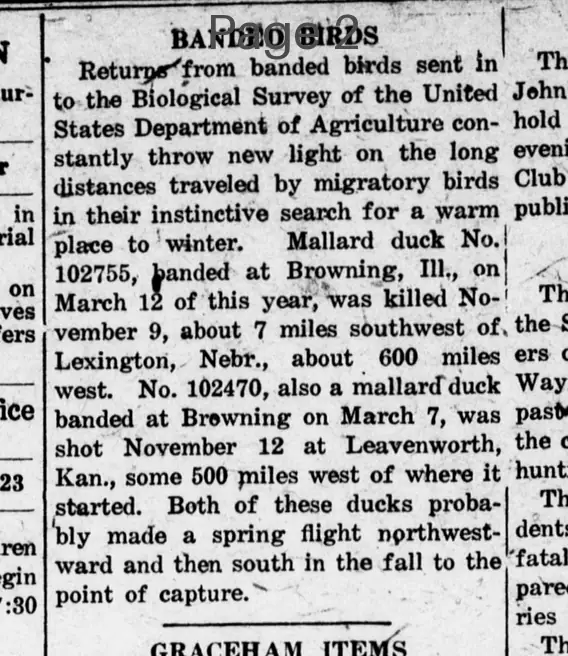
Returns from banded birds sent to the Biological Survey of the United States Department of Agriculture show long distances traveled by migratory birds. Mallard duck No. 102755, banded at Browning, Ill., on March 12 of this year, was killed November 9, about 7 miles southwest of Lexington, Nebr., about 600 miles west. No. 102470, also a mallard duck banded at Browning on March 7, was shot November 12 at Leavenworth, Kan., some 500 miles west of where it started. Both ducks probably made a spring flight northwestward and then south in the fall to the point of capture.