Thank you for visiting SNEWPapers!
Sign up free
Daily Kennebec Journal
Augusta, Kennebec County, Maine
What is this article about?
Article criticizes Greenback party convention in Belfast, Maine, for nominating union leader Thompson H. Murch over editor William M. Rust, portraying it as a communist display by roughs and strikers threatening violence if demands unmet. (187 chars)
Clipping
OCR Quality
Full Text
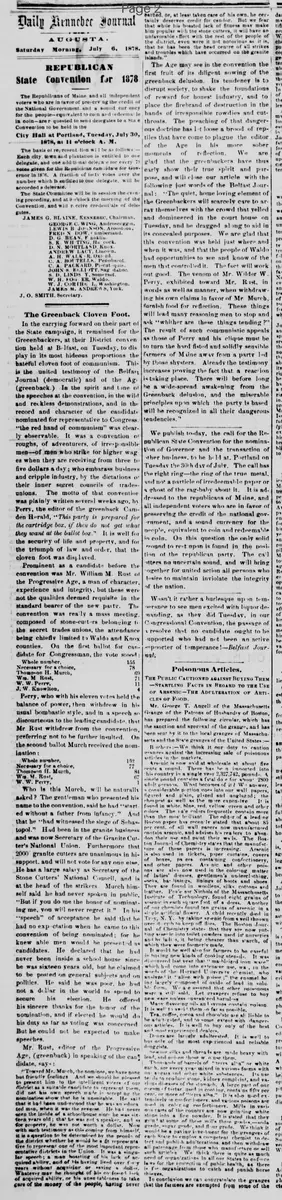
In the carrying forward on their part of the State campaign, it remained for the Greenbackers, at their District convention held at Belfast, on Tuesday, to display in its most hideous proportions the hateful cloven foot of communism. This is the united testimony of the Belfast Journal (democratic) and of the Age (greenback.) In the spirit and tone of the speeches at the convention, in the wild and reckless demonstrations, and in the record and character of the candidate nominated for representative to Congress, "the red hand of communism" was clearly observable. It was a convention of roughs, of adventurers, of irresponsible men—of men who strike for higher wages when they are receiving from three to five dollars a day; who embarrass business and cripple industry, by the dictations of their inner secret councils of trades unions. The motto of that convention was plainly written several weeks ago, by Perry, the editor of the greenback Camden Herald, "This party is prepared for the cartridge box, if they do not get what they want at the ballot box." It is well for the security of life and property, and for the triumph of law and order, that the cloven foot was displayed.
Prominent as a candidate before the convention was Mr. William M. Rust of the Progressive Age, a man of character, experience and integrity, but these were not the qualities deemed requisite in the standard bearer of the new party. The convention was really a mass meeting, composed of stone-cutters belonging to the secret trades unions, the attendance being chiefly limited to Waldo and Knox counties. On the first ballot for candidate for Congressman, the vote stood:
Whole number 155
Necessary for a choice, 78
Thompson H. Murch, 69
Wm. M. Rust, 71
W. W. Perry, 11
J. W. Knowlton,
Perry, who with his eleven votes held the balance of power, then withdrew in his usual bombastic style, and in a speech so discourteous to the leading candidate, that Mr. Rust withdrew from the convention, preferring not to be further insulted. On the second ballot Murch received the nomination:
Whole number 152
Necessary for a choice 77
Thompson H. Murch, 84
Wm. M. Rust, 67
W. W. Perry, 1
Who is this Murch, will be naturally asked? The gentleman who presented his name to the convention, said he had "started without a father from infancy." And that he "had witnessed the siege of Sebastopol." Had been in the granite business and was now Secretary of the Granite Cutters' National Union. Furthermore that 2000 granite cutters are unanimous in his support, and will not vote for any one else. He has a large salary as Secretary of the Stone Cutters' National Council, and is at the head of the strikers. Murch himself said he had never spoken in public. "But if you do me the honor of nominating me, you will never regret it." In his "speech" of acceptance he said that he had no expectation when he came to this convention of being nominated; for he knew able men would be presented as candidates. He declared that he had never been inside a school house since he was sixteen years old, but he claimed to be posted on general subjects and on politics. He said he was poor, he had not a dollar in the world to spend to secure his election. He offered his sincere thanks for the honor of the nomination, and if elected he would do his duty as far as voting was concerned. But he could not be expected to make speeches.
Mr. Rust, editor of the Progressive Age, (greenback) in speaking of the candidate, says:
"Toward Mr. Murch, the nominee, we have none but friendly feelings. And we should be pleased to present him to the intelligent voters of our district as a suitable candidate to represent them, did not his own speech made in accepting the nomination show that he is unsuitable. He said that it had been understood that he was an educated man, when it was the reverse. He had never seen the inside of a schoolhouse since he was sixteen years old; that he was not a speaker, and as for property, he was not worth a dollar. Now with such testimony as this coming from himself, it is a question to be determined by the people of the district whether he would be fit representative to represent one of the most important representative districts in the Union. It was a singular speech; a man boasting of his lack of acquired ability, and of his having lived over fifty years without acquiring or saving a dollar. Whatever may be thought of his confessed lack of acquired ability, or his unsuitableness to take care of the money of the people, having never earned, or at least taken care of his own, he certainly deserves credit for candor. But we fear that while his boasted lack of fitness may make him popular with the stone cutters, it will have an unfavorable effect with the rest of the people of the district, even were it not notorious as it is, that he has been the head centre of all strikes and troubles which have occurred on the granite islands."
The Age may see in the convention the first fruit of its diligent sowing of the greenback delusion. Its tendency is to disrupt society, to shake the foundations of reward for honest industry, and to place the firebrand of destruction in the hands of irresponsible rowdies and cut-throats. The preaching of that dangerous doctrine has let loose a brood of reptiles that have come to plague the editor of the Age in his more sober moments of reflection.
We are glad that the greenbackers have thus early shown their true spirit and purpose, and will close our article with the following just words of the Belfast Journal: "The quiet, home loving element of the Greenbackers will scarcely care to array themselves with the crowd that yelled and domineered in the court house on Tuesday, and be dragged along to aid in its concealed purposes. We are glad that this convention was held just where and when it was, and that the people of Waldo had opportunities to see and know of the men that controlled it. The fact will work out good. The venom of Mr. Wilder W. Perry, exhibited toward Mr. Rust, in words as well as manner, when withdrawing his own claims in favor of Mr. Murch, furnish food for reflection. These things will lead many reasoning men to stop and ask "whither are these things tending?" The result of such communistic appeals as those of Perry and his clique must be to turn the hard fisted and solidly sensible farmers of Maine away from a party led by those shysters. Already the testimony increases proving the fact that a reaction is taking place. There will before long be a wide-spread awakening from the Greenback delusion, and the miserable principles upon which the party is based will be recognized in all their dangerous tendencies."
What sub-type of article is it?
What themes does it cover?
What keywords are associated?
What entities or persons were involved?
Where did it happen?
Story Details
Key Persons
Location
Belfast, Waldo And Knox Counties, Maine
Event Date
Tuesday
Story Details
At the Greenback District convention in Belfast, Thompson H. Murch, secretary of the Granite Cutters' National Union and leader of strikes, was nominated for Congress over William M. Rust after W. W. Perry withdrew. The convention is criticized as displaying communist tendencies, involving roughs and trades union members demanding higher wages.