Thank you for visiting SNEWPapers!
Sign up free
Editorial
March 25, 1915
El Paso Herald
El Paso, El Paso County, Texas
What is this article about?
This editorial urges readers not to accept substitutes for life's core elements like love, ambition, work, and education, warning that impatience or laziness leads to unfulfilled lives, and encourages striving for genuine desires.
Clipping
OCR Quality
98%
Excellent
Full Text
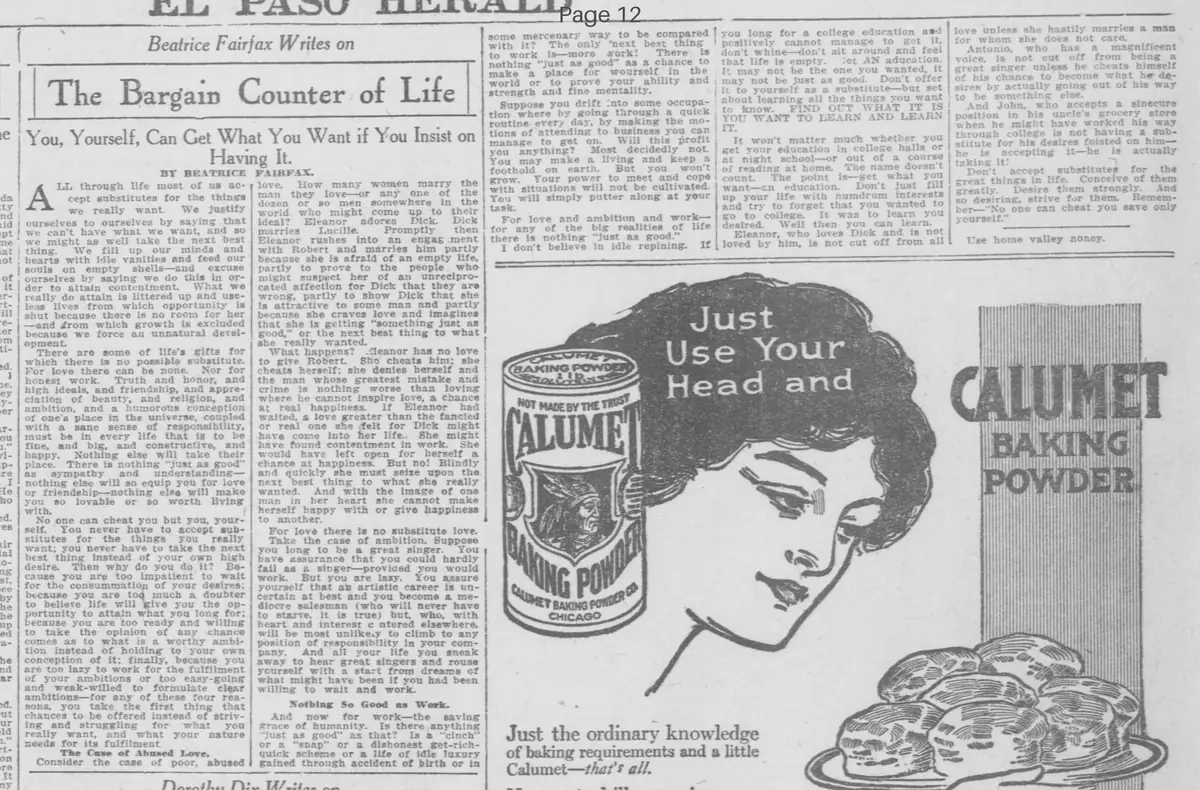
The Bargain Counter of Life
You, Yourself, Can Get What You Want if You Insist on It
In through life most of us accept substitutes for the things we really want. We justify ourselves to ourselves by saying that we can't have what we want, and so we might as well take the next best thing. We fill up our minds and hearts with idle vanities and feed our souls on empty shells—and excuse ourselves by saying we do this in order to attain contentment. What we really do attain is littered up and useless lives from which opportunity is shut because there is no room for her—and from which growth is excluded because we force an unnatural development.
There are some of life's gifts for which there is no possible substitute. For love there can be none. Nor for honest work. Truth and honor, and high ideals, and friendship, and appreciation of beauty, and religion, and ambition, and a humorous conception of one's place in the universe, coupled with a sane sense of responsibility, must be in every life that is to be fine, and big, and constructive, and happy. Nothing else will take their place. There is nothing "just as good" as sympathy and understanding—nothing else will so equip you for love or friendship nothing else will make you so lovable or so worth living with.
No one can cheat you but you, yourself. You never have to accept substitutes for the things you really want; you never have to take the next best thing instead of your own high desire. Then why do you do it? Because you are too impatient to wait for the consummation of your desires; because you are too much a doubter to believe life will give you the opportunity to attain what you long for; because you are too ready and willing to take the opinion of any chance comer as to what is a worthy ambition instead of holding to your own conception of it; finally, because you are too lazy to work for the fulfilment of your ambitions or too easy-going and weak-willed to formulate clear ambitions—for any of these four reasons, you take the first thing that chances to be offered instead of striving and struggling for what you really want, and what your nature needs for its fulfilment.
The Case of Abused Love,
Consider the case of poor, abused love. How many women marry the man they love or any one of the dozen or so men somewhere in the world who might come up to their ideal? Eleanor adores Dick. Dick marries Lucille. Promptly then Eleanor rushes into an engagement with Robert and marries him partly because she is afraid of an empty life, partly to prove to the people who might suspect her of an unreciprocated affection for Dick that they are wrong, partly to show Dick that she is attractive to some man and partly because she craves love and imagines that she is getting "something just as good," or the next best thing to what she really wanted.
What happens? Eleanor has no love to give Robert. She cheats him; she cheats herself; she denies herself and the man whose greatest mistake and crime is nothing worse than loving where he cannot inspire love, a chance at real happiness. If Eleanor had waited, a love greater than the fancied or real one she felt for Dick might have come into her life. She might have found contentment in work. She would have left open for herself a chance at happiness. But no! Blindly and quickly she must seize upon the next best thing to what she really wanted. And with the image of one man in her heart she cannot make herself happy with or give happiness to another.
For love there is no substitute love.
Take the case of ambition. Suppose you long to be a great singer. You have assurance that you could hardly fail as a singer—provided you would work. But you are lazy. You assure yourself that an artistic career is uncertain at best and you become a mediocre salesman (who will never have to starve, it is true) but, who, with heart and interest entered elsewhere, will be most unlikely to climb to any position of responsibility in your company. And all your life you sneak away to hear great singers and rouse yourself with a start from dreams of what might have been if you had been willing to wait and work.
Nothing So Good as Work.
And now for work—the saving grace of humanity. Is there anything "just as good" as that? Is a "cinch" or a "snap" or a dishonest get-rich-quick scheme or a life of idle luxury gained through accident of birth or in some mercenary way to be compared with it? The only 'next best thing to work is—more work!
There is nothing "just as good" as a chance to make a place for yourself in the world or to prove your ability and strength and fine mentality.
Suppose you drift into some occupation where by going through a quick routine every day, by making the motions of attending to business you can manage to get on. Will this profit you anything? Most decidedly not.
You may make a living and keep a foothold on earth. But you won't grow. Your power to meet and cope with situations will not be cultivated. You will simply putter along at your task.
For love and ambition and work—for any of the big realities of life there is nothing "Just as good."
I don't believe in idle repining. If you long for a college education and positively cannot manage to get it, don't whine—don't sit around and feel that life is empty. Get an education. It may not be the one you wanted, it may not be just as good. Don't offer it to yourself as a substitute but set about learning all the things you want to KNOW. FIND OUT WHAT IT IS YOU WANT TO LEARN AND LEARN IT.
It won't matter much whether you get your education in college halls or at night school or out of a course of reading at home. The name doesn't count. The point is—get what you want—an education. Don't just fill up your life with numdrum interests and try to forget that you wanted to go to college. It was to learn you desired. Well then you can learn.
Eleanor, who loves Dick and is not loved by him, is not cut off from all love unless she hastily marries a man for whom she does not care. Antonio, who has a magnificent voice, is not cut off from being a great singer unless he cheats himself of his chance to become what he desires by actually going out of his way to be something else. And John, who accepts a sinecure position in his uncle's grocery store when he might have worked his way through college is not having a substitute for his desires foisted on him—he is accepting it—he is actually taking it.
Don't accept substitutes for the great things in life. Conceive of them greatly. Desire them strongly. And so desiring, strive for them.
Remember "No one can cheat you save only yourself."
You, Yourself, Can Get What You Want if You Insist on It
In through life most of us accept substitutes for the things we really want. We justify ourselves to ourselves by saying that we can't have what we want, and so we might as well take the next best thing. We fill up our minds and hearts with idle vanities and feed our souls on empty shells—and excuse ourselves by saying we do this in order to attain contentment. What we really do attain is littered up and useless lives from which opportunity is shut because there is no room for her—and from which growth is excluded because we force an unnatural development.
There are some of life's gifts for which there is no possible substitute. For love there can be none. Nor for honest work. Truth and honor, and high ideals, and friendship, and appreciation of beauty, and religion, and ambition, and a humorous conception of one's place in the universe, coupled with a sane sense of responsibility, must be in every life that is to be fine, and big, and constructive, and happy. Nothing else will take their place. There is nothing "just as good" as sympathy and understanding—nothing else will so equip you for love or friendship nothing else will make you so lovable or so worth living with.
No one can cheat you but you, yourself. You never have to accept substitutes for the things you really want; you never have to take the next best thing instead of your own high desire. Then why do you do it? Because you are too impatient to wait for the consummation of your desires; because you are too much a doubter to believe life will give you the opportunity to attain what you long for; because you are too ready and willing to take the opinion of any chance comer as to what is a worthy ambition instead of holding to your own conception of it; finally, because you are too lazy to work for the fulfilment of your ambitions or too easy-going and weak-willed to formulate clear ambitions—for any of these four reasons, you take the first thing that chances to be offered instead of striving and struggling for what you really want, and what your nature needs for its fulfilment.
The Case of Abused Love,
Consider the case of poor, abused love. How many women marry the man they love or any one of the dozen or so men somewhere in the world who might come up to their ideal? Eleanor adores Dick. Dick marries Lucille. Promptly then Eleanor rushes into an engagement with Robert and marries him partly because she is afraid of an empty life, partly to prove to the people who might suspect her of an unreciprocated affection for Dick that they are wrong, partly to show Dick that she is attractive to some man and partly because she craves love and imagines that she is getting "something just as good," or the next best thing to what she really wanted.
What happens? Eleanor has no love to give Robert. She cheats him; she cheats herself; she denies herself and the man whose greatest mistake and crime is nothing worse than loving where he cannot inspire love, a chance at real happiness. If Eleanor had waited, a love greater than the fancied or real one she felt for Dick might have come into her life. She might have found contentment in work. She would have left open for herself a chance at happiness. But no! Blindly and quickly she must seize upon the next best thing to what she really wanted. And with the image of one man in her heart she cannot make herself happy with or give happiness to another.
For love there is no substitute love.
Take the case of ambition. Suppose you long to be a great singer. You have assurance that you could hardly fail as a singer—provided you would work. But you are lazy. You assure yourself that an artistic career is uncertain at best and you become a mediocre salesman (who will never have to starve, it is true) but, who, with heart and interest entered elsewhere, will be most unlikely to climb to any position of responsibility in your company. And all your life you sneak away to hear great singers and rouse yourself with a start from dreams of what might have been if you had been willing to wait and work.
Nothing So Good as Work.
And now for work—the saving grace of humanity. Is there anything "just as good" as that? Is a "cinch" or a "snap" or a dishonest get-rich-quick scheme or a life of idle luxury gained through accident of birth or in some mercenary way to be compared with it? The only 'next best thing to work is—more work!
There is nothing "just as good" as a chance to make a place for yourself in the world or to prove your ability and strength and fine mentality.
Suppose you drift into some occupation where by going through a quick routine every day, by making the motions of attending to business you can manage to get on. Will this profit you anything? Most decidedly not.
You may make a living and keep a foothold on earth. But you won't grow. Your power to meet and cope with situations will not be cultivated. You will simply putter along at your task.
For love and ambition and work—for any of the big realities of life there is nothing "Just as good."
I don't believe in idle repining. If you long for a college education and positively cannot manage to get it, don't whine—don't sit around and feel that life is empty. Get an education. It may not be the one you wanted, it may not be just as good. Don't offer it to yourself as a substitute but set about learning all the things you want to KNOW. FIND OUT WHAT IT IS YOU WANT TO LEARN AND LEARN IT.
It won't matter much whether you get your education in college halls or at night school or out of a course of reading at home. The name doesn't count. The point is—get what you want—an education. Don't just fill up your life with numdrum interests and try to forget that you wanted to go to college. It was to learn you desired. Well then you can learn.
Eleanor, who loves Dick and is not loved by him, is not cut off from all love unless she hastily marries a man for whom she does not care. Antonio, who has a magnificent voice, is not cut off from being a great singer unless he cheats himself of his chance to become what he desires by actually going out of his way to be something else. And John, who accepts a sinecure position in his uncle's grocery store when he might have worked his way through college is not having a substitute for his desires foisted on him—he is accepting it—he is actually taking it.
Don't accept substitutes for the great things in life. Conceive of them greatly. Desire them strongly. And so desiring, strive for them.
Remember "No one can cheat you save only yourself."
What sub-type of article is it?
Moral Or Religious
Social Reform
What keywords are associated?
Life Substitutes
True Desires
Honest Work
Personal Ambition
Authentic Love
Self Fulfillment
Moral Growth
Editorial Details
Primary Topic
Rejecting Substitutes For Life's Essential Desires
Stance / Tone
Exhortative Encouragement To Pursue Authentic Ambitions
Key Arguments
No Substitutes Exist For Love, Honest Work, Truth, Honor, High Ideals, Friendship, Appreciation Of Beauty, Religion, Ambition, Humor, And Responsibility
Individuals Cheat Themselves By Accepting Lesser Options Due To Impatience, Doubt, External Opinions, Or Laziness
In Love, Settling For Marriage Without True Affection Denies Happiness To All Involved
Ambition Requires Work; Laziness Leads To Mediocrity And Regret
Work Is Irreplaceable; No 'Easy' Alternative Compares
Education Can Be Pursued Through Any Means If Desired Knowledge Is The Goal
Do Not Accept Substitutes; Strive For What Is Truly Wanted