Thank you for visiting SNEWPapers!

Sign up free
Page thumbnail for Bloomington Herald
Foreign News April 28, 1843

Bloomington Herald

Bloomington, Muscatine, Story County, Muscatine County, Iowa

What is this article about?

Commentary on historical attachment of English laborers to parishes, causing surplus population and opposition to labor-saving improvements, contrasted with migratory Scottish peasantry and fewer laborers overall.

Clipping
OCR Quality

95% Excellent

Full Text

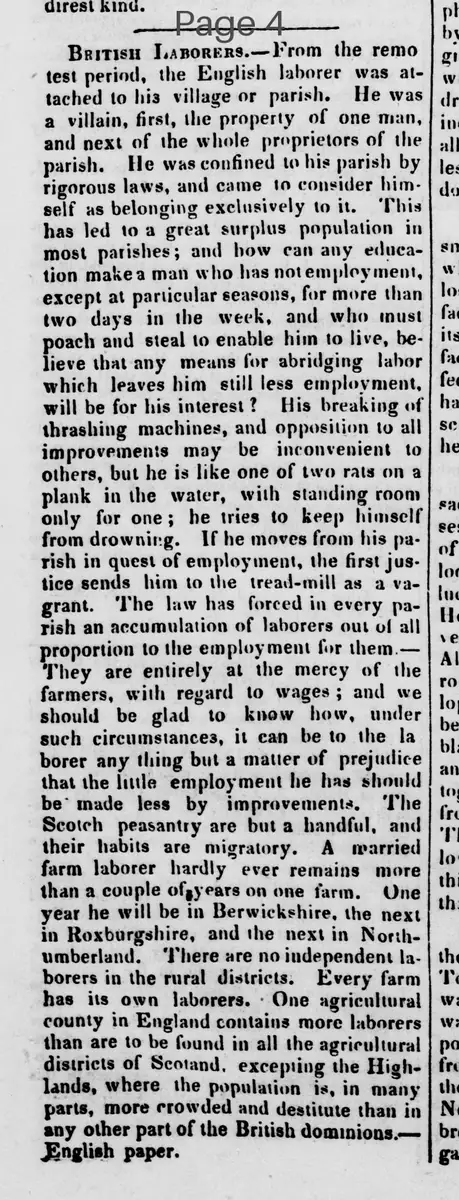
BRITISH LABOURERS.—From the remotest period, the English laborer was attached to his village or parish. He was a villain, first, the property of one man, and next of the whole proprietors of the parish. He was confined to his parish by rigorous laws, and came to consider himself as belonging exclusively to it. This has led to a great surplus population in most parishes; and how can any education make a man who has not employment, except at particular seasons, for more than two days in the week, and who must poach and steal to enable him to live, believe that any means for abridging labor which leaves him still less employment, will be for his interest? His breaking of thrashing machines, and opposition to all improvements may be inconvenient to others, but he is like one of two rats on a plank in the water, with standing room only for one; he tries to keep himself from drowning. If he moves from his parish in quest of employment, the first justice sends him to the tread-mill as a vagrant. The law has forced in every parish an accumulation of laborers out of all proportion to the employment for them.—They are entirely at the mercy of the farmers, with regard to wages; and we should be glad to know how, under such circumstances, it can be to the laborer any thing but a matter of prejudice that the little employment he has should be made less by improvements. The Scotch peasantry are but a handful, and their habits are migratory. A married farm laborer hardly ever remains more than a couple of years on one farm. One year he will be in Berwickshire, the next in Roxburgshire, and the next in Northumberland. There are no independent laborers in the rural districts. Every farm has its own laborers. One agricultural county in England contains more laborers than are to be found in all the agricultural districts of Scotland, excepting the Highlands, where the population is, in many parts, more crowded and destitute than in any other part of the British dominions.—English paper.

What sub-type of article is it?

Economic

What keywords are associated?

English Laborers Surplus Population Parish Confinement Scotch Peasantry Migratory Habits Agricultural Employment Labor Improvements Vagrancy Laws

Where did it happen?

England

Foreign News Details

Primary Location

England

Outcome

great surplus population in most parishes; accumulation of laborers out of all proportion to the employment for them

Event Details

The English laborer was historically attached to his parish as a villain, confined by laws, leading to surplus population. Without steady employment, he resorts to poaching and stealing, opposes improvements like thrashing machines. Moving for work results in punishment as a vagrant. Laborers are at farmers' mercy on wages. Scotch peasantry are migratory, with fewer independent laborers; one English county has more laborers than all Scottish agricultural districts except crowded Highlands.

Are you sure?