Thank you for visiting SNEWPapers!
Sign up free
The New Hampshire Gazette And General Advertiser
Portsmouth, Exeter, Rockingham County, New Hampshire
What is this article about?
Reports from the West Indies detail a naval engagement between British fleet under Sir Samuel Hood and French under Count de Grasse near St. Kitts. Hood maneuvers into Basseterre road; partial battle ensues with British losses of three ships, French one, and possible enemy ship explosion. French capture Brimstone Hill fort and island.
Clipping
OCR Quality
Full Text
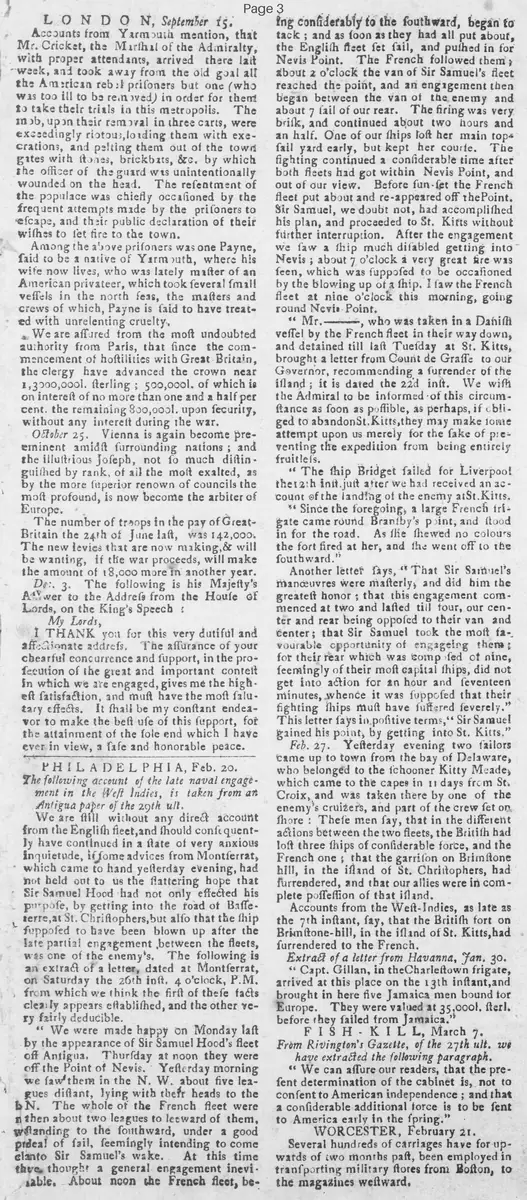
The following account of the late naval engagement in the West Indies, is taken from an Antigua paper of the 20th ult.
We are still without any direct account from the English fleet, and should consequently have continued in a state of very anxious inquietude, if some advices from Montserrat, which came to hand yesterday evening, had not held out to us the flattering hope that Sir Samuel Hood had not only effected his purpose, by getting into the road of Basseterre, at St. Christophers, but also that the ship supposed to have been blown up after the late partial engagement between the fleets, was one of the enemy's. The following is an extract of a letter, dated at Montserrat, on Saturday the 26th inst. 4 o'clock, P.M. from which we think the first of these facts clearly appears established, and the other very fairly deducible.
"We were made happy on Monday last by the appearance of Sir Samuel Hood's fleet off Antigua. Thursday at noon they were off the Point of Nevis. Yesterday morning we saw them in the N. W. about five leagues distant, lying with their heads to the N. The whole of the French fleet were then about two leagues to leeward of them, standing to the southward, under a good breeze of wind, seemingly intending to come close to Sir Samuel's wake. At this time we thought a general engagement inevitable. About noon the French fleet, being considerably to the southward, began to tack; and as soon as they had all put about, the English fleet set sail, and pushed in for Nevis Point. The French followed them about 2 o'clock the van of Sir Samuel's fleet reached the point, and an engagement then began between the van of the enemy and about 7 sail of our rear. The firing was very brisk, and continued about two hours and an half. One of our ships lost her main top-mast yard early, but kept her course. The fighting continued a considerable time after both fleets had got within Nevis Point, and out of our view. Before sun-set the French fleet put about and re-appeared off the Point. Sir Samuel, we doubt not, had accomplished his plan, and proceeded to St. Kitts without further interruption. After the engagement we saw a ship much disabled getting into Nevis; about 7 o'clock a very great fire was seen, which was supposed to be occasioned by the blowing up of a ship. I saw the French fleet at nine o'clock this morning, going round Nevis-Point."
"Mr. Ann, who was taken in a Danish vessel by the French fleet in their way down, and detained till last Tuesday at St. Kitts, brought a letter from Count de Grasse to our Governor, recommending a surrender of the island: it is dated the 22d inst. We wish the Admiral to be informed of this circumstance as soon as possible, as perhaps, if obliged to abandon St. Kitts, they may make some attempt upon us merely for the sake of preventing the expedition from being entirely fruitless."
"The ship Bridget sailed for Liverpool the 12th inst. just after we had received an account of the landing of the enemy at St. Kitts. Since the foregoing, a large French frigate came round Brandy's point, and stood in for the road. As she showed no colours the fort fired at her, and she went off to the southward."
Another letter says, "That Sir Samuel's manoeuvres were masterly, and did him the greatest honor; that this engagement commenced at two and lasted till four, our center and rear being opposed to their van and center: that Sir Samuel took the most favourable opportunity of engaging them; for their rear which was composed of nine, seemingly of their most capital ships, did not get into action for an hour and seventeen minutes, whence it was supposed that their fighting ships must have suffered severely."
This letter says in positive terms, "Sir Samuel gained his point, by getting into St. Kitts."
Feb. 27. Yesterday evening two sailors came up to town from the bay of Delaware, who belonged to the schooner Kitty Meade; which came to the capes in 11 days from St. Croix, and was taken there by one of the enemy's cruisers, and part of the crew set on shore: These men say, that in the different actions between the two fleets, the British had lost three ships of considerable force, and the French one: that the garrison on Brimstone hill, in the island of St. Christophers, had surrendered, and that our allies were in complete possession of that island.
Accounts from the West-Indies, as late as the 7th instant, say, that the British fort on Brimstone-hill, in the island of St. Kitts, had surrendered to the French.
What sub-type of article is it?
What keywords are associated?
What entities or persons were involved?
Where did it happen?
Foreign News Details
Primary Location
St. Kitts
Event Date
Late January 1782
Key Persons
Outcome
british lost three ships; french lost one ship and possibly one blown up; french capture brimstone hill fort and st. kitts island.
Event Details
British fleet under Sir Samuel Hood maneuvers to Basseterre road at St. Christophers despite French pursuit; partial engagement occurs near Nevis Point with brisk firing for two and a half hours; Hood reaches St. Kitts; French land and garrison surrenders; reports of ship explosion and damaged vessels.