Thank you for visiting SNEWPapers!
Sign up free
The Virginia Gazette
Richmond, Williamsburg, Richmond County, Virginia
What is this article about?
A letter from Paris details the escalating conflict between the French King and the Clergy over royal demands on church revenues. Bishops protest and are exiled to dioceses, resisting perceived threats to church autonomy and fearing seizure of assets. Ministers seek to coerce compliance amid political embarrassment.
Merged-components note: Continuation of the foreign news letter from Paris relating to the contest between the King and the Clergy; relabeled from editorial to foreign_news as it is a reported letter on international affairs.
Clippings
1 of 2
OCR Quality
Full Text
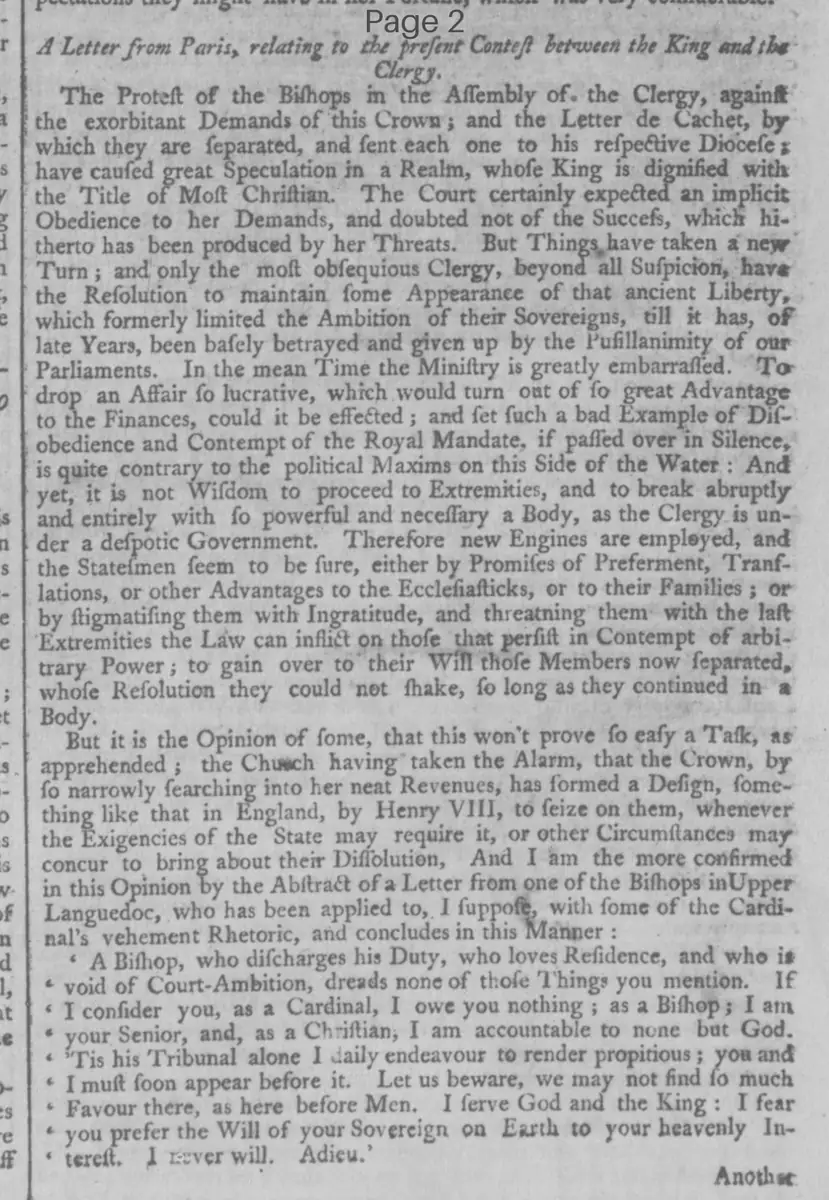
The Protest of the Bishops in the Assembly of the Clergy, against the exorbitant Demands of this Crown; and the Letter de Cachet, by which they are separated, and sent each one to his respective Diocese; have caused great Speculation in a Realm, whose King is dignified with the Title of Most Christian. The Court certainly expected an implicit Obedience to her Demands, and doubted not of the Success, which hitherto has been produced by her Threats. But Things have taken a new Turn; and only the most obsequious Clergy, beyond all Suspicion, have the Resolution to maintain some Appearance of that ancient Liberty, which formerly limited the Ambition of their Sovereigns, till it has, of late Years, been basely betrayed and given up by the Pusillanimity of our Parliaments. In the mean Time the Ministry is greatly embarrassed. To drop an Affair so lucrative, which would turn out of so great Advantage to the Finances, could it be effected; and yet such a bad Example of Disobedience and Contempt of the Royal Mandate, if passed over in Silence, is quite contrary to the political Maxims on this Side of the Water: And yet, it is not Wisdom to proceed to Extremities, and to break abruptly and entirely with so powerful and necessary a Body, as the Clergy is under a despotic Government. Therefore new Engines are employed, and the Statesmen seem to be sure, either by Promises of Preferment, Translations, or other Advantages to the Ecclesiasticks, or to their Families; or by stigmatizing them with Ingratitude, and threatening them with the last Extremities the Law can inflict on those that persist in Contempt of arbitrary Power; to gain over to their Will those Members now separated, whose Resolution they could not shake, so long as they continued in a Body.
But it is the Opinion of some, that this won't prove so easy a Task, as apprehended; the Church having taken the Alarm, that the Crown, by so narrowly searching into her neat Revenues, has formed a Design, something like that in England, by Henry VIII, to seize on them, whenever the Exigencies of the State may require it, or other Circumstances may concur to bring about their Dissolution. And I am the more confirmed in this Opinion by the Abstract of a Letter from one of the Bishops in Upper Languedoc, who has been applied to, I suppose, with some of the Cardinal's vehement Rhetoric, and concludes in this Manner:
A Bishop, who discharges his Duty, who loves Residence, and who is void of Court-Ambition, dreads none of those Things you mention. If I consider you, as a Cardinal, I owe you nothing; as a Bishop; I am your Senior, and, as a Christian, I am accountable to none but God. 'Tis his Tribunal alone I daily endeavour to render propitious; you and I must soon appear before it. Let us beware, we may not find so much Favour there, as here before Men. I serve God and the King: I fear you prefer the Will of your Sovereign on Earth to your heavenly Interest. I never will. Adieu.
Another undaunted Prelate, who seems to have been pressed hard to a Compliance by some favourite Relation at Court, upon a Supposition, That the Clergy's Obstinacy tends to the Ruin of the State, retorts upon him, by observing, 'That, if the State is in real Danger, its Ruin does certainly begin at Court, whose insatiate Avarice, Injustice, Rapine, ill Treatment of Allies and conquered Nations, are the Seed from whence all their Necessities spring. For, has it not been often found, that the Moment any one grows passionately fond of Magnificence, grand Equipage, fine Furniture, Plenty and Elegance in Eating and Drinking; it is a natural Consequence, that he will set no Bounds to his Love of Money, without which he can't procure the Objects of his Desires?---This was the Ruin of the Lacedemonians, and of the Romans, in a more eminent Manner; who, according to the best Historians, were ruined by their Avarice, which prompted the Rulers to rob the People; and their Avarice arose from Riches and Luxury. A Nation, dear Cousin! prompted by these Vices, may be compared to a Woman past Child-bearing, and has ceased to bring forth great Men: And, if it still subsists for some Time longer, it shall be only in Consequence, and by Means of its ancient Grandeur, which continue to support the Commonweal, notwithstanding the Weakness and Vices of its Governors. What noble Sentiments, what Magnanimity in the two Scipio's, in Fabius, and in Paulus Aemilius? Did these ancient Romans set any Value upon Money? When Pyrrhus endeavoured to corrupt the Senate by Presents, was there one single Person in the City tempted to receive them? The Case was much altered in the Time of Jugurtha, who found Means to gain the Votes of almost all the Senators by the Influence of his Bribes; for then there reigned amongst them so much Pomp, Luxury, and Magnificence, in Conjunction with a mean and sordid Avarice (yet not so mean as to thirst after the Revenues of the Priesthood) that when he was forced to leave Rome, turning his Eyes back upon it from Time to Time, he called it a City ready to be sold to the highest Bidder, and only wanted a Purchaser.
So long as a noble Disinterestedness lasted, they, who had the Command of the Troops, and the Government of the Provinces instead of seeking to enrich themselves with the Spoils of their Allies or conquered People, looked upon themselves as their Fathers and Guardians. And it was the Principle of our Forefathers to conquer less by Force of Arms than Benefits; and to prefer the gaining of Friends before the making of Slaves. It would redound much more to our Credit to become Protectors, rather than Masters of the World: And to perform our Oaths and Treaties of Peace with inviolable Justice and Fidelity, rather than by any Means to raise Money to support an insatiable Ambition after universal Monarchy.
How is it you lay such a heavy Charge against the Clergy, when they are the very last that complain? And even now, nothing but the melancholy Presage of a sinking State, under the Weight of its avaricious Managers, could make us resist this last Shock. Have not all the Provinces groaned? Don't all Kingdoms loudly complain of the Violences and Incroachments of our Ministry? In the large Extent of the Countries we possess on this Side; and beyond the Ocean, there is no Place so remote, whither the Avarice of our Admirals, Generals, Governors, and inferior Magistrates, have not penetrated and made us Odious. Therefore, Dear Cousin! inform those who employed you, and furnished you with so fallacious an Argument to me, That, if they will lend a Hand effectually to root out all the above-mentioned Vices, they will find the accustomed Resources abundantly sufficient to support the Dignity, and to defend the Rights of the Crown, and to protect its Allies against all their Enemies, without these oppressive Measures, which border upon Sacrilege. I will always abide by our blessed Saviour's Command, to render unto Cæsar the Things that be Cæsar's; and unto God the Things that be God's.'
What sub-type of article is it?
What keywords are associated?
What entities or persons were involved?
Where did it happen?
Foreign News Details
Primary Location
Paris
Key Persons
Outcome
bishops protested and were sent to their dioceses via lettres de cachet; ministry embarrassed and seeking to coerce compliance through promises and threats; ongoing resistance from clergy fearing seizure of church revenues.
Event Details
Bishops in the Assembly of the Clergy protested against the Crown's exorbitant financial demands. The Court issued Lettres de Cachet separating them and sending each to his diocese, causing speculation. The ministry, expecting obedience, is now embarrassed and employing new tactics like promises of preferment or threats to regain control. Clergy suspect designs to seize revenues similar to Henry VIII in England. Letters from a Bishop in Upper Languedoc and another prelate express defiance, criticizing court avarice and luxury as the true ruin of the state, drawing historical parallels to ancient Rome and Sparta.