Thank you for visiting SNEWPapers!
Sign up free
Literary
March 20, 1820
Daily National Intelligencer
Washington, District Of Columbia
What is this article about?
Excerpts from Dr. Edward Miller of New York praising the enlightened age, scientific revolutions over the last thirty years, and the interconnected progress of knowledge accessible to all through modern communication.
Clipping
OCR Quality
98%
Excellent
Full Text
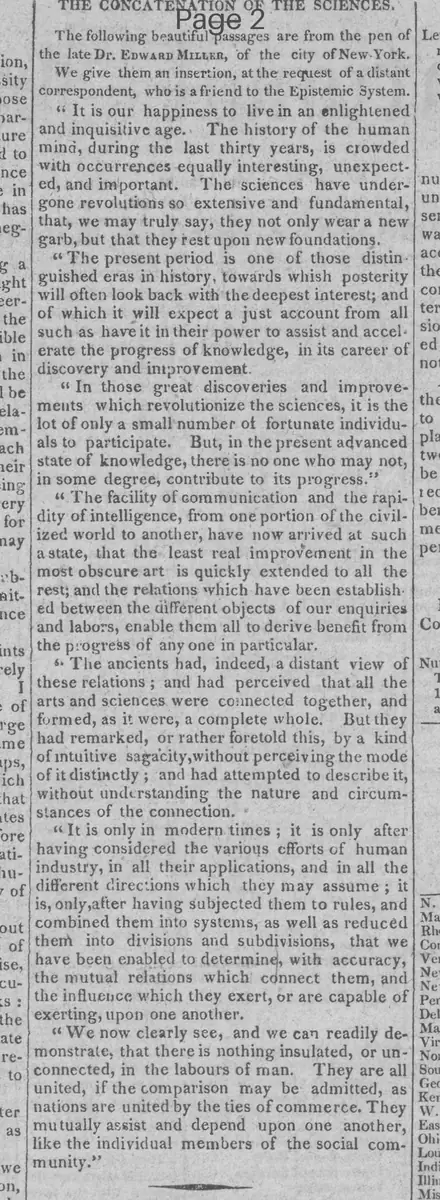
The following beautiful passages are from the pen of the late Dr. Edward Miller, of the city of New York. We give them an insertion, at the request of a distant correspondent, who is a friend to the Epicurean System.
"It is our happiness to live in an enlightened and inquisitive age. The history of the human mind, during the last thirty years, is crowded with occurrences equally interesting, unexpected, and important. The sciences have undergone revolutions so extensive and fundamental, that, we may truly say, they not only wear a new garb, but that they rest upon new foundations."
"The present period is one of those distinguished eras in history, towards which posterity will often look back with the deepest interest; and of which it will expect a just account from all such as have it in their power to assist and accelerate the progress of knowledge, in its career of discovery and improvement."
"In those great discoveries and improvements which revolutionize the sciences, it is the lot of only a small number of fortunate individuals to participate. But, in the present advanced state of knowledge, there is no one who may not, in some degree, contribute to its progress."
"The facility of communication and the rapidity of intelligence, from one portion of the civilized world to another, have now arrived at such a state, that the least real improvement in the most obscure art is quickly extended to all the rest; and the relations which have been established between the different objects of our enquiries and labors, enable them all to derive benefit from the progress of any one in particular."
The ancients had, indeed, a distant view of these relations; and had perceived that all the arts and sciences were connected together, and formed, as it were, a complete whole. But they had remarked, or rather foretold this, by a kind of intuitive sagacity, without perceiving the mode of it distinctly; and had attempted to describe it, without understanding the nature and circumstances of the connection.
"It is only in modern times; it is only after having considered the various efforts of human industry, in all their applications, and in all the different directions which they may assume; it is, only, after having subjected them to rules, and combined them into systems, as well as reduced them into divisions and subdivisions, that we have been enabled to determine, with accuracy, the mutual relations which connect them, and the influence which they exert, or are capable of exerting, upon one another."
"We now clearly see, and we can readily demonstrate, that there is nothing insulated, or unconnected, in the labours of man. They are all united, if the comparison may be admitted, as nations are united by the ties of commerce. They mutually assist and depend upon one another, like the individual members of the social community."
"It is our happiness to live in an enlightened and inquisitive age. The history of the human mind, during the last thirty years, is crowded with occurrences equally interesting, unexpected, and important. The sciences have undergone revolutions so extensive and fundamental, that, we may truly say, they not only wear a new garb, but that they rest upon new foundations."
"The present period is one of those distinguished eras in history, towards which posterity will often look back with the deepest interest; and of which it will expect a just account from all such as have it in their power to assist and accelerate the progress of knowledge, in its career of discovery and improvement."
"In those great discoveries and improvements which revolutionize the sciences, it is the lot of only a small number of fortunate individuals to participate. But, in the present advanced state of knowledge, there is no one who may not, in some degree, contribute to its progress."
"The facility of communication and the rapidity of intelligence, from one portion of the civilized world to another, have now arrived at such a state, that the least real improvement in the most obscure art is quickly extended to all the rest; and the relations which have been established between the different objects of our enquiries and labors, enable them all to derive benefit from the progress of any one in particular."
The ancients had, indeed, a distant view of these relations; and had perceived that all the arts and sciences were connected together, and formed, as it were, a complete whole. But they had remarked, or rather foretold this, by a kind of intuitive sagacity, without perceiving the mode of it distinctly; and had attempted to describe it, without understanding the nature and circumstances of the connection.
"It is only in modern times; it is only after having considered the various efforts of human industry, in all their applications, and in all the different directions which they may assume; it is, only, after having subjected them to rules, and combined them into systems, as well as reduced them into divisions and subdivisions, that we have been enabled to determine, with accuracy, the mutual relations which connect them, and the influence which they exert, or are capable of exerting, upon one another."
"We now clearly see, and we can readily demonstrate, that there is nothing insulated, or unconnected, in the labours of man. They are all united, if the comparison may be admitted, as nations are united by the ties of commerce. They mutually assist and depend upon one another, like the individual members of the social community."
What sub-type of article is it?
Essay
What keywords are associated?
Enlightened Age
Scientific Revolutions
Progress Of Knowledge
Interconnected Sciences
Modern Communication
What entities or persons were involved?
The Late Dr. Edward Miller, Of The City Of New York
Literary Details
Author
The Late Dr. Edward Miller, Of The City Of New York
Subject
Progress Of Sciences And Knowledge In The Enlightened Age
Form / Style
Prose Reflections
Key Lines
It Is Our Happiness To Live In An Enlightened And Inquisitive Age.
The Sciences Have Undergone Revolutions So Extensive And Fundamental, That, We May Truly Say, They Not Only Wear A New Garb, But That They Rest Upon New Foundations.
The Present Period Is One Of Those Distinguished Eras In History, Towards Which Posterity Will Often Look Back With The Deepest Interest;
There Is No One Who May Not, In Some Degree, Contribute To Its Progress.
We Now Clearly See, And We Can Readily Demonstrate, That There Is Nothing Insulated, Or Unconnected, In The Labours Of Man.