Thank you for visiting SNEWPapers!
Sign up free
Edwardsville Spectator
Edwardsville, Madison County, Illinois
What is this article about?
On March 29, 1822, the House of Representatives considered a committee report by Mr. McLane on land office examinations, defending Senator Jesse B. Thomas's 1821 role as constitutional and legal. Debate ensued over the report's unanimity and Mr. Cook's counter-resolution on prohibiting compensated public services for Congress members, both laid on the table.
Merged-components note: Continuation of congressional proceedings in the House of Representatives on land office examinations.
Clippings
1 of 2
OCR Quality
Full Text
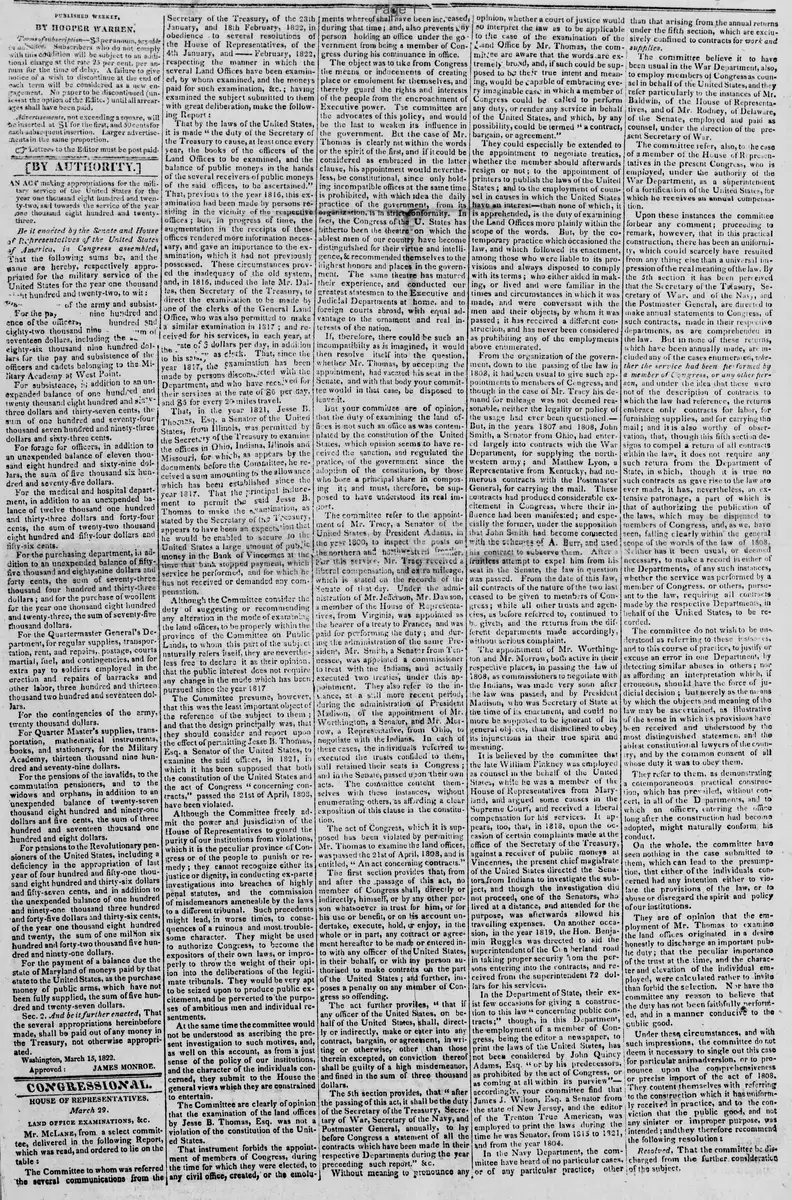
HOUSE OF REPRESENTATIVES.
March 29.
LAND OFFICE EXAMINATIONS, &C.
Mr. McLane, from a select committee, delivered in the following Report, which was read, and ordered to lie on the table:
The Committee to whom was referred the several communications from the Secretary of the Treasury, of the 23d January, and 18th February, 1822, in obedience to several resolutions of the House of Representatives, of the 4th January, and 2d February, 1822, respecting the manner in which the several Land Offices have been examined, by whom examined, and the moneys paid for such examination, &c.; having examined the subject submitted to them with great deliberation, make the following Report:
That by the laws of the United States, it is made 'the duty of the Secretary of the Treasury to cause, at least once every year, the books of the officers of the Land Offices to be examined, and the balance of public moneys in the hands of the several receivers of public moneys of the said offices, to be ascertained.'
That, previous to the year 1816, this examination had been made by persons residing in the vicinity of the respective offices; but, in progress of time, the augmentation in the receipts of these offices rendered more information necessary, and gave an importance to the examination, which it had not previously possessed. These circumstances proved the inadequacy of the old system, and, in 1816, induced the late Mr. Dallas, then Secretary of the Treasury, to direct the examination to be made by one of the clerks of the General Land Office, who was also permitted to make a similar examination in 1817; and received for his services, in each year, at the rate of 3 dollars per day, in addition to his salary, as clerk. That, since the year 1817, the examination has been made by persons unconnected with the Department, and who have received for their services at the rate of $6 per day, and 5 for every 20 miles travel.
That, in the year 1821, Jesse B. Thomas, Esq. a Senator of the United States, from Illinois, was permitted by the Secretary of the Treasury to examine the offices in Ohio, Indiana, Illinois and Missouri, for which, as appears by the documents before the Committee, he received a sum amounting to the allowance of the year 1817. That the principal inducement to permit the said Jesse B. Thomas to make the examination, as stated by the Secretary of the Treasury, appears to have been an expectation that he would be enabled to secure to the United States a large amount of public money in the Bank of Vincennes at the time that bank stopped payment, which service he performed, and for which he has not received or demanded any compensation.
Although the Committee consider the duty of suggesting or recommending any alteration in the mode of examining the land offices, to be properly within the province of the Committee on Public Lands, to whom this part of the subject naturally refers itself, they are nevertheless free to declare it as their opinion, that the public interest does not require any change in the mode which has been pursued since the year 1817.
The Committee presume, however, that this was the least important object of the reference of the subject to them; and that the design principally was, that they should consider and report upon the effect of permitting Jesse B. Thomas, Esq. a Senator of the United States, to examine the said offices, in 1821, in which it has been supposed that both the constitution of the United States and the act of Congress 'concerning contracts,' passed the 21st of April, 1808, have been violated.
Although the Committee freely admit the power and jurisdiction of the House of Representatives to guard the purity of our institutions from violations, which it is the peculiar province of Congress or of the people to punish or remedy; they cannot recognize either its justice or dignity, in conducting ex-parte investigations into breaches of highly penal statutes, and the commission of misdemeanors amenable by the laws to a different tribunal. Such precedents might lead, in worse times, to consequences of a ruinous and most troublesome character. They might be used to authorize Congress, to become the expositors of their own laws, or improperly to throw the weight of their opinion into the deliberations of the legitimate tribunals. They would be very apt to be seized upon to produce public excitement, and be perverted to the purposes of ambitious men and individual resentments.
At the same time the committee would not be understood as ascribing the present investigation to such motives, and, as well on this account, as from a just sense of the policy of our institutions, and the character of the individuals concerned, they submit to the House the general views which they are constrained to entertain.
The Committee are clearly of opinion that the examination of the land offices by Jesse B. Thomas, Esq. was not a violation of the constitution of the United States.
That instrument forbids the appointment of members of Congress, during the time for which they were elected, to any civil office, created, or the emoluments whereof shall have been increased during that time; and, also prevents any person holding an office under the government from being a member of Congress during his continuance in office.
The object was to take from Congress the means or inducements of creating place or emolument for themselves, and thereby guard the rights and interests of the people from the encroachment of Executive power. The committee are the advocates of this policy, and would be the last to weaken its influence in the government. But the case of Mr. Thomas is clearly not within the words or the spirit of the first, and if it could be considered as embraced in the latter clause, his appointment would nevertheless, be constitutional, since only holding incompatible offices at the same time is prohibited, with which idea the daily practice of the government, from its organization, is in strict conformity. In fact, the Congress of the U. States has hitherto been the theatre on which the ablest men of our country have become distinguished for their virtue and intelligence, & recommended themselves to the highest honors and places in the government. The same theatre has matured their experience, and conducted our greatest statesmen to the Executive and Judicial Departments at home, and to foreign courts abroad, with equal advantage to the ornament and real interests of the nation.
If, therefore, there could be such an incompatibility as is imagined, it would then resolve itself into the question, whether Mr. Thomas, by accepting the appointment, had vacated his seat in the Senate, and with that body your committee would in that case, be disposed to leave it.
But your committee are of opinion, that the duty of examining the land offices is not such an office as was contemplated by the constitution of the United States, which opinion seems to have received the sanction, and regulated the practice, of the government since the adoption of the constitution, by those who bore a principal share in composing it; and must, therefore, be supposed to have understood its real import.
The committee refer to the appointment of Mr. Tracy, a Senator of the United States, by President Adams, in the year 1800, to inspect the posts on the northern and northwestern frontier. For this service, Mr. Tracy received a liberal compensation, and extra mileage, which is stated on the records of the Senate of that day. Under the administration of Mr. Jefferson, Mr. Dawson, a member of the House of Representatives, from Virginia, was appointed as the bearer of a treaty to France, and was paid for performing the duty; and during the administration of the same President, Mr. Smith, a Senator from Tennessee, was appointed a commissioner to treat with the Indians, and actually executed two treaties, under this appointment. They also refer to the instance, at a still more recent period, during the administration of President Madison, of the appointment of Mr. Worthington, a Senator, and Mr. Morrow, a Representative, from Ohio, to negotiate with the Indians. In each of these cases, the individuals referred to executed the trusts confided to them, still retained their seats in Congress: and in the Senate passed upon their own acts. The committee content themselves with these instances, without enumerating others, as affording a clear exposition of this clause in the constitution.
The act of Congress, which it is supposed has been violated by permitting Mr. Thomas to examine the land offices, was passed the 21st of April, 1808, and is entitled, 'An act concerning contracts.'
The first section provides that from and after the passage of this act, no member of Congress shall, directly or indirectly, himself, or by any other person whatsoever in trust for him, or for his use or benefit, or on his account undertake, execute, hold, or enjoy, in the whole or in part, any contract or agreement hereafter to be made or entered into with any officer of the United States, in their behalf, or with any person authorized to make contracts on the part of the United States: and further, imposes a penalty on any member of Congress so offending.
The act further provides, 'that if any officer of the United States, on behalf of the United States, shall, directly or indirectly, make or enter into any contract, bargain, or agreement, in writing or otherwise, other than those therein excepted, on conviction thereof shall be guilty of a high misdemeanor, and fined in the sum of three thousand dollars.'
The 5th section provides, that 'after the passing of this act, it shall be the duty of the Secretary of the Treasury, Secretary of War, Secretary of the Navy, and Postmaster General, annually, to lay before Congress a statement of all the contracts which have been made in their respective Departments during the year preceding such report.' &c.
Without meaning to pronounce any opinion, whether a court of justice would so interpret the law as to be applicable to the case of the examination of the land offices by Mr. Thomas, the committee are aware that the words are extremely broad, and, if such could be supposed to be their true intent and meaning, would be capable of embracing every imaginable case in which a member of Congress could be called to perform any duty, or render any service in behalf of the United States, and which, by any possibility, could be termed 'a contract, bargain, or agreement.'
They could especially be extended to the appointment to negotiate treaties, whether the member should afterwards resign or not; to the appointment of printers to publish the laws of the United States; and to the employment of counsel in causes in which the United States have an interest—none of which, it is apprehended, is the duty of examining the Land Offices more plainly within the scope of the words. But, by the contemporary practice which occasioned the law, and which followed its enactment, among those who were liable to its provisions and always disposed to comply with its terms; who either aided in making, or lived and were familiar in the times and circumstances in which it was made, and were conversant with the men and their objects, by whom it was passed; it has received a different construction, and has never been considered as prohibiting any of the employments above enumerated.
From the organization of the government, down to the passing of the law in 1808, it had been usual to give such appointments to members of Congress, and though in the case of Mr. Tracy his demand for mileage was not deemed reasonable, neither the legality or policy of the usage had ever been questioned. But, in the years 1807 and 1808, John Smith, a Senator from Ohio, had entered largely into contracts with the War Department, for supplying the northwestern army; and Matthew Lyon, a Representative from Kentucky, had numerous contracts with the Postmaster General, for carrying the mail. These contracts had produced considerable excitement in Congress, where their influence had been manifested; and especially the former, under the supposition that John Smith had become connected with the schemes of A. Burr, and used his contract to subserve them. After a fruitless attempt to expel him from his seat in the Senate, the law in question was passed. From the date of this law, all contracts of the nature of the two last ceased to be given to members of Congress; while all other trusts and agencies, as before referred to, continued to be given, and the returns from the different departments made accordingly, without serious complaint.
The appointment of Mr. Worthington and Mr. Morrow, both active in their respective places, in passing the law of 1808, as commissioners to negotiate with the Indians, was made very soon after the law was passed, and by President Madison, who was Secretary of State at the time of its enactment, and could no more be supposed to be ignorant of its general objects, than disinclined to obey its injunctions in their true spirit and meaning.
It is believed by the committee that the late William Pinkney was employed as counsel in behalf of the United States, while he was a member of the House of Representatives from Maryland, and argued some causes in the Supreme Court, and received a liberal compensation for his services. It appears, too, that, in 1818, upon the occasion of certain complaints made at the office of the Secretary of the Treasury, against a receiver of public moneys at Vincennes, the present chief magistrate of the United States directed the Senators from Indiana to investigate the subject, and though the investigation did not proceed, one of the Senators, who lived at a distance, and attended for the purpose, was afterwards allowed his travelling expenses. On another occasion, in the year 1819, the Hon. Benjamin Ruggles was directed to aid the superintendent of the Cumberland road in taking proper security from the persons entering into the contracts, and received from the superintendent 72 dollars for his services.
In the Department of State, there exist few occasions for giving a construction to this law 'concerning public contracts;' though, in this Department, the employment of a member of Congress, being the editor a newspaper, to print the laws of the United States, has not been considered by John Quincy Adams, Esq. or by his predecessors, as prohibited by the act of Congress, or as coming at all within its purview' accordingly, your committee find that James J. Wilson, Esq. a Senator from the state of New Jersey, and the editor of the Trenton True American, was employed to print the laws during the time he was Senator, from 1815 to 1821, and from the year 1804.
In the Navy Department, the committee have heard of no particular cases, or of any particular practice, other than that arising from the annual returns under the fifth section, which are exclusively confined to contracts for work and supplies.
The committee believe it to have been usual in the War Department, also, to employ members of Congress as counsel in behalf of the United States, and they refer particularly to the instances of Mr. Baldwin, of the House of Representatives, and of Mr. Rodney, of Delaware, of the Senate, employed and paid as counsel, under the direction of the present Secretary of War.
The committee refer, also, to the case of a member of the House of Representatives in the present Congress, who is employed, under the authority of the War Department, as a superintendent of a fortification of the United States, for which he receives an annual compensation.
Upon these instances the committee forbear any comment; proceeding to remark, however, that in this practical construction, there has been an uniformity, which could scarcely have resulted from any thing else than a universal impression of the real meaning of the law. By the 5th section it has been perceived that the Secretary of the Treasury, Secretary of War, and of the Navy, and the Postmaster General, are directed to make annual statements to Congress, of such contracts, made in their respective departments, as are comprehended in the law. But in none of these returns, which have been annually made, are included any of the cases enumerated, whether the service had been performed by a member of Congress, or any other person, and under the idea that these were not of the description of contracts to which the law had reference, the returns embrace only contracts for labor, for furnishing supplies, and for carrying the mail; and it is also worthy of observation, that, though this fifth section designs to compel a return of all contracts within the law, it does not require any such return from the Department of State, in which, though it is true no such contracts as gave rise to the law are ever made, it has, nevertheless, an extensive patronage, a part of which is that of authorizing the publication of the laws, which may be dispensed to members of Congress, and, as we have seen, falling clearly within the general scope of the words of the law of 1808.
Neither has it been usual, or deemed necessary, to make a record in either of the Departments, of any such instances, whether the service was performed by a member of Congress, or others, pursuant to the law, requiring all contracts made by the respective Departments, in behalf of the United States, to be recorded.
The committee do not wish to be understood as referring to these instances, and to this course of practice, to justify or excuse an error in one Department, by detecting similar abuses in others; nor as affording an interpretation which, if erroneous, should have the force of judicial decision: but merely as the means by which the objects and meaning of the law may be ascertained, as illustrative of the sense in which is provisions have been received and understood by the most distinguished statesmen, and the ablest constitutional lawyers of the country, and by the common consent of all whose duty it was to obey them.
They refer to them, as demonstrating a contemporaneous practical construction, which has prevailed, without concert, in all of the Departments, and to which an officer, entering the office long after the construction had become adopted, might naturally conform, his conduct.
On the whole, the committee have seen nothing in the case submitted to them, which can lead to the presumption, that either of the individuals concerned had any intention either to violate the provisions of the law, or to abuse or disregard the spirit and policy of our institutions.
They are of opinion that the employment of Mr. Thomas to examine the land offices originated in a desire honestly to discharge an important public duty; that the peculiar importance of the trust at the time, and the character and elevation of the individual employed, were calculated rather to invite than forbid the selection. Nor have the committee any reason to believe that the duty has not been faithfully performed, and in a manner conducive to the public good.
Under these circumstances, and with such impressions, the committee do not deem it necessary to single out this case for particular animadversion, or to pronounce upon the comprehensiveness or precise import of the act of 1808.
They content themselves with referring to the construction which it has uniformly received in practice, and to the conviction that the public good, and not any sinister or improper purpose, was intended; and they therefore recommend the following resolution:
Resolved, That the committee be discharged from the further consideration of the subject.
Mr. Cook stated that it was due to himself and to the committee to say, that the committee were not unanimous in agreeing to the report, and to express the views which he personally had of this subject which he considered in some points of view, as of great importance, he offered a counter-resolution which he requested might accompany the report, and be laid on the table with it.
Mr. McLane said he was sorry that, on the present occasion, the gentleman from Illinois had thought it proper to deviate from the usual practice on making reports, in stating, as he had done, that there was a division in the committee on the subject of the report. An obvious objection to such a proceeding was, that each member of the committee might feel himself called upon to say how he had voted, if any one of the committee did so. He believed, he said, that he should be authorized in saying that the honorable gentleman himself was the only one of the committee who disagreed to the resolution now on the table. Mr. McLane did not think this course the proper one to be pursued. It would be an encroachment on propriety to suffer a committee to make a report, and accompany it with another report which might possibly be of a very different tendency. The object of the gentleman, besides, could be as well attained by moving his proposition in the shape of a separate and distinct resolution, as in the way he proposed.
The Speaker, deprecating the debates growing out of incidental questions, uselessly consuming the time of the House, pronounced his decision, that nothing can be received as the act of a committee but what is the report of a committee, and that a committee can make but one report. Nothing, therefore, but the report of the committee was now under consideration. Mr. B. adverted to the famous case of the Seminole War, in which a counter-report had been offered by one of the committee, and received by the House, but he considered it an erroneous proceeding, and not to be drawn into precedent.
Mr. Mercer concurred in the view which the Speaker had taken of this point, and added, that in the case of the Seminole War, the counter-report had not been received until after considerable debate, and it was afterwards a subject of general regret that it had been received at all.
Mr. Cook said, he was not sure he had understood the gentleman from Delaware (Mr. McLane) correctly—but, repeating what he had said when before up, Mr. C. now justified it. It was no new thing for it to be announced, on the presentation of a report, that the committee was divided in relation to it. He quoted the example of the case of the report at the last session on the admission of Missouri into the Union. He did not know whether the member from Delaware meant to intimate that he had made an incorrect statement or taken any undue advantage. He would rather abandon his seat—he would rather never have set foot in this House, than do a dishonorable act, or even an act of unkindness to any of his fellow members. He deemed it a matter of importance even to the persons about whom on this subject, so much had been said, to frankly present to the House his views, that no man should be taken by surprise in voting on a question deeply connected with the purity of the Legislative Body—
The Speaker here arrested the debate as going improperly into the main subject, on a question merely incidental.
Mr. McLane disclaimed any intention, in what he had said, to alarm the feelings of the gentleman from Illinois, or impeach his motives. He considered it an act of justice to himself and to the committee to state the facts of the case and he had done no more.
The question was taken on laying the report on the table, as moved by Mr. Cook, and carried.
Mr. Cook then submitted the following resolution:
Resolved, That the employment of members of Congress by the Executive, or any Executive officer of the United States, in the performance of any public service, during the continuance of their membership, for which they receive compensation out of the public Treasury, is inconsistent with the independence of Congress, and in derogation of the rights of the people, and, if it be not already, ought to be prohibited.
Mr. Cannon required the question of consideration of the resolution; and that question being taken, the House agreed to consider the same.
Mr. Cook moved for a re-consideration of the vote taken upon the disposal of the resolution reported by the committee; on the ground that his object was to offer the last resolution as an amendment or rather as, a substitute for the resolution reported by the committee.
A question of order occurred, in which Messrs. Cook, H. Nelson, Cannon, and Taylor, took part, when the proceedings ended in deciding to lay Mr. Cook's resolution on the table, in the same manner as the report had been; and both were ordered to be printed.
What sub-type of article is it?
What keywords are associated?
What entities or persons were involved?
Domestic News Details
Event Date
March 29, 1822
Key Persons
Outcome
the committee report was read and ordered to lie on the table. mr. cook's counter-resolution was also laid on the table and both were ordered to be printed. the house agreed to consider mr. cook's resolution but ultimately tabled it.
Event Details
A select committee, led by Mr. McLane, reported on the examination of land offices, defending the 1821 appointment of Senator Jesse B. Thomas as not violating the Constitution or the 1808 act concerning contracts, citing historical precedents. Debate arose over the report's unanimity, with Mr. Cook dissenting and proposing a resolution prohibiting compensated public services for Congress members during their term.