Thank you for visiting SNEWPapers!
Sign up free
Literary
April 18, 1840
The Pilot
Baltimore, Maryland
What is this article about?
After the conquest of Sedan, King Henry IV dispatches Marshal Bassompierre to Paris with state papers and secret love letters to the Marchioness de Verneuil and Countess de Moret. Bassompierre's valet Pierre reunites with his lover Annette, recounts his war exploits, and plans their marriage despite her persistent suitors, including the Mousquetaire Blaise.
Clipping
OCR Quality
95%
Excellent
Full Text
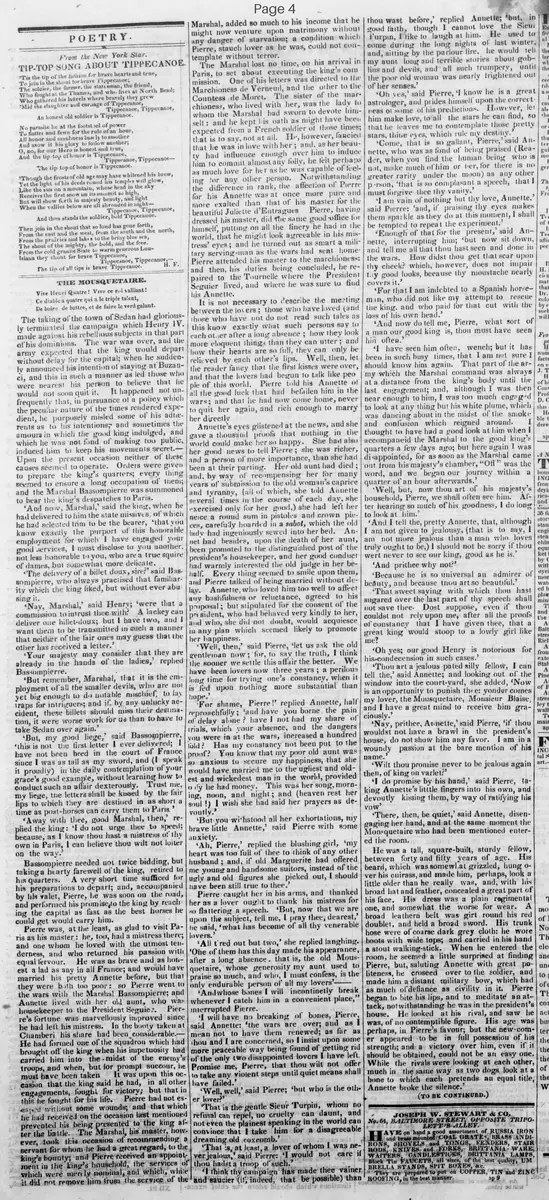
THE MOUSQUETAIRE.
Vive Henri Quatre! Vive ce roi vaillant!
Ce diable a quatre qui a le triple talent,
De boire de battre, et de faire le verd galant.
The taking of the town of Sedan had gloriously terminated the campaign which Henry IV. made against his rebellious subjects in that part of his dominions. The war was over, and the army expected that the king would depart without delay for the capital; when he suddenly announced his intention of staying at Buzancy, and this in such a manner as led those who were nearest his person to believe that he would not soon quit it. It happened not unfrequently that, in pursuance of a policy which the peculiar nature of the times rendered expedient, he purposely misled some of his adherents as to his intentions; and sometimes the amours in which the good king indulged, and which he was not fond of making too public, induced him to keep his movements secret. Upon the present occasion neither of these causes seemed to operate. Orders were given to prepare the king's quarters; every thing seemed to ensure a long occupation of them; and the Marshal Bassompierre was summoned to bear the king's despatches to Paris.
'And now, Marshal,' said the king, when he had delivered to him the state missives of which he had selected him to be the bearer, 'that you know exactly the purport of this honorable employment for which I have engaged your good services, I must disclose to you another, not less honorable to you, who are a true squire of dames, but somewhat more delicate.'
'The delivery of a billet doux, sire?' said Bassompierre, who always practised that familiarity which the king liked, but without ever abusing it.
'Nay, Marshal,' said Henry; 'were that a commission to intrust thee with? A lackey can deliver one billet-doux; but I have two, and I want them to be transmitted in such a manner that neither of the fair ones may guess that the other has received a letter.'
'Your majesty may consider that they are already in the hands of the ladies,' replied Bassompierre.
'But remember, Marshal, that it is the employment of all the smaller devils, who are not yet big enough to do notable mischief, to lay traps for intriguers; and if, by any unlucky accident, these billets should miss their destination, it were worse work for us than to have to take Sedan over again.'
'But, my good liege,' said Bassompierre, 'this is not the first letter I ever delivered; I have not been bred in the court of France since I was as tall as my sword, and (I speak it proudly) in the daily contemplation of your grace's good example, without learning how to conduct such an affair dexterously. Trust me, my liege, the letters shall be kissed by the fair lips to which they are destined in as short a time as post-horses can carry them to Paris.'
'Away with thee, good Marshal, then,' replied the king: 'I do not urge thee to speed; because, as I know thou hast a mistress of thy own in Paris, I can believe thou wilt not loiter on the way.'
Bassompierre needed not twice bidding, but taking a hearty farewell of the king, retired to his quarters. A very short time sufficed for his preparations to depart; and, accompanied by his valet, Pierre, he was soon on the road, and performed his promise to the king by reaching the capital as fast as the best horses he could get would carry him.
Pierre was, at the least, as glad to visit Paris as his master. he, too, had a mistress there; and one whom he loved with the utmost tenderness, and who returned his passion with equal fervour. He was as brave and as honest a lad as any in all France; and would have married his pretty Annette before, but that they were both too poor: so Pierre went to the wars with the Marshal Bassompierre; and Annette lived with her old aunt, who was housekeeper to the President Seguier. Pierre's fortune was marvellously improved since he had left his mistress. In the booty taken at Chambery his share had been considerable. He had formed one of the squadron which had brought off the king when his impetuosity had carried him into the midst of the enemy's troops, and when, but for prompt succour, he must have been taken. It was upon this occasion that the king said he had, in all other engagements, ought of victory; but that in this he ought of his life. Pierre had not escaped without some wounds; and that which he had received on the occasion last mentioned prevented his being presented to the king after the battle. The Marshal, his master, however, took this occasion of recommending a servant of whom he had a great regard, to the king's bounty: and Pierre received an appointment in the king's household, the services of which were merely nominal, and which, while it did not remove him from the service of the Marshal, added so much to his income that he might now venture upon matrimony without any danger of starvation; a condition which Pierre, staunch lover as he was, could not contemplate without terror.
The Marshal lost no time, on his arrival in Paris, to set about executing the king's commission. One of his letters was directed to the Marchioness de Verneuil, and the other to the Countess de Moret. The sister of the marchioness, who lived with her, was the lady to whom the Marshal had sworn to devote himself; and he kept his oath as might have been expected from a French soldier of those times: that is to say, not at all. He, however, fancied that he was in love with her; and, as her beauty had influence enough over him to induce him to commit almost any folly, he felt perhaps as much love for her as he was capable of feeling for any other person. Notwithstanding the difference in rank, the affection of Pierre for his Annette was at once more pure and more exalted than that of his master for the beautiful Juliette d'Entragues. Pierre, having dressed his master, did the same good office for himself, putting on all the finery he had in the world, that he might look agreeable in his mistress' eyes; and he turned out as smart a military serving-man as the wars had sent home. Pierre attended his master to the marchioness: and then, his duties being concluded, he repaired to the Tournelle where the President Seguier lived, and where he was sure to find his Annette.
It is not necessary to describe the meeting between the lovers; those who have loved (and those who have not do not read such tales as this) know exactly what such persons say to each other after a long absence; how they look more eloquent things than they can utter; and how their hearts are so full, they can only be relieved by each other's lips. Well, then, let the reader fancy that the first kisses were over, and that the lovers had begun to talk like people of this world. Pierre told his Annette of all the good luck that had befallen him in the wars; and that he had now come home, never to quit her again, and rich enough to marry her directly.
Annette's eyes glistened at the news, and she gave a thousand proofs that nothing in the world could make her so happy. She had also her good news to tell Pierre; she was richer, and a person of more importance, than she had been at their parting. Her old aunt had died; and, by way of recompensing her for many years of submission to the old woman's caprice and tyranny, (all of which, she told Annette several times in the course of each day, she exercised only for her good,) she had left her niece a round sum in pistoles and crown pieces, carefully hoarded in a sabot, which the old lady had ingeniously sewed into her bed. Annette had besides, upon the death of her aunt, been promoted to the distinguished post of the president's housekeeper, and her good conduct had warmly interested the old judge in her behalf. Every thing seemed to smile upon them, and Pierre talked of being married without delay. Annette, who loved him too well to affect any bashfulness or reluctance, agreed to his proposal; but stipulated for the consent of the president, who had behaved very kindly to her, and who, she did not doubt, would acquiesce in any plan which seemed likely to promote her happiness.
'Well, then,' said Pierre, 'let us ask the old gentleman now; for, to say the truth, I think the sooner we settle this affair the better. We have been lovers now three years; a perilous long time for trying one's constancy, when it is built upon nothing more substantial than hope.'
'For shame, Pierre!' replied Annette, half reproachfully; 'and have you borne the pain of delay alone? have I not had my share of trials, which your absence, and the dangers you were in at the wars, increased a hundred fold? Has my constancy not been put to the proof? You know that my poor old aunt was so anxious to secure my happiness, that she would have married me to the ugliest and oldest and wickedest man in the world, provided only he had money. This was her song, morning, noon, and night; and (heaven rest her soul!) I wish she had said her prayers as devoutly.'
'But you withstood all her exhortations, my brave little Annette,' said Pierre with some anxiety.
'Ah, Pierre,' replied the blushing girl, 'my heart was too full of thee to think of any other husband; and, if old Marguerite had offered me young and handsome suitors, instead of the ugly and old figures she picked out, I should have been still true to thee.'
Pierre caught her in his arms, and thanked her as a lover ought to thank his mistress for so flattering a speech. 'But, now that we are upon the subject, tell me, I pray thee, dearest,' he said, 'what has become of all thy venerable lovers?'
'All tired out but two,' she replied laughing. 'One of them has this day made his appearance, after a long absence, that is, the old Mousquetaire, whose generosity my aunt used to praise so much, and who, I must confess, is the only endurable person of all my lovers.'
'And whose bones I will incontinently break whenever I catch him in a convenient place,' interrupted Pierre.
'I will have no breaking of bones, Pierre,' said Annette: 'the wars are over; and as I mean not to have them renewed; as far as thou and I are concerned, so I insist upon some more peaceable way being found of getting rid of the only two disappointed lovers I have left. Promise me, Pierre, that thou wilt not offer to take any violent steps until quiet means shall have failed.'
'Well, well,' said Pierre; 'but who is the other lover?'
'That is the gentle Sieur Turpin, whom no refusal can repel, no cruelty can daunt, and not even the plainest speaking in the world can convince that I take him for a disagreeable dreaming old coxcomb.'
'That's, at least, a lover of whom I was never jealous,' said Pierre: 'I would not care if thou hadst a troop of such.'
'I think thy campaign has made thee vainer and saucier (is, indeed, that be possible) than thou wast before,' replied Annette; but, in good faith, though I cannot love the Sieur Turpin, I like to laugh at him. He used to come during the long nights of last winter, and, sitting by the parlour fire, he would tell my aunt long and terrible stories about goblins and devils, and all such trumpery, until the poor old woman was nearly frightened out of her senses.'
'Oh yes,' said Pierre, 'I know he is a great astrologer, and prides himself upon the correctness of some of his predictions. However, let him make love to all the stars he can find, so that he leaves me to contemplate those pretty stars, thine eyes, which rule my destiny.'
'Come, that is so gallant, Pierre,' said Annette, who was as fond of being praised (Reader, when you find the human being who is not, make much of him or her, for there is no greater rarity under the moon) as any other person, 'that is so complaisant a speech, that I must forgive thee thy vanity.'
'I am vain of nothing but thy love, Annette,' said Pierre: 'and, if praising thy eyes makes them sparkle as they do at this moment, I shall be tempted to repeat the experiment.'
'Enough of that for the present,' said Annette, interrupting him; 'but now sit down, and tell me all that thou hast seen and done in the wars. How didst thou get that scar upon thy cheek? which, however, does not impair thy good looks, because thy moustache nearly covers it.'
'For that I am indebted to a Spanish horseman, who did not like my attempt to rescue the king, and who paid for that cut with the loss of his own head.'
'And now do tell me, Pierre, what sort of a man our good king is, thou must have seen him often.'
'I have seen him often, wench; but it has been in such busy times, that I am not sure I should know him again. That part of the army which the Marshal commanded was always at a distance from the king's body until the last engagement; and, although I was then near enough to him, I was too much engaged to look at any thing but his white plume, which was dancing about in the midst of the smoke and confusion which reigned around. I thought to have had a good look at him when I accompanied the Marshal to the good king's quarters a few days ago; but here again I was disappointed, for as soon as the Marshal came out from his majesty's chamber, "Off" was the word, and we began our journey within a quarter of an hour afterwards.'
'Well, but, now thou art of his majesty's household, Pierre, we shall often see him. After hearing so much of his goodness, I do long to look at him.'
'And I tell thee, pretty Annette, that, although I am not given to jealousy, (that is to say, I am not more jealous than a man who loves truly ought to be,) I should not be sorry if thou wert never to see our king, good as he is.'
'And prithee why not?"
'Because he is so universal an admirer of beauty, and because thou art so beautiful.'
'That sweet saving with which thou hast sugared over the last part of thy speech shall not save thee. Dost suppose, even if thou couldst not rely upon me, after all the proofs of constancy that I have given thee, that a great king would stoop to a lowly girl like me?'
'Oh yes; our good Henry is notorious for his condescension in such cases.'
'Thou art a jealous-pated silly fellow, I can tell thee,' said Annette; and looking out of the window into the court-yard, she added, 'Now is an opportunity to punish thee: yonder comes my lover, the Mousquetaire, Monsieur Blaise, and I have a great mind to receive him graciously.'
'Nay, prithee, Annette,' said Pierre, 'if thou wouldst not have a brawl in the president's house, do not show him any favor. I am in a woundy passion at the bare mention of his name.'
'Wilt thou promise never to be jealous again then, of king or varlet?'
'I do promise by his hand,' said Pierre, taking Annette's little fingers into his own, and devoutly kissing them, by way of ratifying his vow.
'There, then, be quiet,' said Annette, disengaging her hand, and at the same moment the Mousquetaire who had been mentioned entered the room.
He was a tall, square-built, sturdy fellow, between forty and fifty years of age. His beard, which was somewhat grizzled, hung over his cuirass, and made him, perhaps, look a little older than he really was, and, with his broad hat and feather, concealed a great part of his face. His dress was a plain regimental one, and somewhat the worse for wear. A broad leathern belt was girt round his red doublet, and held a broad sword. His trunk hose were of coarse dark grey cloth: he wore boots with wide tops; and carried in his hand a stout walking-stick. When he entered the room, he seemed a little surprised at finding Pierre, but, saluting Annette with great politeness, he crossed over to the soldier, and made him a distant military bow, which had as much of defiance as civility in it. Pierre began to bite his lips, and to meditate an attack, notwithstanding he was in the president's house. He looked at his rival, and saw he was of no contemptible figure. His age was perhaps in Pierre's favour; but the new-comer appeared to be in full possession of his strength; and a victory over him, even if it should be obtained, could not be an easy one. While the rivals were looking at each other, much in the same way as two dogs look at a bone to which each pretends an equal title; Annette broke the silence.
(TO BE CONTINUED.)
Vive Henri Quatre! Vive ce roi vaillant!
Ce diable a quatre qui a le triple talent,
De boire de battre, et de faire le verd galant.
The taking of the town of Sedan had gloriously terminated the campaign which Henry IV. made against his rebellious subjects in that part of his dominions. The war was over, and the army expected that the king would depart without delay for the capital; when he suddenly announced his intention of staying at Buzancy, and this in such a manner as led those who were nearest his person to believe that he would not soon quit it. It happened not unfrequently that, in pursuance of a policy which the peculiar nature of the times rendered expedient, he purposely misled some of his adherents as to his intentions; and sometimes the amours in which the good king indulged, and which he was not fond of making too public, induced him to keep his movements secret. Upon the present occasion neither of these causes seemed to operate. Orders were given to prepare the king's quarters; every thing seemed to ensure a long occupation of them; and the Marshal Bassompierre was summoned to bear the king's despatches to Paris.
'And now, Marshal,' said the king, when he had delivered to him the state missives of which he had selected him to be the bearer, 'that you know exactly the purport of this honorable employment for which I have engaged your good services, I must disclose to you another, not less honorable to you, who are a true squire of dames, but somewhat more delicate.'
'The delivery of a billet doux, sire?' said Bassompierre, who always practised that familiarity which the king liked, but without ever abusing it.
'Nay, Marshal,' said Henry; 'were that a commission to intrust thee with? A lackey can deliver one billet-doux; but I have two, and I want them to be transmitted in such a manner that neither of the fair ones may guess that the other has received a letter.'
'Your majesty may consider that they are already in the hands of the ladies,' replied Bassompierre.
'But remember, Marshal, that it is the employment of all the smaller devils, who are not yet big enough to do notable mischief, to lay traps for intriguers; and if, by any unlucky accident, these billets should miss their destination, it were worse work for us than to have to take Sedan over again.'
'But, my good liege,' said Bassompierre, 'this is not the first letter I ever delivered; I have not been bred in the court of France since I was as tall as my sword, and (I speak it proudly) in the daily contemplation of your grace's good example, without learning how to conduct such an affair dexterously. Trust me, my liege, the letters shall be kissed by the fair lips to which they are destined in as short a time as post-horses can carry them to Paris.'
'Away with thee, good Marshal, then,' replied the king: 'I do not urge thee to speed; because, as I know thou hast a mistress of thy own in Paris, I can believe thou wilt not loiter on the way.'
Bassompierre needed not twice bidding, but taking a hearty farewell of the king, retired to his quarters. A very short time sufficed for his preparations to depart; and, accompanied by his valet, Pierre, he was soon on the road, and performed his promise to the king by reaching the capital as fast as the best horses he could get would carry him.
Pierre was, at the least, as glad to visit Paris as his master. he, too, had a mistress there; and one whom he loved with the utmost tenderness, and who returned his passion with equal fervour. He was as brave and as honest a lad as any in all France; and would have married his pretty Annette before, but that they were both too poor: so Pierre went to the wars with the Marshal Bassompierre; and Annette lived with her old aunt, who was housekeeper to the President Seguier. Pierre's fortune was marvellously improved since he had left his mistress. In the booty taken at Chambery his share had been considerable. He had formed one of the squadron which had brought off the king when his impetuosity had carried him into the midst of the enemy's troops, and when, but for prompt succour, he must have been taken. It was upon this occasion that the king said he had, in all other engagements, ought of victory; but that in this he ought of his life. Pierre had not escaped without some wounds; and that which he had received on the occasion last mentioned prevented his being presented to the king after the battle. The Marshal, his master, however, took this occasion of recommending a servant of whom he had a great regard, to the king's bounty: and Pierre received an appointment in the king's household, the services of which were merely nominal, and which, while it did not remove him from the service of the Marshal, added so much to his income that he might now venture upon matrimony without any danger of starvation; a condition which Pierre, staunch lover as he was, could not contemplate without terror.
The Marshal lost no time, on his arrival in Paris, to set about executing the king's commission. One of his letters was directed to the Marchioness de Verneuil, and the other to the Countess de Moret. The sister of the marchioness, who lived with her, was the lady to whom the Marshal had sworn to devote himself; and he kept his oath as might have been expected from a French soldier of those times: that is to say, not at all. He, however, fancied that he was in love with her; and, as her beauty had influence enough over him to induce him to commit almost any folly, he felt perhaps as much love for her as he was capable of feeling for any other person. Notwithstanding the difference in rank, the affection of Pierre for his Annette was at once more pure and more exalted than that of his master for the beautiful Juliette d'Entragues. Pierre, having dressed his master, did the same good office for himself, putting on all the finery he had in the world, that he might look agreeable in his mistress' eyes; and he turned out as smart a military serving-man as the wars had sent home. Pierre attended his master to the marchioness: and then, his duties being concluded, he repaired to the Tournelle where the President Seguier lived, and where he was sure to find his Annette.
It is not necessary to describe the meeting between the lovers; those who have loved (and those who have not do not read such tales as this) know exactly what such persons say to each other after a long absence; how they look more eloquent things than they can utter; and how their hearts are so full, they can only be relieved by each other's lips. Well, then, let the reader fancy that the first kisses were over, and that the lovers had begun to talk like people of this world. Pierre told his Annette of all the good luck that had befallen him in the wars; and that he had now come home, never to quit her again, and rich enough to marry her directly.
Annette's eyes glistened at the news, and she gave a thousand proofs that nothing in the world could make her so happy. She had also her good news to tell Pierre; she was richer, and a person of more importance, than she had been at their parting. Her old aunt had died; and, by way of recompensing her for many years of submission to the old woman's caprice and tyranny, (all of which, she told Annette several times in the course of each day, she exercised only for her good,) she had left her niece a round sum in pistoles and crown pieces, carefully hoarded in a sabot, which the old lady had ingeniously sewed into her bed. Annette had besides, upon the death of her aunt, been promoted to the distinguished post of the president's housekeeper, and her good conduct had warmly interested the old judge in her behalf. Every thing seemed to smile upon them, and Pierre talked of being married without delay. Annette, who loved him too well to affect any bashfulness or reluctance, agreed to his proposal; but stipulated for the consent of the president, who had behaved very kindly to her, and who, she did not doubt, would acquiesce in any plan which seemed likely to promote her happiness.
'Well, then,' said Pierre, 'let us ask the old gentleman now; for, to say the truth, I think the sooner we settle this affair the better. We have been lovers now three years; a perilous long time for trying one's constancy, when it is built upon nothing more substantial than hope.'
'For shame, Pierre!' replied Annette, half reproachfully; 'and have you borne the pain of delay alone? have I not had my share of trials, which your absence, and the dangers you were in at the wars, increased a hundred fold? Has my constancy not been put to the proof? You know that my poor old aunt was so anxious to secure my happiness, that she would have married me to the ugliest and oldest and wickedest man in the world, provided only he had money. This was her song, morning, noon, and night; and (heaven rest her soul!) I wish she had said her prayers as devoutly.'
'But you withstood all her exhortations, my brave little Annette,' said Pierre with some anxiety.
'Ah, Pierre,' replied the blushing girl, 'my heart was too full of thee to think of any other husband; and, if old Marguerite had offered me young and handsome suitors, instead of the ugly and old figures she picked out, I should have been still true to thee.'
Pierre caught her in his arms, and thanked her as a lover ought to thank his mistress for so flattering a speech. 'But, now that we are upon the subject, tell me, I pray thee, dearest,' he said, 'what has become of all thy venerable lovers?'
'All tired out but two,' she replied laughing. 'One of them has this day made his appearance, after a long absence, that is, the old Mousquetaire, whose generosity my aunt used to praise so much, and who, I must confess, is the only endurable person of all my lovers.'
'And whose bones I will incontinently break whenever I catch him in a convenient place,' interrupted Pierre.
'I will have no breaking of bones, Pierre,' said Annette: 'the wars are over; and as I mean not to have them renewed; as far as thou and I are concerned, so I insist upon some more peaceable way being found of getting rid of the only two disappointed lovers I have left. Promise me, Pierre, that thou wilt not offer to take any violent steps until quiet means shall have failed.'
'Well, well,' said Pierre; 'but who is the other lover?'
'That is the gentle Sieur Turpin, whom no refusal can repel, no cruelty can daunt, and not even the plainest speaking in the world can convince that I take him for a disagreeable dreaming old coxcomb.'
'That's, at least, a lover of whom I was never jealous,' said Pierre: 'I would not care if thou hadst a troop of such.'
'I think thy campaign has made thee vainer and saucier (is, indeed, that be possible) than thou wast before,' replied Annette; but, in good faith, though I cannot love the Sieur Turpin, I like to laugh at him. He used to come during the long nights of last winter, and, sitting by the parlour fire, he would tell my aunt long and terrible stories about goblins and devils, and all such trumpery, until the poor old woman was nearly frightened out of her senses.'
'Oh yes,' said Pierre, 'I know he is a great astrologer, and prides himself upon the correctness of some of his predictions. However, let him make love to all the stars he can find, so that he leaves me to contemplate those pretty stars, thine eyes, which rule my destiny.'
'Come, that is so gallant, Pierre,' said Annette, who was as fond of being praised (Reader, when you find the human being who is not, make much of him or her, for there is no greater rarity under the moon) as any other person, 'that is so complaisant a speech, that I must forgive thee thy vanity.'
'I am vain of nothing but thy love, Annette,' said Pierre: 'and, if praising thy eyes makes them sparkle as they do at this moment, I shall be tempted to repeat the experiment.'
'Enough of that for the present,' said Annette, interrupting him; 'but now sit down, and tell me all that thou hast seen and done in the wars. How didst thou get that scar upon thy cheek? which, however, does not impair thy good looks, because thy moustache nearly covers it.'
'For that I am indebted to a Spanish horseman, who did not like my attempt to rescue the king, and who paid for that cut with the loss of his own head.'
'And now do tell me, Pierre, what sort of a man our good king is, thou must have seen him often.'
'I have seen him often, wench; but it has been in such busy times, that I am not sure I should know him again. That part of the army which the Marshal commanded was always at a distance from the king's body until the last engagement; and, although I was then near enough to him, I was too much engaged to look at any thing but his white plume, which was dancing about in the midst of the smoke and confusion which reigned around. I thought to have had a good look at him when I accompanied the Marshal to the good king's quarters a few days ago; but here again I was disappointed, for as soon as the Marshal came out from his majesty's chamber, "Off" was the word, and we began our journey within a quarter of an hour afterwards.'
'Well, but, now thou art of his majesty's household, Pierre, we shall often see him. After hearing so much of his goodness, I do long to look at him.'
'And I tell thee, pretty Annette, that, although I am not given to jealousy, (that is to say, I am not more jealous than a man who loves truly ought to be,) I should not be sorry if thou wert never to see our king, good as he is.'
'And prithee why not?"
'Because he is so universal an admirer of beauty, and because thou art so beautiful.'
'That sweet saving with which thou hast sugared over the last part of thy speech shall not save thee. Dost suppose, even if thou couldst not rely upon me, after all the proofs of constancy that I have given thee, that a great king would stoop to a lowly girl like me?'
'Oh yes; our good Henry is notorious for his condescension in such cases.'
'Thou art a jealous-pated silly fellow, I can tell thee,' said Annette; and looking out of the window into the court-yard, she added, 'Now is an opportunity to punish thee: yonder comes my lover, the Mousquetaire, Monsieur Blaise, and I have a great mind to receive him graciously.'
'Nay, prithee, Annette,' said Pierre, 'if thou wouldst not have a brawl in the president's house, do not show him any favor. I am in a woundy passion at the bare mention of his name.'
'Wilt thou promise never to be jealous again then, of king or varlet?'
'I do promise by his hand,' said Pierre, taking Annette's little fingers into his own, and devoutly kissing them, by way of ratifying his vow.
'There, then, be quiet,' said Annette, disengaging her hand, and at the same moment the Mousquetaire who had been mentioned entered the room.
He was a tall, square-built, sturdy fellow, between forty and fifty years of age. His beard, which was somewhat grizzled, hung over his cuirass, and made him, perhaps, look a little older than he really was, and, with his broad hat and feather, concealed a great part of his face. His dress was a plain regimental one, and somewhat the worse for wear. A broad leathern belt was girt round his red doublet, and held a broad sword. His trunk hose were of coarse dark grey cloth: he wore boots with wide tops; and carried in his hand a stout walking-stick. When he entered the room, he seemed a little surprised at finding Pierre, but, saluting Annette with great politeness, he crossed over to the soldier, and made him a distant military bow, which had as much of defiance as civility in it. Pierre began to bite his lips, and to meditate an attack, notwithstanding he was in the president's house. He looked at his rival, and saw he was of no contemptible figure. His age was perhaps in Pierre's favour; but the new-comer appeared to be in full possession of his strength; and a victory over him, even if it should be obtained, could not be an easy one. While the rivals were looking at each other, much in the same way as two dogs look at a bone to which each pretends an equal title; Annette broke the silence.
(TO BE CONTINUED.)
What sub-type of article is it?
Prose Fiction
Dialogue
What themes does it cover?
Love Romance
War Peace
Social Manners
What keywords are associated?
Henry Iv
Marshal Bassompierre
Love Letters
Pierre Annette
Mousquetaire
Sedan Conquest
Historical Romance
Literary Details
Title
The Mousquetaire.
Key Lines
Vive Henri Quatre! Vive Ce Roi Vaillant!
Ce Diable A Quatre Qui A Le Triple Talent,
De Boire De Battre, Et De Faire Le Verd Galant.
'The Delivery Of A Billet Doux, Sire?' Said Bassompierre...
'Away With Thee, Good Marshal, Then,' Replied The King...