Thank you for visiting SNEWPapers!
Sign up free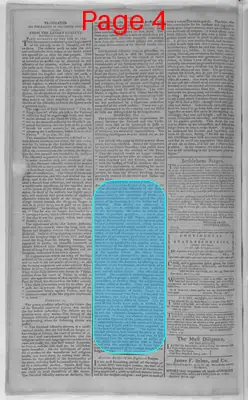
Gazette Of The United States
New York, New York County, New York
What is this article about?
Extract from Brussels dated February 17 details tumultuous National Assembly meetings in the Braban tine Revolution, with objections to the Breda committee's sovereignty claims, a circulated letter warning against alterations, failed calming efforts by Henry Vander Noot, foreign emissaries' presence, and noble entertainments amid discontent over appointments.
Clipping
OCR Quality
Full Text
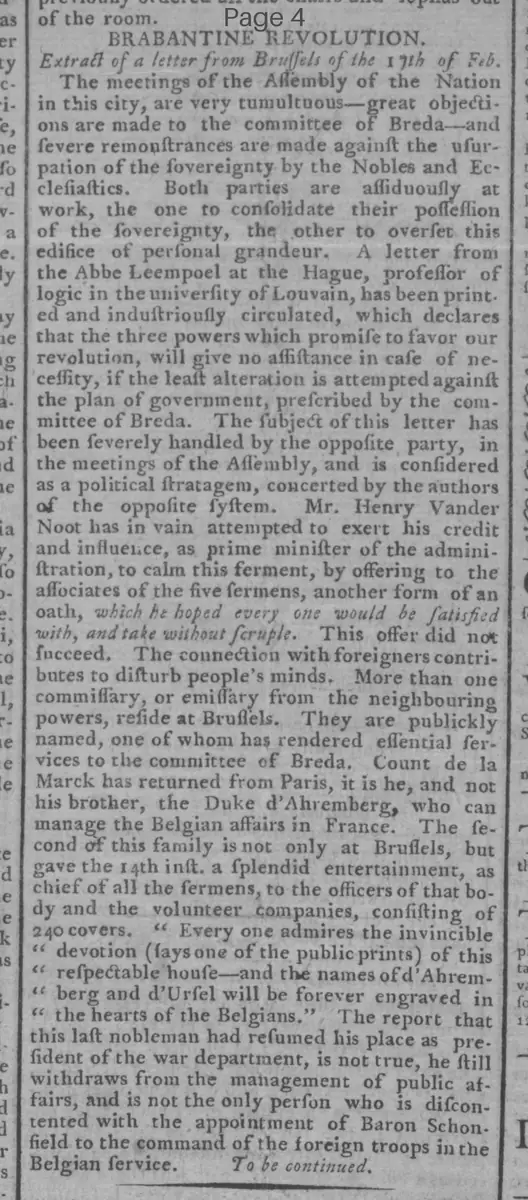
Extract of a letter from Brussels of the 17th of Feb.
The meetings of the Assembly of the Nation in this city, are very tumultuous—great objections are made to the committee of Breda and severe remonstrances are made against the usurpation of the sovereignty by the Nobles and Ecclesiastics. Both parties are assiduously at work, the one to consolidate their possession of the sovereignty, the other to overturn this edifice of personal grandeur. A letter from the Abbe Leempoel at the Hague, professor of logic in the university of Louvain, has been printed and industriously circulated, which declares that the three powers which promise to favor our revolution, will give no assistance in case of necessity, if the least alteration is attempted against the plan of government, prescribed by the committee of Breda. The subject of this letter has been severely handled by the opposite party, in the meetings of the Assembly, and is considered as a political stratagem, concerted by the authors of the opposite system. Mr. Henry Vander Noot has in vain attempted to exert his credit and influence, as prime minister of the administration, to calm this ferment, by offering to the associates of the five germs, another form of an oath, which he hoped every one would be satisfied with, and take without scruple. This offer did not succeed. The connection with foreigners contributes to disturb people's minds. More than one commissary, or emissary from the neighbouring powers, reside at Brussels. They are publicly named, one of whom has rendered essential services to the committee of Breda. Count de la Marck has returned from Paris, it is he, and not his brother, the Duke d'Ahremberg, who can manage the Belgian affairs in France. The second of this family is not only at Brussels, but gave the 14th inst. a splendid entertainment, as chief of all the germs, to the officers of that body and the volunteer companies, consisting of 240 covers. "Every one admires the invincible devotion (says one of the public prints) of this respectable house—and the names of d'Ahremberg and d'Urfel will be forever engraved in the hearts of the Belgians." The report that this last nobleman had resumed his place as president of the war department, is not true, he still withdraws from the management of public affairs, and is not the only person who is discontented with the appointment of Baron Schoenfeld to the command of the foreign troops in the Belgian service.
To be continued.
What sub-type of article is it?
What keywords are associated?
What entities or persons were involved?
Where did it happen?
Foreign News Details
Primary Location
Brussels
Event Date
17th Of Feb.
Key Persons
Outcome
tumultuous assembly meetings with failed attempts to resolve disputes over sovereignty and oaths; foreign connections and appointments cause discontent; no military outcomes reported.
Event Details
Tumultuous meetings of the National Assembly in Brussels object to the Breda committee and noble-ecclesiastical sovereignty usurpation. Parties vie for control. A letter from Abbe Leempoel warns against altering the Breda plan, dismissed as stratagem. Vander Noot's oath proposal fails. Foreign emissaries present; Count de la Marck handles French affairs. Duke d'Ahremberg hosts entertainment; d'Urfel withdraws from affairs amid discontent over Baron Schoenfeld's command.