Thank you for visiting SNEWPapers!
Sign up free
Story
March 17, 1827
New Hampshire Statesman And Concord Register
Concord, Merrimack County, New Hampshire
What is this article about?
A narrator recounts asking a distinguished Senator why people idolize successful military leaders. The Senator explains that military exploits appeal directly to the senses, dazzling even the illiterate, while statesmen and philosophers' good requires intellectual effort and is progressive, leading to controversy.
Clipping
OCR Quality
98%
Excellent
Full Text
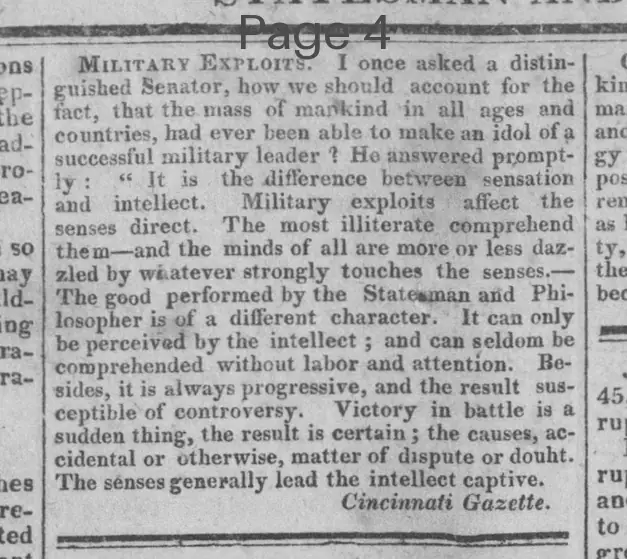
MILITARY EXPLOITS. I once asked a distinguished Senator, how we should account for the fact, that the mass of mankind in all ages and countries, had ever been able to make an idol of a successful military leader? He answered promptly: "It is the difference between sensation and intellect. Military exploits affect the senses direct. The most illiterate comprehend them—and the minds of all are more or less dazzled by whatever strongly touches the senses.—The good performed by the Statesman and Philosopher is of a different character. It can only be perceived by the intellect; and can seldom be comprehended without labor and attention. Besides, it is always progressive, and the result susceptible of controversy. Victory in battle is a sudden thing, the result is certain; the causes, accidental or otherwise, matter of dispute or doubt. The senses generally lead the intellect captive."
Cincinnati Gazette.
Cincinnati Gazette.
What sub-type of article is it?
Curiosity
Biography
What themes does it cover?
Moral Virtue
Social Manners
What keywords are associated?
Military Exploits
Idolization Of Leaders
Sensation Vs Intellect
Senator's Explanation
What entities or persons were involved?
Distinguished Senator
Story Details
Key Persons
Distinguished Senator
Story Details
Narrator asks a Senator why mankind idolizes military leaders; Senator replies it's due to military exploits' direct sensory appeal versus the intellectual demands of statesmen and philosophers' work.