Thank you for visiting SNEWPapers!
Sign up free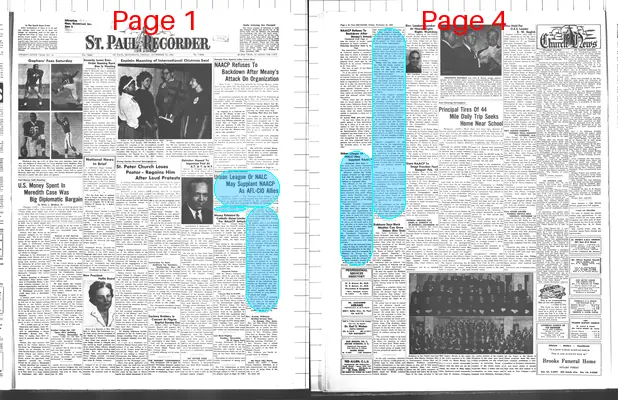
St. Paul Recorder
Saint Paul, Ramsey County, Minnesota
What is this article about?
AFL-CIO may replace NAACP with Urban League or NALC as ally against labor discrimination, amid feud over Herbert Hill. Over 100 unions sign anti-bias pledges with President Kennedy at White House in Washington.
Merged-components note: Continuation of the story on Urban League or NALC potentially supplanting NAACP from page 1 to page 4.
Clippings
1 of 2
OCR Quality
Full Text
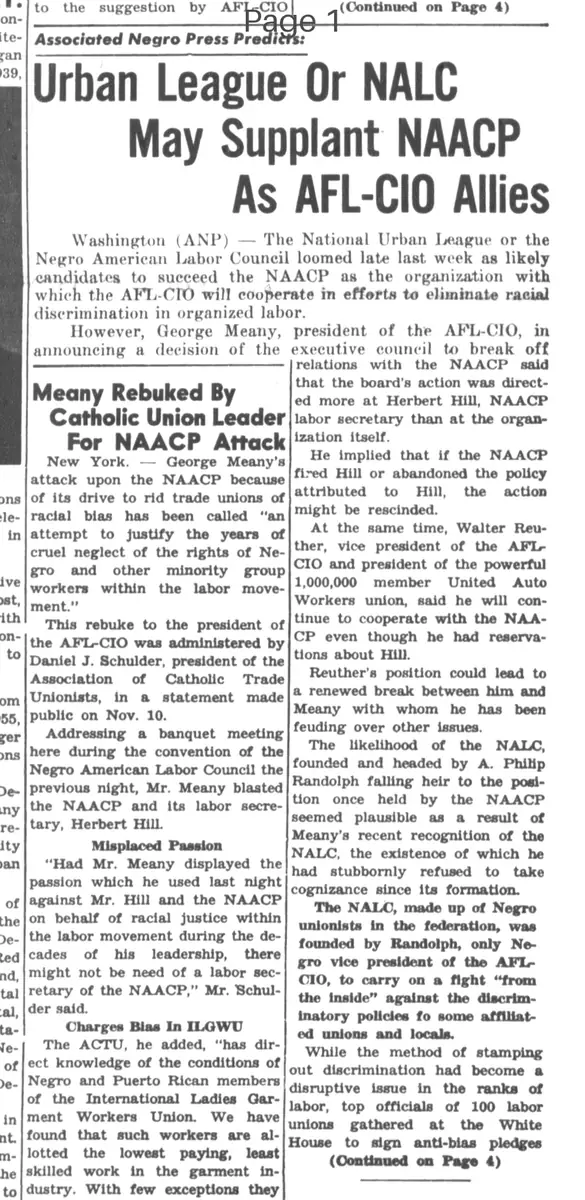
Urban League Or NALC May Supplant NAACP As AFL-CIO Allies
Washington (ANP) - The National Urban League or the Negro American Labor Council loomed late last week as likely candidates to succeed the NAACP as the organization with which the AFL-CIO will cooperate in efforts to eliminate racial discrimination in organized labor.
However, George Meany, announcing a decision of the executive council to break off relations with the NAACP said that the board's action was directed more at Herbert Hill, NAACP labor secretary than at the organization itself.
He implied that if the NAACP fired Hill or abandoned the policy attributed to Hill, the action might be rescinded.
At the same time, Walter Reuther, vice president of the AFL-CIO and president of the powerful 1,000,000 member United Auto Workers union, said he will continue to cooperate with the NAACP even though he had reservations about Hill.
Reuther's position could lead to a renewed break between him and Meany with whom he has been feuding over other issues.
The likelihood of the NALC, founded and headed by A. Philip Randolph falling heir to the position once held by the NAACP seemed plausible as a result of Meany's recent recognition of the NALC, the existence of which he had stubbornly refused to take cognizance since its formation.
The NALC, made up of Negro unionists in the federation, was founded by Randolph, only Negro vice president of the AFL-CIO, to carry on a fight "from the inside" against the discriminatory policies of some affiliated unions and locals.
While the method of stamping out discrimination had become a disruptive issue in the ranks of labor, top officials of 100 labor unions gathered at the White House to sign anti-bias pledges (Continued on Page 4)
Urban League or NALC May Supplant NAACP
(Continued from Page 1)
Last week. The unions represented comprise more than 90 per cent of the membership of the AFL-CIO.
However, neither the Urban League, NAACP nor the NALC feels that the gesture is sufficient to eliminate the racial injustices in organized labor.
The officials of the 100 labor unions met with President Kennedy to sign pledges "to eliminate discrimination and unfair practices wherever they exist" within labor's ranks. Nineteen other national unions signed the pledges but did not take part in the White House ceremonies.
President Kennedy commended the labor leaders on their action. He said their fight against discrimination was appropriate because "the labor movement began as a union of those who were the least privileged in our society."
"So I ask you today," he added "to join in an old cause and a new one, and that is to make sure that in the ranks of labor, labor itself practices what it preaches."
The pledges were sponsored by the President's Committee on Equal Employment Opportunity. They were worked out during months of negotiations with labor officials.
The bid by the National Urban League to help the AFL-CIO end racial discrimination in the labor movement came in a proposal by Whitney M. Young, Jr., the league's executive secretary, at a meeting with the merged federation's executive council here.
Meany said at the end of the two-day quarterly council session that there had been no action on the Urban League's proposal. He said the federation, in the midst of the dispute with the NAACP, did not want to appear to be throwing all its support to "what might be termed a rival organization."
The federation president said the executive council had instructed him to write the NAACP a letter arguing that trying to have unions decertified was not the way to fight racial discrimination in the labor movement.
Meany said the letter would say that his group wanted to work with the NAACP, but "could not under the circumstances we are faced with by their labor secretary."
"Hill's approach defeats the purposes of his organization," Meany said, contending that the way to eliminate racial discrimination in a local union was to work with its parent national union, not try to have the local stripped of bargaining rights.
The Urban League's proposal basically was that the AFL-CIO let the league's staff participate in handling complaints of racial discrimination filed against unions by members and non-members.
Young told the Executive Council members that although labor's own anti-discrimination machinery was necessary, Negroes would never have confidence in that alone.
He also said that the league had 62 local units and 500 full-time staff members in cities in which 70 per cent of the nation's Negroes lived, and offered to put those facilities at the disposal of the labor movement in an effort to eliminate from it "the last vestiges of segregation and discrimination based on race."
Meany's recognition of the NALC came at the organization's three-day meeting last week in New York. Randolph, commenting on remarks by Meany at the meeting, preferred to stress the importance of the federation president's appearance rather than the content of his statement, in which Meany accused Hill of falsehoods, smears and political attacks on labor.
Whitney M. Young, Jr., National Urban League executive director in a letter to Roy Wilkins, NAACP executive head dated November 15, disavowed any intention by him to undermine the NAACP labor union program.
Young told Wilkins, the meeting he had with the AFL-CIO executive council was originally set for August this year, where he was prepared to present the program of cooperation he presented on Nov. 14.
In his statement to the AFL-CIO executive council Young said "I would also like to make it clear that the Urban League opposes segregation and discrimination as strongly as any other organization in this country."
What sub-type of article is it?
What themes does it cover?
What keywords are associated?
What entities or persons were involved?
Where did it happen?
Story Details
Key Persons
Location
Washington
Event Date
Late Last Week, November 15
Story Details
The AFL-CIO executive council decides to break relations with the NAACP primarily due to issues with labor secretary Herbert Hill, considering the National Urban League or Negro American Labor Council as potential successors for cooperation against racial discrimination in labor. Walter Reuther vows to continue working with NAACP. Over 100 unions sign anti-bias pledges at the White House with President Kennedy. Whitney M. Young Jr. proposes Urban League involvement in handling complaints. Meany recognizes NALC and criticizes Hill's approach.