Thank you for visiting SNEWPapers!
Sign up free
Literary
May 27, 1801
The Providence Journal, And Town And Country Advertiser
Providence, Providence County, Rhode Island
What is this article about?
Excerpt from Mavor's Natural History describing the common seal's physical features, habitat in European and polar seas, behavior including migration and reproduction, and its value for skin, oil, and flesh to indigenous peoples and historically in Britain.
Clipping
OCR Quality
95%
Excellent
Full Text
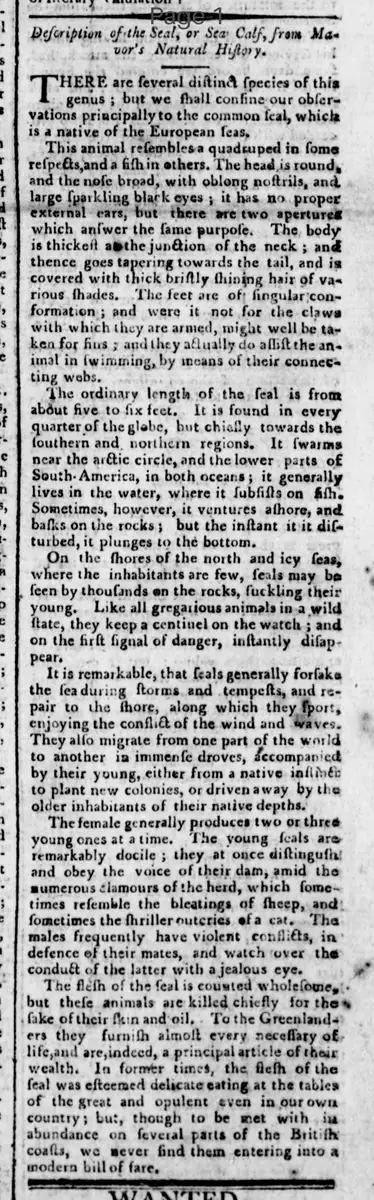
Description of the Seal, or Sea Calf, from Mavor's Natural History.
THERE are several distinct species of this genus; but we shall confine our observations principally to the common seal, which is a native of the European seas.
This animal resembles a quadruped in some respects, and a fish in others. The head is round and the nose broad, with oblong nostrils, and large sparkling black eyes; it has no proper external ears, but there are two apertures which answer the same purpose. The body is thickest at the junction of the neck; and thence goes tapering towards the tail, and is covered with thick bristly shining hair of various shades. The feet are of singular conformation; and were it not for the claws with which they are armed, might well be taken for fins; and they actually do assist the animal in swimming, by means of their connecting webs.
The ordinary length of the seal is from about five to six feet. It is found in every quarter of the globe, but chiefly towards the southern and northern regions. It swarms near the arctic circle, and the lower parts of South-America, in both oceans; it generally lives in the water, where it subsists on fish. Sometimes, however, it ventures ashore, and basks on the rocks; but the instant it is disturbed, it plunges to the bottom.
On the shores of the north and icy seas, where the inhabitants are few, seals may be seen by thousands on the rocks, suckling their young. Like all gregarious animals in a wild state, they keep a centinel on the watch; and on the first signal of danger, instantly disappear.
It is remarkable, that seals generally forsake the sea during storms and tempests, and repair to the shore, along which they sport, enjoying the conflict of the wind and waves.
They also migrate from one part of the world to another in immense droves, accompanied by their young, either from a native instinct to plant new colonies, or driven away by the older inhabitants of their native depths.
The female generally produces two or three young ones at a time. The young seals are remarkably docile; they at once distinguish and obey the voice of their dam, amid the numerous clamours of the herd, which sometimes resemble the bleatings of sheep, and sometimes the shriller outcries of a cat. The males frequently have violent conflicts, in defence of their mates, and watch over the conduct of the latter with a jealous eye.
The flesh of the seal is counted wholesome but these animals are killed chiefly for the sake of their skin and oil. To the Greenlanders they furnish almost every necessary of life, and are, indeed, a principal article of their wealth. In former times, the flesh of the seal was esteemed delicate eating at the tables of the great and opulent even in our own country; but, though to be met with in abundance on several parts of the British coasts, we never find them entering into a modern bill of fare.
THERE are several distinct species of this genus; but we shall confine our observations principally to the common seal, which is a native of the European seas.
This animal resembles a quadruped in some respects, and a fish in others. The head is round and the nose broad, with oblong nostrils, and large sparkling black eyes; it has no proper external ears, but there are two apertures which answer the same purpose. The body is thickest at the junction of the neck; and thence goes tapering towards the tail, and is covered with thick bristly shining hair of various shades. The feet are of singular conformation; and were it not for the claws with which they are armed, might well be taken for fins; and they actually do assist the animal in swimming, by means of their connecting webs.
The ordinary length of the seal is from about five to six feet. It is found in every quarter of the globe, but chiefly towards the southern and northern regions. It swarms near the arctic circle, and the lower parts of South-America, in both oceans; it generally lives in the water, where it subsists on fish. Sometimes, however, it ventures ashore, and basks on the rocks; but the instant it is disturbed, it plunges to the bottom.
On the shores of the north and icy seas, where the inhabitants are few, seals may be seen by thousands on the rocks, suckling their young. Like all gregarious animals in a wild state, they keep a centinel on the watch; and on the first signal of danger, instantly disappear.
It is remarkable, that seals generally forsake the sea during storms and tempests, and repair to the shore, along which they sport, enjoying the conflict of the wind and waves.
They also migrate from one part of the world to another in immense droves, accompanied by their young, either from a native instinct to plant new colonies, or driven away by the older inhabitants of their native depths.
The female generally produces two or three young ones at a time. The young seals are remarkably docile; they at once distinguish and obey the voice of their dam, amid the numerous clamours of the herd, which sometimes resemble the bleatings of sheep, and sometimes the shriller outcries of a cat. The males frequently have violent conflicts, in defence of their mates, and watch over the conduct of the latter with a jealous eye.
The flesh of the seal is counted wholesome but these animals are killed chiefly for the sake of their skin and oil. To the Greenlanders they furnish almost every necessary of life, and are, indeed, a principal article of their wealth. In former times, the flesh of the seal was esteemed delicate eating at the tables of the great and opulent even in our own country; but, though to be met with in abundance on several parts of the British coasts, we never find them entering into a modern bill of fare.
What sub-type of article is it?
Essay
What themes does it cover?
Nature
What keywords are associated?
Seal
Sea Calf
Natural History
Marine Mammal
Arctic Regions
Migration
Reproduction
Economic Value
What entities or persons were involved?
Mavor
Literary Details
Title
Description Of The Seal, Or Sea Calf, From Mavor's Natural History.
Author
Mavor
Subject
Description Of The Common Seal
Key Lines
This Animal Resembles A Quadruped In Some Respects, And A Fish In Others.
It Is Found In Every Quarter Of The Globe, But Chiefly Towards The Southern And Northern Regions.
The Flesh Of The Seal Is Counted Wholesome But These Animals Are Killed Chiefly For The Sake Of Their Skin And Oil.