Thank you for visiting SNEWPapers!
Sign up free
The Hawaiian Gazette
Honolulu, Honolulu County, Hawaii
What is this article about?
Proceedings of the 25th day of the Hawaiian Legislative Assembly on Dec. 3, 1887, covering petitions on leprosy, military organization report, investigation into duty-free liquor imports abuses involving diplomats and the King, Princess Likelike funeral expense claims, ministerial questions, and passage of bills on police, cable, and liquor licenses. (248 characters)
Clipping
OCR Quality
Full Text
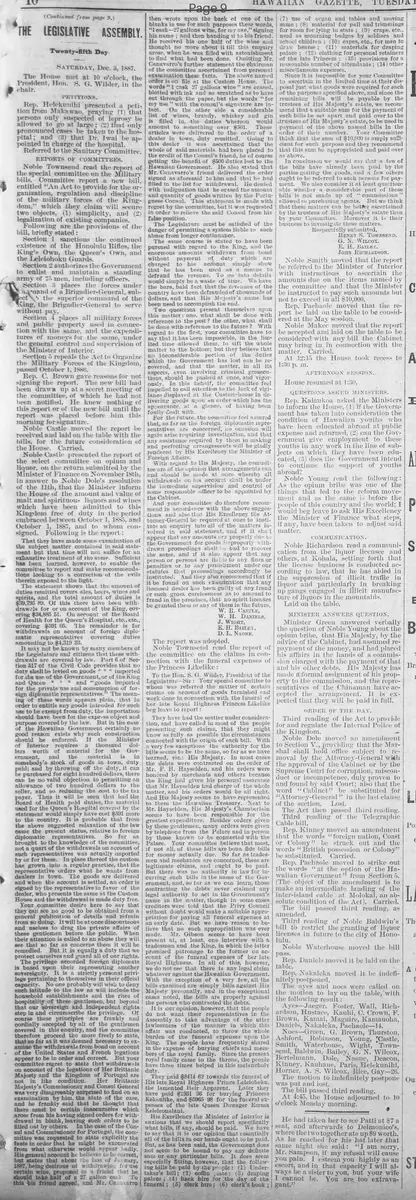
THE LEGISLATIVE ASSEMBLY
Twenty-fifth Day
SATURDAY, Dec. 3, 1887
The House met at 10 o'clock, the President, Hon. S. G. Wilder, in the chair.
PETITIONS.
Rep. Helekunihi presented a petition from Makawao, praying (1) that persons only suspected of leprosy be allowed to go at large; (2) that only pronounced cases be taken to the hospital; and (3) that Dr. Iwai be appointed in charge of the hospital.
Referred to the Sanitary Committee.
REPORTS OF COMMITTEES.
Noble Townsend read the report of the special committee on the Military bills. Committee report a new bill entitled "An Act to provide for the organization, regulation and discipline of the military forces of the Kingdom," which they claim will secure two objects, (1) simplicity, and (2) legalization of existing companies.
Following are the provisions of the bill, briefly stated:
Section 1 sanctions the continued existence of the Honolulu Rifles, the King's Own, the Queen's Own, and the Leleiohoku Guards.
Section 2 authorizes the Government to enlist and maintain a standing army of 75 men, including officers.
Section 3 places the forces under command of a Brigadier-General, subject to the superior command of the King, the Brigadier-General to serve without pay.
Section 4 places all military forces and public property used in connection with the same, and the expenditures of moneys for the same, under the general control and supervision of the Minister of Interior.
Section 5 repeals the Act to Organize the Military Forces of the Kingdom, passed October 1, 1886.
Rep. C. Brown gave reasons for not signing the report. The new bill had been drawn up at a secret meeting of the committee, of which he had not been notified. He knew nothing of this report or of the new bill until the report was placed before him this morning for signature.
Noble Castle moved the report be received and laid on the table with the bills, for the future consideration of the House. Carried.
Noble Castle presented the report of the select committee on opiumn and liquor, on the return submitted by the Minister of Finance on November 18th, in answer to Noble Dole's resolution of the 1st. that the Minister inform the House of the amount and value of malt and spirituous liquors and wines which have been admitted to this Kingdom free of duty in the period embraced between October 1, 1885, and October 1, 1887, and to whom consigned. Following is the report:
That they have made some examination of the subject matter contained in said statement but that time will not suffice for an exhaustive treatment of the same. Sufficient has been learned, however, to enable the committee to report and make recommendations looking to a correction of the evils therein exposed to the light.
The statement shows that the amount of duties remitted covers ales, beers, wines and spirits, and the total amount of duties is $39,795.89. Of this there have been withdrawals for or on account of the King, covering $34,885.51. On account of the Board of Health for the Queen's Hospital, etc., etc., covering $591.05. The remainder is for withdrawals on account of foreign diplomatic representatives covering duties amounting to $4,319.33.
It may not be known by many members of the Legislature and citizens that these withdrawals are covered by law. Part 6 of Section 517 of the Civil Code provides that no duty shall be levied on goods * * * imported for the use of the Government, or of the King and Queen and "goods imported for the private use and consumption of foreign diplomatic representatives." The meaning of these words appears plain, that in order to entitle any goods intended for such use to be exempt from duty, the importation should have been for the express object and purpose covered by the law. But in the case of the Hawaiian Government certainly no good reason exists why such construction should be enforced. If the Minister of Interior requires a thousand dollars worth of material for the Government, and the material is in somebody's stock of goods in town, duty paid; and by throwing off the duty, it can be purchased for eight hundred dollars, there can be no valid objection to permitting an allowance of two hundred dollars to the seller, and so reducing the cost to the tax payer. Thus it will be seen that had the Board of Health paid duties, the material used for the Queen's Hospital covered by the statement would simply have cost $591 more to the country. It is probable that from the above suggested relaxation of the law came the present status, relative to foreign diplomatic representatives. So far as brought to the knowledge of the committee, not a quart of the withdrawals on account of such representatives was actually imported by or for them. In place thereof the custom has grown into a regular practice, that the representative orders what he wants from dealers in town. The goods are delivered and when the account is settled, an order is signed by the representative in favor of the dealer, who presents the same at the Custom House and the withdrawal is made duty free.
Your committee desire here to say that they can see no good to be obtained from a general publication of details and refrain from so doing. It will be at once discourteous and useless to drag the private affairs of these gentlemen before the public. When their attention is called to an abuse they will see that so far as concerns them it will be remedied. But it is equally a duty that we protect ourselves and guard all of our rights. The privilege accorded foreign diplomats is based upon their representing another sovereignty. It is a strictly personal privilege pertaining to themselves in their official capacity. No one probably will wish to deny such latitude to the law as will include the household establishments and the rites of hospitality of these gentlemen, but beyond that our sovereign and independent rights step in and circumscribe the privilege. Of course these principles are frankly and cordially accepted by all of the gentlemen covered in this enquiry, and the committee therefore proceed the more freely to state, that so far as it was deemed necessary to examine the withdrawals from bond on account of the United States and French legations appear to be in order and correct. But your committee regret to state that withdrawals on account of the legations of Her Britannic Majesty and the Kingdom of Portugal are not in like condition. Her Britannic Majesty's Commissioner and Consul General was very disagreeably surprised to find on an examination by him, the state of the case, and he frankly said that he thought that there must be certain inaccuracies which arose from his having signed orders for withdrawal in blank, leaving such orders to be filled out by others. In the case of the Consul and Commissioner for Portugal, the committee was requested to state explicitly the facts in order that he might be exonerated from what otherwise would appear badly. His general account he believes to be correct, but states that about the last of January, 1887, being desirous of withdrawing for use certain wine, proposed to a friend that he should take half of a 27 gallon cask. To this his friend agreed, and Mr. Canavarro then wrote upon the back of one of the blanks in use for such purposes these words. "1 cask—27 gallons wine, for my use," signing his name: and then handing it to his friend. He received his one half of the wine and thought no more about it till this enquiry arose, when he was filled with astonishment to find what had been done. Omitting Mr. Canavarro's further statement the chairman of the committee ascertained from personal examination these facts. The above named order is on file at the Custom House. The words "1 cask 27 gallons wine" are erased, blotted with ink and so scratched as to have cut through the paper, but the words "for my use" with the consul's signature are intact. On the other side a considerable list of wines, brandy, whiskey and gin is filled in, the duties whereon would amount to something over $500. These articles were delivered to the order of a dealer in town, duty remitted. Going to this dealer it was ascertained that the whole of said materials had been placed to the credit of the Consul's friend, he of course getting the benefit of $500 duties lost to the Hawaiian Government. He also stated that Mr. Canavarro's friend delivered the order signed as aforesaid to him and that he had filled in the list for withdrawal. He denied with indignation that he erased the amount and quantity of goods written by the Portuguese Consul. This statement is made with regret by the committee, but it was requested in order to relieve the said Consul from his false position.
The Legislature must be satisfied of the danger of permitting a system liable to such abuse from longer continuance.
The same course is stated to have been pursued with regard to the King, and the enormous amounts withdrawn from bond without payment of duty which are charged to his account simply show that he has been used as a means to defraud the revenue. To go into details would simply be a waste of time. We have the bare, bald fact that the revenues of the country have been defrauded of thousands of dollars, and that His Majesty's name has been used to accomplish the end.
Two questions present themselves upon this matter: one, what shall be done with reference to the past? the other, what shall be done with reference to the future? With regard to the first, your committee have to say that it has been impossible, in the limited time allowed them, to sift the whole matter to the bottom; but they believe that no inconsiderable portion of the duties which the Government has lost can be recovered, and that the matter, in all its aspects, even involving criminal prosecutions, should be pushed at once, and vigorously. In this behalf, the committee feel impelled to call attention to the lack of vigilance displayed at the Custom-house in delivering goods upon an order which has the appearance, at a glance, of having been foully dealt with.
For the future, the committee feel assured that, so far as the foreign diplomatic representatives are concerned, no occasion will again arise requiring investigation, and that any assistance required by them in making and perfecting arrangements will be gladly rendered by His Excellency the Minister of Foreign Affairs.
With regard to His Majesty, the committee are of the opinion that arrangements can and should be made at once whereby all withdrawals on his account shall be under the immediate supervision and control of some responsible officer to be appointed by the Cabinet.
And your committee do therefore recommend in accordance with the above suggestions and also that His Excellency the Attorney-General be required at once to institute an enquiry into all of the matters involved in said statement, and if it shall appear that any amounts are properly due to the Government for goods improperly withdrawn proceedings shall be had to recover the same, and if it also appear that any person or persons are liable to any fines or penalties or to any punishment under our statutes that proceedings accordingly be instituted. And they also recommend that if it be found on such examination that any licensed dealer has been guilty of any fraud or such gross carelessness as to amount to fraud in the premises, that no spirit licenses be granted them or any of them in the future.
W. R. CASTLE,
W. H. Daniels,
J. WIGHT,
E. H. BAILEY,
D. L. NAONE.
The report was adopted.
Noble Townsend read the report of the committee on the claims in connection with the funeral expenses of the Princess Likelike:
To the Hon. S. G. Wilder, President of the Legislature—Sir: Your special committee to whom was referred the matter of certain claims on account of goods furnished and work done in connection with the funeral of her late Royal Highness Princess Likelike beg leave to report:
They have had the matter under consideration, and have called in most of the people presenting such claims, that they might know as fully as possible the circumstances connected with the origin of each bill. With a very few exceptions the authority for the bills seems to be the same, so far as we have learned, viz.: His Majesty. In most cases the debts were contracted on the order of Mr. F. H. Hayselden, and his orders were honored by merchants and others because the King had given his personal assurance that Mr. Hayselden had charge of the whole matter, and his orders would be all right. And His Majesty seems to have represented to them the Hawaiian Treasury. Next to Mr. Hayselden, His Majesty's Chamberlain seems to have been responsible for the greatest expenditure. Besides orders given by these gentlemen, many orders were given by telephone from the Palace and in person by those known to be connected with the Palace. Your committee believe that most, if not all, of these bills are bona fide bills for money actually due. So far as tradesmen and mechanics are concerned, these are legitimate claims, and ought to be paid.
But there was no authority in law for incurring such bills in the name of the Government, and, so far as we can learn, those contracting the debts never claimed any legal authority to act in the Government's name in the matter, though in some cases creditors were told that the Privy Council without doubt would make a suitable appropriation for paying all funeral expenses at an early date. But we have reason to believe that no such appropriation was ever made. Mr. Gibson seems to have been present at, at least, one interview with a tradesman and the King, in which the latter promised patronage to the former on account of the funeral expenses of her late Royal Highness. In all of this, however, we do not see that there is any legal claim whatever against the Hawaiian Government.
With the exception of a very few, all the bills examined are simply bills against His Majesty personally, and in the exceptional cases noted, the bills are properly against the persons who contracted the debts.
It is our opinion, however, that the people do not want their representatives in the Assembly to take advantage of the utter lawlessness of the manner in which this affair was conducted, to throw the whole burden of the funeral expenses upon the King. The people have frequently shared in the expense of burying chiefs and members of the royal family. Since the present royal family came to the throne, the people have three times helped in this melancholy duty.
They paid $8414.62 towards the funeral of His late Royal Highness Prince Leleiohoku the lamented Heir Apparent. Later they have paid $1931.36 for burying Princess Kekaulike, and $5965.98 for the funeral expenses of the late Queen Dowager Emma Kaleleonalani.
His Excellency the Minister of Interior is anxious that we should report specifically what bills, if any, should be paid. We have to say that it is our opinion that essentially all of the bills in our hands ought to be paid. But, as has been said, the Government does not seem to be bound to pay any definite sum or any particular bills. It does seem especially fitting, however, that the following bills be paid by the people: (1) Undertaker's bill; (2) coffin plate; (3) draping palace; (4) hack hire for the day of the funeral; (5) clerk hire; (6) clerks book;
(7) use of organ and tables and moving same; (8) material for pall and trimmings for room for lying in state; (9) crape, etc., used as mourning badges by soldiers and school children; (10) capes, etc., for men to draw hearse; (11) materials for draping palace; (12) clothing for personal retainers of the late Princess; (13) provisions for a reasonable number of attendants; (14) other miscellaneous expenses.
Since it is impossible for your Committee to ascertain in the limited time at their disposal just what goods were required for each of the purposes specified above, and since the remaining bills will be payable by the trustees of His Majesty's estate, we recommend that a suitable sum for the payment of such bills be set apart and paid over to the trustees of His Majesty's estate, to be used in payment of the above named bills in the order of their number. Your Committee think that the sum of $10,000 is amply sufficient for such purpose and they recommend that this sum be appropriated and paid over as above.
In conclusion we would say that a few of the bills have already been paid by the parties getting the goods, and a few others ought to be referred to such persons for payment. We also consider it at least questionable whether a considerable part of these bills is not made up of "commissions" allowed to purchasing agents. But we think that these matters can be better ascertained by the trustees of His Majesty's estate than by your Committee. Moreover it is their business to investigate these matters.
Respectfully submitted,
HENRY S. TOWNSEND,
G. N. WILCOX.
E. H. Bailey.
JOHN RICHARDSON
Noble Smith moved that the report be referred to the Minister of Interior with instructions to ascertain the amounts due on the items named by the committee and that the Minister be instructed to pay such amounts but not to exceed in all $10,000.
Rep. Paehaole moved that the report be laid on the table to be considered at the May session.
Noble Makee moved that the report be accepted and laid on the table to be considered with any bill the Cabinet may bring in in connection with the matter. Carried.
At 12:15 the House took recess to 1:30 p. m.
AFTERNOON SESSION.
House resumed at 1:30.
QUESTIONS ASKED MINISTERS.
Rep. Kalaukoa asked the Ministers to inform the House, (1) if the Government has taken into consideration the condition of Hawaiian youths who have been educated abroad at public expense and returned, (2) can the Government give employment to these youths in any work in the line of subjects on which they have been educated, (3) does the Government intend to continue the support of youths abroad?
Noble Young read the following:
As the opium bribe was one of the things that led to the reform movement and as the same is before the people of this country and the world; I would beg leave to ask His Excellency the Minister of Finance what steps, if any, have been taken to adjust said matter.
COMMUNICATION.
Noble Richardson read a communication from the liquor licensee and others, at Kohala, setting forth that the license business is conducted according to law, that he has aided in the suppression of illicit traffic in liquor and particularly in breaking up gangs engaged in illicit manufacture of liquors in the mountains.
Laid on the table.
MINISTER ANSWERS QUESTION.
Minister Green answered verbally the question of Noble Young about the opium bribe, that His Majesty, by the advice of the Cabinet, had assumed repayment of the money, and had placed his affairs in the hands of a commission charged with the payment of that and his other debts. His Majesty has made a formal assignment of his property to the commission, and the representatives of the Chinaman have accepted the arrangement. It is expected that they will be paid in full.
ORDER OF THE DAY.
Third reading of the Act to provide for and regulate the Internal Police of the Kingdom.
Noble Dole moved an amendment to Section V., providing that the Marshal shall hold office subject to removal by the Attorney-General with the approval of the Cabinet or by the Supreme Court for corruption, misconduct or incompetence, duly proven to and found by said Court; also that the word "Cabinet" be substituted for "Attorney-General" in the last clause of the section. Lost.
The Act then passed third reading.
Third reading of the Telegraphic Cable bill.
Rep. Kinney moved an amendment that the words "foreign nation, Coast or Colony" be struck out and the words "British possession or Colony" be substituted. Carried.
Rep. Paehaole moved to strike out the words "at the option of the Hawaiian Government" from Section 5. (The object of the amendment is to make an intermediate landing of the inter-island cable at Molokai, an absolute condition of the Act). Carried.
The bill passed third reading, as amended.
Third reading of Noble Baldwin's bill to restrict the granting of liquor licenses in future to the city of Honolulu.
Noble Waterhouse moved the bill pass.
Rep. Daniels moved it be laid on the table.
Rep. Nakaleka moved it be indefinitely postponed.
The ayes and noes were called on the motion to lay on the table, with the following result:
Ayes—Jaeger, Foster, Wall, Richardson, Hustace, Kauhi, C. Crown, F. Brown, Kamai, Maguire, Kamauoha, Daniels, Nakaleka, Paehaole—14.
Noes—Green, G. Brown, Thurston, Ashford, Robinson, Young, Castle, Smith, Waterhouse, Wight, Townsend, Baldwin, Bailey, G. N. Wilcox, Bertelmann, Dole, Naone, Deacon, Kinney, Kauhane, Paris, Helekunihi, Horner, A. S. Wilcox, Rice, Gay—26.
The motion to indefinitely postpone was put and lost.
The bill passed third reading.
At 4:45, the House adjourned to 10 o'clock Monday morning.
What sub-type of article is it?
What themes does it cover?
What keywords are associated?
What entities or persons were involved?
Where did it happen?
Story Details
Key Persons
Location
Kingdom Of Hawaii
Event Date
Dec. 3, 1887
Story Details
The Hawaiian Legislative Assembly convenes on December 3, 1887. Key actions include: petition on leprosy handling referred to committee; report on new military organization bill presented; detailed report on duty-free liquor imports revealing abuses by diplomats and the King, recommending investigations and reforms; report on Princess Likelike's funeral expenses suggesting $10,000 appropriation; questions to ministers on educated youths and opium bribe; communications and answers; third readings and passages of bills on internal police, telegraphic cable, and liquor license restrictions.