Thank you for visiting SNEWPapers!
Sign up free
Story
July 27, 1928
The Butler County Press
Hamilton, Butler County, Ohio
What is this article about?
Sam Squib accuses West Point Army officers of underpaying granite cutters below prevailing rates, lengthening work weeks, and ignoring protests to maintain low standards, as detailed in a July Granite Cutters' Journal editorial.
Clipping
OCR Quality
100%
Excellent
Full Text
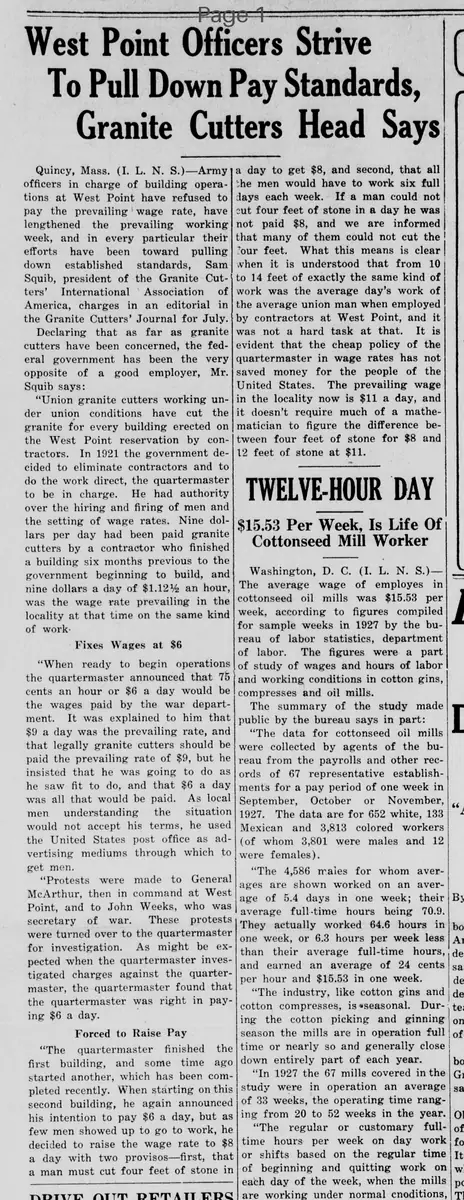
West Point Officers Strive To Pull Down Pay Standards, Granite Cutters Head Says
Quincy, Mass. (I. L. N. S.)—Army officers in charge of building operations at West Point have refused to pay the prevailing wage rate, have lengthened the prevailing working week, and in every particular their efforts have been toward pulling down established standards, Sam Squib, president of the Granite Cutters' International Association of America, charges in an editorial in the Granite Cutters' Journal for July.
Declaring that as far as granite cutters have been concerned, the federal government has been the very opposite of a good employer, Mr. Squib says:
"Union granite cutters working under union conditions have cut the granite for every building erected on the West Point reservation by contractors. In 1921 the government decided to eliminate contractors and to do the work direct, the quartermaster to be in charge. He had authority over the hiring and firing of men and the setting of wage rates. Nine dollars per day had been paid granite cutters by a contractor who finished a building six months previous to the government beginning to build, and nine dollars a day or $1.12½ an hour was the wage rate prevailing in the locality at that time on the same kind of work.
Fixes Wages at $6
"When ready to begin operations the quartermaster announced that 75 cents an hour or $6 a day would be the wages paid by the war department. It was explained to him that $9 a day was the prevailing rate, and that legally granite cutters should be paid the prevailing rate of $9, but he insisted that he was going to do as he saw fit to do, and that $6 a day was all that would be paid. As local men understanding the situation would not accept his terms, he used the United States post office as advertising mediums through which to get men.
"Protests were made to General McArthur, then in command at West Point, and to John Weeks, who was secretary of war. These protests were turned over to the quartermaster for investigation. As might be expected when the quartermaster investigated charges against the quartermaster, the quartermaster found that the quartermaster was right in paying $6 a day.
Forced to Raise Pay
"The quartermaster finished the first building, and some time ago started another, which has been completed recently. When starting on this second building, he again announced his intention to pay $6 a day, but as few men showed up to go to work, he decided to raise the wage rate to $8 a day with two provisos—first, that a man must cut four feet of stone in
a day to get $8, and second, that all the men would have to work six full days each week. If a man could not cut four feet of stone in a day he was not paid $8, and we are informed that many of them could not cut the four feet. What this means is clear when it is understood that from 10 to 14 feet of exactly the same kind of work was the average day's work of the average union man when employed by contractors at West Point, and it was not a hard task at that. It is evident that the cheap policy of the quartermaster in wage rates has not saved money for the people of the United States. The prevailing wage in the locality now is $11 a day, and it doesn't require much of a mathematician to figure the difference between four feet of stone for $8 and 12 feet of stone at $11."
Quincy, Mass. (I. L. N. S.)—Army officers in charge of building operations at West Point have refused to pay the prevailing wage rate, have lengthened the prevailing working week, and in every particular their efforts have been toward pulling down established standards, Sam Squib, president of the Granite Cutters' International Association of America, charges in an editorial in the Granite Cutters' Journal for July.
Declaring that as far as granite cutters have been concerned, the federal government has been the very opposite of a good employer, Mr. Squib says:
"Union granite cutters working under union conditions have cut the granite for every building erected on the West Point reservation by contractors. In 1921 the government decided to eliminate contractors and to do the work direct, the quartermaster to be in charge. He had authority over the hiring and firing of men and the setting of wage rates. Nine dollars per day had been paid granite cutters by a contractor who finished a building six months previous to the government beginning to build, and nine dollars a day or $1.12½ an hour was the wage rate prevailing in the locality at that time on the same kind of work.
Fixes Wages at $6
"When ready to begin operations the quartermaster announced that 75 cents an hour or $6 a day would be the wages paid by the war department. It was explained to him that $9 a day was the prevailing rate, and that legally granite cutters should be paid the prevailing rate of $9, but he insisted that he was going to do as he saw fit to do, and that $6 a day was all that would be paid. As local men understanding the situation would not accept his terms, he used the United States post office as advertising mediums through which to get men.
"Protests were made to General McArthur, then in command at West Point, and to John Weeks, who was secretary of war. These protests were turned over to the quartermaster for investigation. As might be expected when the quartermaster investigated charges against the quartermaster, the quartermaster found that the quartermaster was right in paying $6 a day.
Forced to Raise Pay
"The quartermaster finished the first building, and some time ago started another, which has been completed recently. When starting on this second building, he again announced his intention to pay $6 a day, but as few men showed up to go to work, he decided to raise the wage rate to $8 a day with two provisos—first, that a man must cut four feet of stone in
a day to get $8, and second, that all the men would have to work six full days each week. If a man could not cut four feet of stone in a day he was not paid $8, and we are informed that many of them could not cut the four feet. What this means is clear when it is understood that from 10 to 14 feet of exactly the same kind of work was the average day's work of the average union man when employed by contractors at West Point, and it was not a hard task at that. It is evident that the cheap policy of the quartermaster in wage rates has not saved money for the people of the United States. The prevailing wage in the locality now is $11 a day, and it doesn't require much of a mathematician to figure the difference between four feet of stone for $8 and 12 feet of stone at $11."
What sub-type of article is it?
Historical Event
What themes does it cover?
Justice
Misfortune
What keywords are associated?
West Point
Granite Cutters
Wage Dispute
Union Labor
Government Employer
Quartermaster
What entities or persons were involved?
Sam Squib
General Mcarthur
John Weeks
Where did it happen?
West Point
Story Details
Key Persons
Sam Squib
General Mcarthur
John Weeks
Location
West Point
Event Date
1921
Story Details
Army officers at West Point refused prevailing wage rates for granite cutters, paying $6 per day instead of $9 in 1921, leading to protests to General McArthur and Secretary Weeks, which were dismissed. For a second building, they raised to $8 per day but required cutting four feet of stone daily and six-day weeks, below union standards of 10-14 feet at $11 per day.