Thank you for visiting SNEWPapers!
Sign up free
Literary
March 15, 1811
The Enquirer
Richmond, Henrico County, Virginia
What is this article about?
In 'The Old Bachelor' No. XVIII, Doctor Robert Cecil receives angry letters accusing him of personal lampoons in his essays. His niece Rosalie persuades him to continue, arguing that general satirical depictions of vices naturally apply to many individuals and are essential for moral reform, citing Addison and Johnson as precedents.
Clipping
OCR Quality
95%
Excellent
Full Text
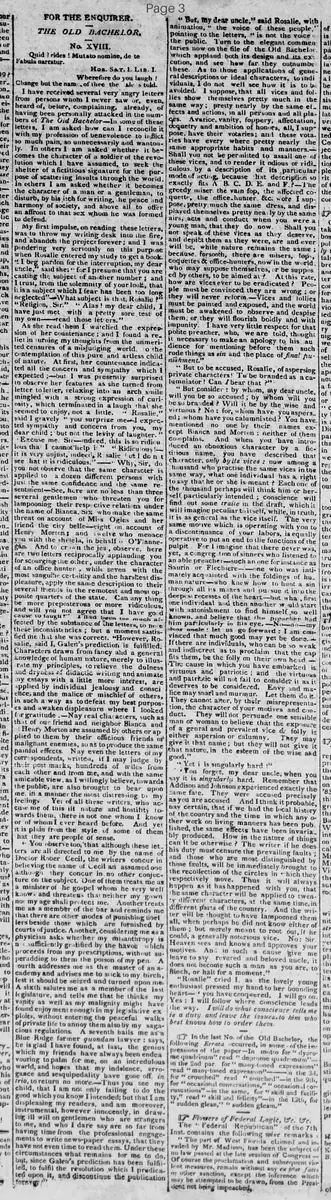
FOR THE ENQUIRER.
THE OLD BACHELOR.
No. XVIII.
Quid? rides! Mutato nomine, de te
Fabula narratur.
Hor. Sat. 1. Lib. I.
Wherefore do you laugh?
Change but the name, of thee the tale's told.
I have received several very angry letters from persons whom I never saw or, even, heard of, before, complaining, already, of having been personally attacked in the numbers of The Old Bachelor—In some of these letters, I am asked how can I reconcile it with my profession of benevolence to inflict so much pain, so unnecessarily and wantonly. In others I am asked whether it becomes the character of a soldier of the revolution which I have assumed, to seek the shelter of a fictitious signature for the purpose of scattering insults through the world. In others I am asked whether it becomes the character of a man or a gentleman, to disturb, by his itch for writing, the peace and harmony of society, and above all to offer an affront to that sex whom he was formed to defend.
My first impulse, on reading these letters, was to throw my writing desk into the fire, and abandon the project forever; and I was pondering very seriously on this purpose when Rosalie entered my study to get a book. "I beg pardon for the interruption, my dear uncle," said she; "for I presume that you are casting the subject of another number; and I trust, from the solemnity of your look, that it is a subject which I fear has been too long neglected." What subject is that, Rosalie? "Religion, Sir." "Alas! my dear child, I have just met with a pretty sore test of my own—read those letters."
As she read them I watched the expression of her countenance; and I found a relief in turning my thoughts from the unmerited censures of a misjudging world, to the contemplation of this pure and artless child of nature. At first, her countenance indicated all the concern and sympathy, which I expected; but I was presently surprised to observe her features as she turned from letter to letter, relaxing into an arch smile mingled with a strong expression of curiosity, which terminated in a laugh that she seemed to enjoy, not a little. "Rosalie," said I gravely "you surprize me—I expected sympathy and concern from you, my dear child; but not the levity of laughter." "Excuse me, Sir—indeed, this is so ridiculous that I cannot help it." "Ridiculous!—it is very unjust, indeed, Rosalie; but I do not see what it is ridiculous." "Why, Sir, do you not observe that the same character is applied to a dozen different persons with just the same confidence and the same resentment—See, here are no less than three several gentlemen who threaten you for lampooning their respective relations under the name of Bianca. Six who make the same threat on account of Miss Ogles and her friend the city belles—eight on account of Henry Morton! and twelve who menace you with the shelela, in behalf of O'Flannigan. And to crown the jest, observe, here are two letters reciprocally applauding you for scourging the other, under the character of an office hunter, while seven with the most sanguine certainty and the harshest displeasure, apply the same description to their several friends in the remotest and most opposite quarters of the state. Can any thing be more preposterous or more ridiculous, and will you not agree that I have good cause to laugh?"
I had been too much affected by the substance of the letters, to notice these inconsistencies; but a moment's reflection satisfied me that she was correct. "However, Rosalie, said I, Galen's prediction is fulfilled. Characters drawn from fancy and a general knowledge of human nature, merely to illustrate my principles, to relieve the dullness and dryness of didactic writing and animate my essays with a little more interest, are applied by individual jealousy and conscience, and the malice or mischief of others, in such a way as to defeat my best purposes and awaken displeasure where I looked for gratitude.—Nay real characters, such as that of our friend and neighbor Bianca and Henry Morton are assumed by others or applied to them by their officious friends or malignant enemies, so as to produce the same painful effects. Nay even the letters of my correspondents, written, if I may judge by their post marks, hundreds of miles from each other and from me, and with the same amicable view, as I willingly believe, towards the public, are also brought to bear upon me, in a manner the most distressing to my feelings. Yet of all these writers, who accuse me of this ill nature and hostility towards them, there is not one whom I know or of whom I ever heard before. And yet it is plain from the style of some of them that they are people of sense.
You observe too, that although these letters are all directed to me by the name of Doctor Robert Cecil, the writers concur in believing the name of Cecil an assumed one although they concur in no other conjecture on the subject. One of them treats me as a minister of the gospel whom he very well knows, and threatens that neither my gown nor my age shall protect me. Another treats me as a member of the bar and reminds me that there are other modes of punishing libellers beside those which are furnished by courts of justice. Another, considering me as a physician asks whether my misanthropy is not sufficiently gratified by the havoc which proceeds from my prescriptions, without superadding to them the poison of my pen. A fourth addresses me as the master of an academy and advises me to stick to my birch, lest it should be seized and turned upon me. A fifth salutes me as a member of the last legislature, and tells me that he thinks my vanity as well as my malignity might have found enjoyment enough in my legislative exploits, without entering the peaceful walks of private life to annoy them also by my sagacious regulations. A sixth hails me as a Blue Ridge farmer quondam lawyer: says, he is glad I have found, at last, the genius which my friends have always been endeavoring to palm for me, on an incredulous world, and hopes that my indolence, arrogance and sesquipedality have gone off, in trio, to return no more.—Thus you see my child, that I am not only failing to do the good which you know I intended; but that I am displeasing my readers, and am moreover, instrumental, however innocently, in drawing ill will on gentlemen who are strangers to me, and who I dare say are so far from having time from the professional engagements to write news-paper essays, that they have not even time to read them. Under these circumstances what remains for me to do, but, since Galen's prediction has been fulfilled, to fulfil the resolution which I predicated upon it, and discontinue the publication forever?"
"But, my dear uncle," said Rosalie, with animation, "the voice of these people," pointing to the letters, "is not the voice of the public. Turn to the elegant commentaries now on the file of the Old Bachelor, which applaud both its design and its execution, and see how far they outnumber these. As to those applications of general descriptions or ideal characters, to individuals, I do not well see how it is to be avoided. I suppose, that all vices and follies show themselves pretty much in the same way; pretty nearly by the same effects and actions, in all persons and all places. Avarice, vanity, foppery, affectation, coquetry and ambition of honors, all, I suppose, have their votaries; and these votaries have every where pretty nearly the same appropriate habits and manners.—Shall you not be permitted to assail one of these vices, and to render it odious or ridiculous, by a description of its particular mode of acting, because that description shall exactly fit A B. C. D. E. and F.?—The greedy miser, the vain fop, the affected coquette, the office-hunter, &c. wore I suppose, pretty much the same dress, and displayed themselves pretty nearly by the same airs, acts and conduct when you were a young man, that they do now. Shall you not speak of these vices as they deserve, and depict them as they were, are and ever will be, while nature remains the same; because, forsooth, there are misers, fops, coquettes & office-hunters, now in the world, who may suppose themselves, or be supposed by others, to be aimed at?. At this rate, how are vices ever to be eradicated? People must be convinced they are wrong: or they will never reform.—Vices and follies must be painted and exposed, and the world must be awakened to observe and despise them, or they will flourish boldly and with impunity. I have very little respect for that polite preacher, who, we are told, thought it necessary to make an apology to his audience for mentioning before them such rude things as sin and the place of final punishment.
"But to be accused, Rosalie, of aspersing private characters! To be branded as calumniator! Can I bear that?" "But consider: by whom, my dear uncle, will you be so accused; by whom will you be so branded? Will it be by the wise and virtuous? No: for, whom have you aspersed; whom have you calumniated? You have mentioned no one by their names except Bianca and Morton: neither of them complains. And when you have introduced an obnoxious character by a fictitious name, you have described that character, only by its vices: now among a thousand who practise the same vices in the same way, what one individual has a right to say that he or she is meant? Each one of the thousand perhaps will think him or herself particularly intended; conscience will find out some trait in the draft, which it will imagine peculiar to itself, while, in truth, it is as general as the vice itself. The very same motive which is operating with you to a discontinuance of your labors, is equally operative to put an end to the functions of the pulpit. For I imagine that there never was, yet, a congregation of sinners who listened to an able preacher—such an one for instance as Saurin or Flechier—one who was intimately acquainted with the foldings of human nature—who knew how to hunt a sin through all its mazes and pursue it into the deepest recesses of the heart—but what, first one individual and then another would start with astonishment to find himself so well known, and believe that the preacher had him particularly in his eye.—No—no—my dear uncle: let us go forward: I am convinced that much good may yet be done. If there are individuals, who can be so weak and indiscreet as to proclaim that the cap fits them, be the folly on their own head. The cause in which you have embarked is virtuous and patriotic; and the virtuous and patriotic will not fail to consider it as it deserves to be considered. Envy and malice may snarl and murmur. Let them do it. They cannot alter, by their misrepresentation, the character of your motives and conduct. They will not persuade one sensible man or woman to believe that the exposure of a general and prevalent vice or folly is either aspersion or calumny. They may give it that name; but they will not give it that nature, in the esteem of the wise and good."
"Yet it is singularly hard!" "You forget, my dear uncle; when you say it is singularly hard. Remember that Addison and Johnson experienced exactly the same fate. They were accused precisely as you are accused. And I think it probable, nay certain, that if we had the local history of the country and the time in which any other work on living manners has been published, the same effects have been invariably produced. How in the nature of things can it be otherwise? The writer if he does his duty must censure the prevailing faults; and those who are most distinguished by those faults, will be immediately brought to the recollection of the circles in which they respectively move. Thus it will always happen as it has happened with you, that the same character will be applied to twenty different characters, at the same time, in different parts of the country. And the writer will be thought to have lampooned them all, when perhaps he did not know either of them; but merely meant to root out, if he could, a generally notorious vice. No: Sir Heaven sees and knows and approves your motives. And in such a cause give me leave to say, revered and beloved uncle, it does not become such a man as you are, to flinch, or halt for a moment."
"Rosalie" cried I, as the lovely young enthusiast pressed my hand to her bounding heart—"you have conquered. I will go on. Yes: I will follow where Conscience leads the way. I will do what conscience tells me is a duty and leave the issues to him who best knows how to order them."
In the last No. of the Old Bachelor, the following Errata occurred, in some of the impressions of the paper—In motto for "deprome quadrinum" read "deprome quadratum"—in the 2nd par. for "many-toned expressions" read "many-toned expression"—in the 3d. for "crouched" read "couched"—in the 9th, for "occasional conversations," "occasional conversations"—in the same, for "skill and facility," read "skill and felicity"—in the 13th, for "sudden glean," "sudden gleam."
THE OLD BACHELOR.
No. XVIII.
Quid? rides! Mutato nomine, de te
Fabula narratur.
Hor. Sat. 1. Lib. I.
Wherefore do you laugh?
Change but the name, of thee the tale's told.
I have received several very angry letters from persons whom I never saw or, even, heard of, before, complaining, already, of having been personally attacked in the numbers of The Old Bachelor—In some of these letters, I am asked how can I reconcile it with my profession of benevolence to inflict so much pain, so unnecessarily and wantonly. In others I am asked whether it becomes the character of a soldier of the revolution which I have assumed, to seek the shelter of a fictitious signature for the purpose of scattering insults through the world. In others I am asked whether it becomes the character of a man or a gentleman, to disturb, by his itch for writing, the peace and harmony of society, and above all to offer an affront to that sex whom he was formed to defend.
My first impulse, on reading these letters, was to throw my writing desk into the fire, and abandon the project forever; and I was pondering very seriously on this purpose when Rosalie entered my study to get a book. "I beg pardon for the interruption, my dear uncle," said she; "for I presume that you are casting the subject of another number; and I trust, from the solemnity of your look, that it is a subject which I fear has been too long neglected." What subject is that, Rosalie? "Religion, Sir." "Alas! my dear child, I have just met with a pretty sore test of my own—read those letters."
As she read them I watched the expression of her countenance; and I found a relief in turning my thoughts from the unmerited censures of a misjudging world, to the contemplation of this pure and artless child of nature. At first, her countenance indicated all the concern and sympathy, which I expected; but I was presently surprised to observe her features as she turned from letter to letter, relaxing into an arch smile mingled with a strong expression of curiosity, which terminated in a laugh that she seemed to enjoy, not a little. "Rosalie," said I gravely "you surprize me—I expected sympathy and concern from you, my dear child; but not the levity of laughter." "Excuse me, Sir—indeed, this is so ridiculous that I cannot help it." "Ridiculous!—it is very unjust, indeed, Rosalie; but I do not see what it is ridiculous." "Why, Sir, do you not observe that the same character is applied to a dozen different persons with just the same confidence and the same resentment—See, here are no less than three several gentlemen who threaten you for lampooning their respective relations under the name of Bianca. Six who make the same threat on account of Miss Ogles and her friend the city belles—eight on account of Henry Morton! and twelve who menace you with the shelela, in behalf of O'Flannigan. And to crown the jest, observe, here are two letters reciprocally applauding you for scourging the other, under the character of an office hunter, while seven with the most sanguine certainty and the harshest displeasure, apply the same description to their several friends in the remotest and most opposite quarters of the state. Can any thing be more preposterous or more ridiculous, and will you not agree that I have good cause to laugh?"
I had been too much affected by the substance of the letters, to notice these inconsistencies; but a moment's reflection satisfied me that she was correct. "However, Rosalie, said I, Galen's prediction is fulfilled. Characters drawn from fancy and a general knowledge of human nature, merely to illustrate my principles, to relieve the dullness and dryness of didactic writing and animate my essays with a little more interest, are applied by individual jealousy and conscience, and the malice or mischief of others, in such a way as to defeat my best purposes and awaken displeasure where I looked for gratitude.—Nay real characters, such as that of our friend and neighbor Bianca and Henry Morton are assumed by others or applied to them by their officious friends or malignant enemies, so as to produce the same painful effects. Nay even the letters of my correspondents, written, if I may judge by their post marks, hundreds of miles from each other and from me, and with the same amicable view, as I willingly believe, towards the public, are also brought to bear upon me, in a manner the most distressing to my feelings. Yet of all these writers, who accuse me of this ill nature and hostility towards them, there is not one whom I know or of whom I ever heard before. And yet it is plain from the style of some of them that they are people of sense.
You observe too, that although these letters are all directed to me by the name of Doctor Robert Cecil, the writers concur in believing the name of Cecil an assumed one although they concur in no other conjecture on the subject. One of them treats me as a minister of the gospel whom he very well knows, and threatens that neither my gown nor my age shall protect me. Another treats me as a member of the bar and reminds me that there are other modes of punishing libellers beside those which are furnished by courts of justice. Another, considering me as a physician asks whether my misanthropy is not sufficiently gratified by the havoc which proceeds from my prescriptions, without superadding to them the poison of my pen. A fourth addresses me as the master of an academy and advises me to stick to my birch, lest it should be seized and turned upon me. A fifth salutes me as a member of the last legislature, and tells me that he thinks my vanity as well as my malignity might have found enjoyment enough in my legislative exploits, without entering the peaceful walks of private life to annoy them also by my sagacious regulations. A sixth hails me as a Blue Ridge farmer quondam lawyer: says, he is glad I have found, at last, the genius which my friends have always been endeavoring to palm for me, on an incredulous world, and hopes that my indolence, arrogance and sesquipedality have gone off, in trio, to return no more.—Thus you see my child, that I am not only failing to do the good which you know I intended; but that I am displeasing my readers, and am moreover, instrumental, however innocently, in drawing ill will on gentlemen who are strangers to me, and who I dare say are so far from having time from the professional engagements to write news-paper essays, that they have not even time to read them. Under these circumstances what remains for me to do, but, since Galen's prediction has been fulfilled, to fulfil the resolution which I predicated upon it, and discontinue the publication forever?"
"But, my dear uncle," said Rosalie, with animation, "the voice of these people," pointing to the letters, "is not the voice of the public. Turn to the elegant commentaries now on the file of the Old Bachelor, which applaud both its design and its execution, and see how far they outnumber these. As to those applications of general descriptions or ideal characters, to individuals, I do not well see how it is to be avoided. I suppose, that all vices and follies show themselves pretty much in the same way; pretty nearly by the same effects and actions, in all persons and all places. Avarice, vanity, foppery, affectation, coquetry and ambition of honors, all, I suppose, have their votaries; and these votaries have every where pretty nearly the same appropriate habits and manners.—Shall you not be permitted to assail one of these vices, and to render it odious or ridiculous, by a description of its particular mode of acting, because that description shall exactly fit A B. C. D. E. and F.?—The greedy miser, the vain fop, the affected coquette, the office-hunter, &c. wore I suppose, pretty much the same dress, and displayed themselves pretty nearly by the same airs, acts and conduct when you were a young man, that they do now. Shall you not speak of these vices as they deserve, and depict them as they were, are and ever will be, while nature remains the same; because, forsooth, there are misers, fops, coquettes & office-hunters, now in the world, who may suppose themselves, or be supposed by others, to be aimed at?. At this rate, how are vices ever to be eradicated? People must be convinced they are wrong: or they will never reform.—Vices and follies must be painted and exposed, and the world must be awakened to observe and despise them, or they will flourish boldly and with impunity. I have very little respect for that polite preacher, who, we are told, thought it necessary to make an apology to his audience for mentioning before them such rude things as sin and the place of final punishment.
"But to be accused, Rosalie, of aspersing private characters! To be branded as calumniator! Can I bear that?" "But consider: by whom, my dear uncle, will you be so accused; by whom will you be so branded? Will it be by the wise and virtuous? No: for, whom have you aspersed; whom have you calumniated? You have mentioned no one by their names except Bianca and Morton: neither of them complains. And when you have introduced an obnoxious character by a fictitious name, you have described that character, only by its vices: now among a thousand who practise the same vices in the same way, what one individual has a right to say that he or she is meant? Each one of the thousand perhaps will think him or herself particularly intended; conscience will find out some trait in the draft, which it will imagine peculiar to itself, while, in truth, it is as general as the vice itself. The very same motive which is operating with you to a discontinuance of your labors, is equally operative to put an end to the functions of the pulpit. For I imagine that there never was, yet, a congregation of sinners who listened to an able preacher—such an one for instance as Saurin or Flechier—one who was intimately acquainted with the foldings of human nature—who knew how to hunt a sin through all its mazes and pursue it into the deepest recesses of the heart—but what, first one individual and then another would start with astonishment to find himself so well known, and believe that the preacher had him particularly in his eye.—No—no—my dear uncle: let us go forward: I am convinced that much good may yet be done. If there are individuals, who can be so weak and indiscreet as to proclaim that the cap fits them, be the folly on their own head. The cause in which you have embarked is virtuous and patriotic; and the virtuous and patriotic will not fail to consider it as it deserves to be considered. Envy and malice may snarl and murmur. Let them do it. They cannot alter, by their misrepresentation, the character of your motives and conduct. They will not persuade one sensible man or woman to believe that the exposure of a general and prevalent vice or folly is either aspersion or calumny. They may give it that name; but they will not give it that nature, in the esteem of the wise and good."
"Yet it is singularly hard!" "You forget, my dear uncle; when you say it is singularly hard. Remember that Addison and Johnson experienced exactly the same fate. They were accused precisely as you are accused. And I think it probable, nay certain, that if we had the local history of the country and the time in which any other work on living manners has been published, the same effects have been invariably produced. How in the nature of things can it be otherwise? The writer if he does his duty must censure the prevailing faults; and those who are most distinguished by those faults, will be immediately brought to the recollection of the circles in which they respectively move. Thus it will always happen as it has happened with you, that the same character will be applied to twenty different characters, at the same time, in different parts of the country. And the writer will be thought to have lampooned them all, when perhaps he did not know either of them; but merely meant to root out, if he could, a generally notorious vice. No: Sir Heaven sees and knows and approves your motives. And in such a cause give me leave to say, revered and beloved uncle, it does not become such a man as you are, to flinch, or halt for a moment."
"Rosalie" cried I, as the lovely young enthusiast pressed my hand to her bounding heart—"you have conquered. I will go on. Yes: I will follow where Conscience leads the way. I will do what conscience tells me is a duty and leave the issues to him who best knows how to order them."
In the last No. of the Old Bachelor, the following Errata occurred, in some of the impressions of the paper—In motto for "deprome quadrinum" read "deprome quadratum"—in the 2nd par. for "many-toned expressions" read "many-toned expression"—in the 3d. for "crouched" read "couched"—in the 9th, for "occasional conversations," "occasional conversations"—in the same, for "skill and facility," read "skill and felicity"—in the 13th, for "sudden glean," "sudden gleam."
What sub-type of article is it?
Essay
Dialogue
Satire
What themes does it cover?
Moral Virtue
Social Manners
Political
What keywords are associated?
Satirical Essays
Moral Reform
Personal Attacks
Vice Exposure
Reader Complaints
Didactic Dialogue
Literary Defense
What entities or persons were involved?
Doctor Robert Cecil
Literary Details
Title
The Old Bachelor. No. Xviii.
Author
Doctor Robert Cecil
Subject
Response To Angry Letters Accusing Personal Attacks In Previous Essays
Form / Style
Didactic Essay In Dialogue Form Defending Satirical Moral Instruction
Key Lines
Quid? Rides! Mutato Nomine, De Te Fabula Narratur.
Characters Drawn From Fancy And A General Knowledge Of Human Nature, Merely To Illustrate My Principles... Are Applied By Individual Jealousy And Conscience...
Vices And Follies Must Be Painted And Exposed, And The World Must Be Awakened To Observe And Despise Them, Or They Will Flourish Boldly And With Impunity.
Remember That Addison And Johnson Experienced Exactly The Same Fate.
I Will Follow Where Conscience Leads The Way.