Thank you for visiting SNEWPapers!
Sign up free
Letter to Editor
August 26, 1856
Mineral Point Tribune
Mineral Point, Iowa County, Wisconsin
What is this article about?
A letter from 'Shanghai' to the editor quotes Daniel Webster's 1848 Senate speech opposing slavery's extension into new territories like Oregon, arguing against carrying slave laws there and supporting free labor. Promises future quotes from Clay and Pierce to counter 'Old Line Whig.'
Clipping
OCR Quality
95%
Excellent
Full Text
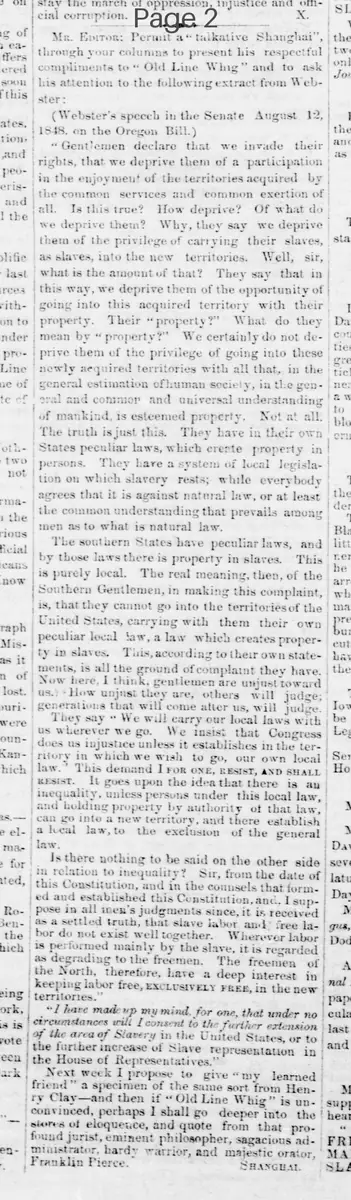
Mr. Editor: Permit a "talkative Shanghai" through your columns to present his respectful compliments to "Old Line Whig" and to ask his attention to the following extract from Webster:
(Webster's speech in the Senate August 12, 1848, on the Oregon Bill.)
"Gentlemen declare that we invade their rights, that we deprive them of a participation in the enjoyment of the territories acquired by the common services and common exertion of all. Is this true? How deprive? Of what do we deprive them? Why, they say we deprive them of the privilege of carrying their slaves, as slaves, into the new territories. Well, sir, what is the amount of that? They say that in this way, we deprive them of the opportunity of going into this acquired territory with their property. Their "property?" What do they mean by "property?" We certainly do not deprive them of the privilege of going into these newly acquired territories with all that, in the general estimation of human society, in the general and common and universal understanding of mankind, is esteemed property. Not at all. The truth is just this. They have in their own States peculiar laws, which create property in persons. They have a system of local legislation on which slavery rests; while everybody agrees that it is against natural law, or at least the common understanding that prevails among men as to what is natural law.
The southern States have peculiar laws, and by those laws there is property in slaves. This is purely local. The real meaning, then, of the Southern Gentlemen, in making this complaint, is, that they cannot go into the territories of the United States, carrying with them their own peculiar local law, a law which creates property in slaves. This, according to their own statements, is all the ground of complaint they have. Now here, I think, gentlemen are unjust toward us. How unjust they are, others will judge, generations that will come after us, will judge. They say "We will carry our local laws with us wherever we go. We insist that Congress does us injustice unless it establishes in the territory in which we wish to go, our own local law." This demand I FOR ONE, RESIST, AND SHALL RESIST. It goes upon the idea that there is an inequality, unless persons under this local law, and holding property by authority of that law, can go into a new territory, and there establish a local law, to the exclusion of the general law.
Is there nothing to be said on the other side in relation to inequality? Sir, from the date of this Constitution, and in the counsels that formed and established this Constitution, and, I suppose in all men's judgments since, it is received as a settled truth, that slave labor and free labor do not exist well together. Wherever labor is performed mainly by the slave, it is regarded as degrading to the freeman. The freemen of the North, therefore, have a deep interest in keeping labor free, EXCLUSIVELY FREE, in the new territories.
"I have made up my mind, for one, that under no circumstances will I consent to the further extension of the area of Slavery in the United States, or to the further increase of Slave representation in the House of Representatives.
Next week I propose to give "my learned friend" a specimen of the same sort from Henry Clay—and then if "Old Line Whig" is unconvinced, perhaps I shall go deeper into the stores of eloquence, and quote from that profound jurist, eminent philosopher, sagacious administrator, hardy warrior, and majestic orator, Franklin Pierce.
SHANGHAI.
(Webster's speech in the Senate August 12, 1848, on the Oregon Bill.)
"Gentlemen declare that we invade their rights, that we deprive them of a participation in the enjoyment of the territories acquired by the common services and common exertion of all. Is this true? How deprive? Of what do we deprive them? Why, they say we deprive them of the privilege of carrying their slaves, as slaves, into the new territories. Well, sir, what is the amount of that? They say that in this way, we deprive them of the opportunity of going into this acquired territory with their property. Their "property?" What do they mean by "property?" We certainly do not deprive them of the privilege of going into these newly acquired territories with all that, in the general estimation of human society, in the general and common and universal understanding of mankind, is esteemed property. Not at all. The truth is just this. They have in their own States peculiar laws, which create property in persons. They have a system of local legislation on which slavery rests; while everybody agrees that it is against natural law, or at least the common understanding that prevails among men as to what is natural law.
The southern States have peculiar laws, and by those laws there is property in slaves. This is purely local. The real meaning, then, of the Southern Gentlemen, in making this complaint, is, that they cannot go into the territories of the United States, carrying with them their own peculiar local law, a law which creates property in slaves. This, according to their own statements, is all the ground of complaint they have. Now here, I think, gentlemen are unjust toward us. How unjust they are, others will judge, generations that will come after us, will judge. They say "We will carry our local laws with us wherever we go. We insist that Congress does us injustice unless it establishes in the territory in which we wish to go, our own local law." This demand I FOR ONE, RESIST, AND SHALL RESIST. It goes upon the idea that there is an inequality, unless persons under this local law, and holding property by authority of that law, can go into a new territory, and there establish a local law, to the exclusion of the general law.
Is there nothing to be said on the other side in relation to inequality? Sir, from the date of this Constitution, and in the counsels that formed and established this Constitution, and, I suppose in all men's judgments since, it is received as a settled truth, that slave labor and free labor do not exist well together. Wherever labor is performed mainly by the slave, it is regarded as degrading to the freeman. The freemen of the North, therefore, have a deep interest in keeping labor free, EXCLUSIVELY FREE, in the new territories.
"I have made up my mind, for one, that under no circumstances will I consent to the further extension of the area of Slavery in the United States, or to the further increase of Slave representation in the House of Representatives.
Next week I propose to give "my learned friend" a specimen of the same sort from Henry Clay—and then if "Old Line Whig" is unconvinced, perhaps I shall go deeper into the stores of eloquence, and quote from that profound jurist, eminent philosopher, sagacious administrator, hardy warrior, and majestic orator, Franklin Pierce.
SHANGHAI.
What sub-type of article is it?
Persuasive
Political
Historical
What themes does it cover?
Slavery Abolition
Politics
Constitutional Rights
What keywords are associated?
Slavery Extension
Oregon Bill
Daniel Webster
Free Labor
Territorial Rights
Slave Property
Constitutional Inequality
What entities or persons were involved?
Shanghai
Mr. Editor
Letter to Editor Details
Author
Shanghai
Recipient
Mr. Editor
Main Argument
the writer opposes the extension of slavery into new u.s. territories, quoting webster's 1848 speech to argue that southern states cannot impose their local slave laws there, emphasizing the incompatibility of slave and free labor and the need to keep territories free.
Notable Details
Quotes Webster's Senate Speech On Oregon Bill From August 12, 1848
Mentions Future Quotes From Henry Clay And Franklin Pierce
Responds To 'Old Line Whig'