Thank you for visiting SNEWPapers!
Sign up free
Literary
June 6, 1855
Burlington Tri Weekly Hawk Eye
Burlington, Des Moines County, Iowa
What is this article about?
An essay personifying the wind as a busy, purposeful force in nature, contrasting human idleness by describing its roles in dispersing seeds, driving clouds, carrying scents, making music, aiding pollination, and more, ultimately affirming its vital contributions to life and seasons.
Clipping
OCR Quality
95%
Excellent
Full Text
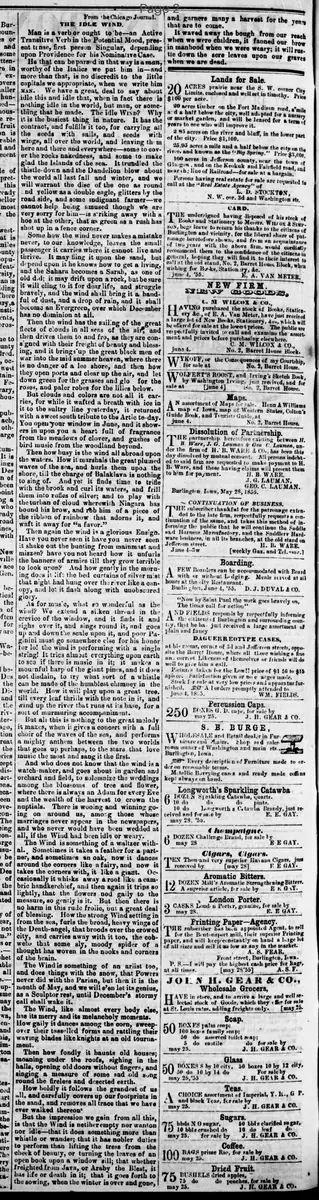
From the Chicago Journal.
THE IDLE WIND.
Man is a verb or ought to be—an Active Transitive Verb in the Potential Mood, present tense, first person Singular, depending upon Providence for his Nominative Case. He that can be parsed in that way is a man, worthy of the Italics we put him in—and more than that, is no discredit to the little capitals we appropriate, when we write him MaN. We have a great deal to say about idle this and idle that, when in fact there is nothing idle in the world, but man, or something that he made. The idle Wind? Why it is the busiest thing in nature. It has the contract, and fulfills it too, for carrying all the seeds with sails, and seeds with wings, all over the world, and leaving them here and there and everywhere—some to cover the rocks nakedness, and some to make glad the Islands of the sea. It trundled the thistle-down and the Dandelion blow about the world all last fall and winter, and we will warrant the disc of the one as round and yellow as a double eagle, glitters by the road side, and some indignant farmer—we cannot help being amused though we are very sorry for him—is striking away with a hoe at the other, that as green as a rush has shot up in a fence corner.
Some how the wind never makes a mistake never, to our knowledge, leaves the small passenger it carries where it cannot live and thrive. It may fling it upon the sand, but depend upon it he knows how to get a living, and the Sahara becomes a Sarah, as one of old did; it may drift upon a rock, but be sure it will cling to it for dear life, and struggle bravely, and the wind shall bring it a handful of dust, and a drop of rain, and it shall become an Evergreen, over which December has no dominion at all.
Then the wind has the sailing of the great fleets of clouds in all seas of the air and then drives them to and fro, as they are consigned with their freight of beauty and blessing, and it brings up the great black men of war into the mid summer heaven, where there is no danger of a lee shore, and then how they open ports and clear up the air, and let down green for the grasses and gold for the roses, and paler robes for the lilies below.
But clouds and colors are not all it carries, for while it wafted a breath with ice in it to the sultry line yesterday, it returned with a sweet south tribute to the Arctic to-day. You open your window in June, and it showers in upon you a heart full of fragrance from the meadows of clover, and gushes of bird music from the woodland beyond.
Then how busy is the wind all abroad upon the waters. How it marshals the great plumed waves of the sea, and hurls them upon the shore, till the charge of Balaklava is nothing to sing of. And yet it finds time to trifle with the brook and curl its waters, and frill them into ruffles of silver; and to play with the turban of cloud wherewith Niagara has bound his brow, and rob him of a piece of the ribbon of rainbow that adorns it, and waft it away for "a favor."
Then again the wind is a glorious Ensign. Have you never seen it have you never seen it shake out the bunting from mainmast and mizzen? have you not heard how it unfurls the banners of armies till they grow terrible to look upon? And how gently in the morning does it lift the bed curtains of silver mist that night had hung over the river like a canopy, and let it flash along with unobscured glory.
As for music, what so wonderful as the wind? We extend a silken thread in the crevice of the window, and it finds it and sighs over it, and sings round it, and goes up and down the scale upon it, and poor Paganini must go somewhere else for his honor for lo! the wind is performing with a single string! It tries almost everything upon earth to see if there is music in it; it makes a mournful harp of the giant pines, and it does not disdain, to try what sort of a whistle can be made of the humblest chimney in the world. How it will play upon a great tree, till every leaf thrills with the note in it, and wind up the river that runs at its base, for a sort of murmuring accompaniment.
But all this is nothing to the great melody it makes, when it gives a concert with a full choir of the waves of the sea, and performs a mighty anthem between the two worlds that goes up perhaps, to the stars that love music the most and sang it the first.
And who does not know that the wind is a watch-maker, and goes about in garden and orchard and field, to solemnize the weddings among the blossoms of tree and flower, where there is always an Adam for every Eve and the wealth of the harvest to crown the nuptials. There is wooing and winning going on around us, among those whose marriages never appear in the newspapers, and who never would have been wedded at all, if the Wind had been idle or weary.
The Wind is something of a waltzer withal. Sometimes it takes a feather for a partner, and sometimes an oak, now it dances around the corners like a fairy, and now it takes the corners with, it like a giant. Occasionally it whisks away a roof like a cambric handkerchief, and then again it trips so lightly, that the flowers nod gaily to the measure, so gently is it. But then there is no harm in this rude frolic, but a great deal of blessing. How the strong Wind setting in from the sea, furls the broad, heavy wings of the Death-angel, that broods over the crowded city, and carries away with it too, the cobwebs that some sly, moody spider of a thought has woven in the nooks and corners of the brain.
The Wind is something of an artist too, and does things with the snow, that Powers never did with the Parian, but then it is the month of May, and we will e'en let its genius, as a Sculptor rest, until December's stormy call shall wake it.
The Wind, like almost every body else, has its merry and its melancholy moments. How gaily it dances among the corn, sweeping over their tasseled forms and rattling their waving blades like knights at an old tournament.
Then how fondly it haunts old houses; moaning under the roofs, sighing in the halls, opening old doors without fingers, and singing a measure of some sad old song round the fireless and deserted hearth.
How boldly it follows the grandest of us all, and carefully covers up our footprints in the sand, and removes all trace that we have ever walked thereon.
But the impression we gain from all this, is that the Wind is neither empty nor wanton nor idle—that it does something more than whistle or wander; that it has nobler duties to perform than lifting the tress from the cheek of beauty, or turning the leaves of an open book upon a window sill; that whether freighted from Java, or Araby the Blest, it has life or death in it; that it goes forth to the sowing, when the winter is over and gone, and garners many a harvest for the years that are to come.
It waved away the bough from our reach when we were children, it fanned our brow in manhood when we were weary; it will rustle down the sere leaves upon our graves when we are dead.
THE IDLE WIND.
Man is a verb or ought to be—an Active Transitive Verb in the Potential Mood, present tense, first person Singular, depending upon Providence for his Nominative Case. He that can be parsed in that way is a man, worthy of the Italics we put him in—and more than that, is no discredit to the little capitals we appropriate, when we write him MaN. We have a great deal to say about idle this and idle that, when in fact there is nothing idle in the world, but man, or something that he made. The idle Wind? Why it is the busiest thing in nature. It has the contract, and fulfills it too, for carrying all the seeds with sails, and seeds with wings, all over the world, and leaving them here and there and everywhere—some to cover the rocks nakedness, and some to make glad the Islands of the sea. It trundled the thistle-down and the Dandelion blow about the world all last fall and winter, and we will warrant the disc of the one as round and yellow as a double eagle, glitters by the road side, and some indignant farmer—we cannot help being amused though we are very sorry for him—is striking away with a hoe at the other, that as green as a rush has shot up in a fence corner.
Some how the wind never makes a mistake never, to our knowledge, leaves the small passenger it carries where it cannot live and thrive. It may fling it upon the sand, but depend upon it he knows how to get a living, and the Sahara becomes a Sarah, as one of old did; it may drift upon a rock, but be sure it will cling to it for dear life, and struggle bravely, and the wind shall bring it a handful of dust, and a drop of rain, and it shall become an Evergreen, over which December has no dominion at all.
Then the wind has the sailing of the great fleets of clouds in all seas of the air and then drives them to and fro, as they are consigned with their freight of beauty and blessing, and it brings up the great black men of war into the mid summer heaven, where there is no danger of a lee shore, and then how they open ports and clear up the air, and let down green for the grasses and gold for the roses, and paler robes for the lilies below.
But clouds and colors are not all it carries, for while it wafted a breath with ice in it to the sultry line yesterday, it returned with a sweet south tribute to the Arctic to-day. You open your window in June, and it showers in upon you a heart full of fragrance from the meadows of clover, and gushes of bird music from the woodland beyond.
Then how busy is the wind all abroad upon the waters. How it marshals the great plumed waves of the sea, and hurls them upon the shore, till the charge of Balaklava is nothing to sing of. And yet it finds time to trifle with the brook and curl its waters, and frill them into ruffles of silver; and to play with the turban of cloud wherewith Niagara has bound his brow, and rob him of a piece of the ribbon of rainbow that adorns it, and waft it away for "a favor."
Then again the wind is a glorious Ensign. Have you never seen it have you never seen it shake out the bunting from mainmast and mizzen? have you not heard how it unfurls the banners of armies till they grow terrible to look upon? And how gently in the morning does it lift the bed curtains of silver mist that night had hung over the river like a canopy, and let it flash along with unobscured glory.
As for music, what so wonderful as the wind? We extend a silken thread in the crevice of the window, and it finds it and sighs over it, and sings round it, and goes up and down the scale upon it, and poor Paganini must go somewhere else for his honor for lo! the wind is performing with a single string! It tries almost everything upon earth to see if there is music in it; it makes a mournful harp of the giant pines, and it does not disdain, to try what sort of a whistle can be made of the humblest chimney in the world. How it will play upon a great tree, till every leaf thrills with the note in it, and wind up the river that runs at its base, for a sort of murmuring accompaniment.
But all this is nothing to the great melody it makes, when it gives a concert with a full choir of the waves of the sea, and performs a mighty anthem between the two worlds that goes up perhaps, to the stars that love music the most and sang it the first.
And who does not know that the wind is a watch-maker, and goes about in garden and orchard and field, to solemnize the weddings among the blossoms of tree and flower, where there is always an Adam for every Eve and the wealth of the harvest to crown the nuptials. There is wooing and winning going on around us, among those whose marriages never appear in the newspapers, and who never would have been wedded at all, if the Wind had been idle or weary.
The Wind is something of a waltzer withal. Sometimes it takes a feather for a partner, and sometimes an oak, now it dances around the corners like a fairy, and now it takes the corners with, it like a giant. Occasionally it whisks away a roof like a cambric handkerchief, and then again it trips so lightly, that the flowers nod gaily to the measure, so gently is it. But then there is no harm in this rude frolic, but a great deal of blessing. How the strong Wind setting in from the sea, furls the broad, heavy wings of the Death-angel, that broods over the crowded city, and carries away with it too, the cobwebs that some sly, moody spider of a thought has woven in the nooks and corners of the brain.
The Wind is something of an artist too, and does things with the snow, that Powers never did with the Parian, but then it is the month of May, and we will e'en let its genius, as a Sculptor rest, until December's stormy call shall wake it.
The Wind, like almost every body else, has its merry and its melancholy moments. How gaily it dances among the corn, sweeping over their tasseled forms and rattling their waving blades like knights at an old tournament.
Then how fondly it haunts old houses; moaning under the roofs, sighing in the halls, opening old doors without fingers, and singing a measure of some sad old song round the fireless and deserted hearth.
How boldly it follows the grandest of us all, and carefully covers up our footprints in the sand, and removes all trace that we have ever walked thereon.
But the impression we gain from all this, is that the Wind is neither empty nor wanton nor idle—that it does something more than whistle or wander; that it has nobler duties to perform than lifting the tress from the cheek of beauty, or turning the leaves of an open book upon a window sill; that whether freighted from Java, or Araby the Blest, it has life or death in it; that it goes forth to the sowing, when the winter is over and gone, and garners many a harvest for the years that are to come.
It waved away the bough from our reach when we were children, it fanned our brow in manhood when we were weary; it will rustle down the sere leaves upon our graves when we are dead.
What sub-type of article is it?
Essay
What themes does it cover?
Nature
Seasonal Cycle
Moral Virtue
What keywords are associated?
Idle Wind
Personification
Nature's Busyness
Wind's Roles
Seasonal Activity
What entities or persons were involved?
From The Chicago Journal
Literary Details
Title
The Idle Wind
Author
From The Chicago Journal
Subject
Reflections On The Purposeful Activity Of The Wind In Nature
Form / Style
Prose Essay With Personification And Metaphorical Descriptions
Key Lines
The Idle Wind? Why It Is The Busiest Thing In Nature.
It Has The Contract, And Fulfills It Too, For Carrying All The Seeds With Sails, And Seeds With Wings, All Over The World...
But The Impression We Gain From All This, Is That The Wind Is Neither Empty Nor Wanton Nor Idle—That It Does Something More Than Whistle Or Wander...