Thank you for visiting SNEWPapers!
Sign up free
Editorial
December 19, 1833
Herald Of The Times
Newport, Newport County, Rhode Island
What is this article about?
The editorial praises William Butler's appointment as U.S. Attorney-General, highlighting his piety and farewell to Albany's Sabbath school. It urges public officials to uphold religious zeal, as their elevated positions amplify moral influence for good or ill. (248 characters)
Clipping
OCR Quality
95%
Excellent
Full Text
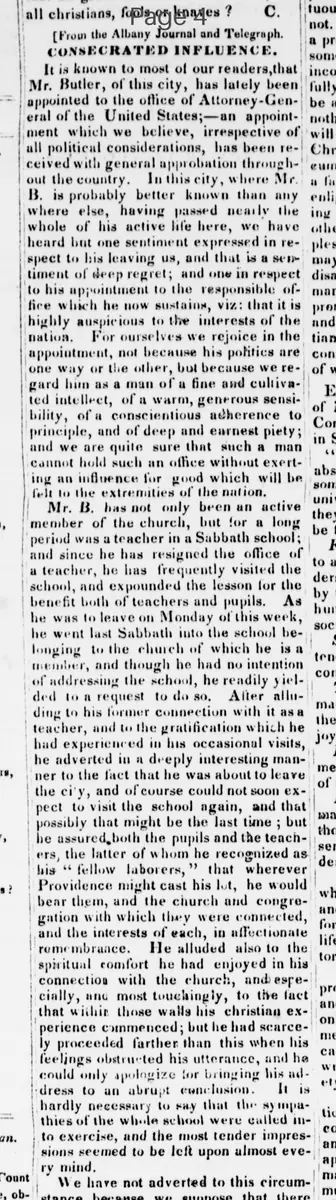
[From the Albany Journal and Telegraph.]
CONSECRATED INFLUENCE.
It is known to most of our readers, that Mr. Butler, of this city, has lately been appointed to the office of Attorney-General of the United States;—an appointment which we believe, irrespective of all political considerations, has been received with general approbation throughout the country.
In this city, where Mr. B. is probably better known than any where else, having passed nearly the whole of his active life here, we have heard but one sentiment expressed in respect to his leaving us, and that is a sentiment of deep regret; and one in respect to his appointment to the responsible office which he now sustains, viz: that it is highly auspicious to the interests of the nation. For ourselves we rejoice in the appointment, not because his politics are one way or the other, but because we regard him as a man of a fine and cultivated intellect, of a warm, generous sensibility, of a conscientious adherence to principle, and of deep and earnest piety; and we are quite sure that such a man cannot hold such an office without exerting an influence for good which will be felt to the extremities of the nation.
Mr. B. has not only been an active member of the church, but for a long period was a teacher in a Sabbath school; and since he has resigned the office of a teacher, he has frequently visited the school, and expounded the lesson for the benefit both of teachers and pupils. As he was to leave on Monday of this week, he went last Sabbath into the school belonging to the church of which he is a member, and though he had no intention of addressing the school, he readily yielded to a request to do so.
After alluding to his former connection with it as a teacher, and to the gratification which he had experienced in his occasional visits, he adverted in a deeply interesting manner to the fact that he was about to leave the city, and of course could not soon expect to visit the school again, and that possibly that might be the last time; but he assured both the pupils and the teachers, the latter of whom he recognized as his "fellow laborers,"
that wherever Providence might cast his lot, he would bear them, and the church and congregation with which they were connected, and the interests of each, in affectionate remembrance. He alluded also to the spiritual comfort he had enjoyed in his connection with the church, and especially, and most touchingly, to the fact that while those walls his christian experience commenced; but he had scarcely proceeded farther than this when his feelings obstructed his utterance, and he could only apologize for bringing his address to an abrupt conclusion. It is hardly necessary to say that the sympathies of the whole school were called into exercise, and the most tender impressions seemed to be left upon almost every mind.
We have not adverted to this circumstance because we suppose that there was any thing in it which may be considered as condescension on the part of Mr. Butler; for we regard the man who instructs, or by his influence encourages a Sabbath school, as performing a truly honorable as well as benevolent office—an office which no doubt attracts the regards of angels, while in the pageantry of earthly distinction they see nothing but vanity or sin; but we have referred to it as a rebuke to many professors of religion in the higher walks of life, and especially in public office, who seem to think that any thing like religious zeal or even consistency is scarcely compatible with the dignity of their station.
Let all such professors know that they are in a wretched mistake in respect to this matter. As the professed disciples of Christ, the very same obligations are resting on them as on the most obscure members of the community; and they cannot disregard these obligations but at the expense of crucifying the Son of God afresh. Let them remember too, that their conduct is referred by the world as well as by their fellow professors to the same standard with that of other Christians, and that just in proportion as they fall short of it, the inconsistency is marked, and the more from the very circumstance of their elevation. Let them bear in mind moreover, that the fact of their occupying a high place in society, gives an additional influence to their example whether for good or evil; that if they shew themselves zealous, and humble, and self-denied, they will accomplish far more for the cause of Christ than they could by the same course if they were in the humbler walks of life; whereas if they appear proud, and worldly-minded, and evince little interest in the cause of truth and piety, the very same circumstance will give to their example a wider and more baneful influence.
We are aware that it is often pleaded by professors in the higher walks of life, and especially those who are high in civil office, that they are sometimes obliged by the necessity of the case to yield, when their own convictions would mark out a different course.
But we do not believe such an apology can be sustained for a moment. In the worst view of the case that can be taken, it comes to this, whether is it better to serve God or man;—better to sacrifice conscience, principle, consistency, and the honor of religion, than the favorable regard of the vain and the worldly.
We say this is the worst of the case; but as a general rule we feel assured that even this latter sacrifice will not be involved in a steady adherence to duty; for such is the Constitution of human nature that men are compelled to respect a consistent and virtuous character, whether they will or not.
That a decided christian course in a professor in an elevated station, may sometimes be attended with temporary inconvenience, we readily admit: but we fully believe that an opposite course will be attended with much greater; to say nothing of the reproach which the latter will constantly bring on the cause of Christ. Let an individual in such circumstances show himself for a little time a faithful adherent to the dictates of an enlightened conscience, incapable of being moved by ridicule, or flattery, or any other influence, from the stern principles of duty, and the difficulties which may at first press upon him, will soon disappear; but let him on the other hand manifest a timid, and yielding, and compromising spirit, in ever so slight a degree, and his comfort and usefulness as a Christian will soon be lost between a goading conscience on the one hand and a spirit of worldliness on the other.
CONSECRATED INFLUENCE.
It is known to most of our readers, that Mr. Butler, of this city, has lately been appointed to the office of Attorney-General of the United States;—an appointment which we believe, irrespective of all political considerations, has been received with general approbation throughout the country.
In this city, where Mr. B. is probably better known than any where else, having passed nearly the whole of his active life here, we have heard but one sentiment expressed in respect to his leaving us, and that is a sentiment of deep regret; and one in respect to his appointment to the responsible office which he now sustains, viz: that it is highly auspicious to the interests of the nation. For ourselves we rejoice in the appointment, not because his politics are one way or the other, but because we regard him as a man of a fine and cultivated intellect, of a warm, generous sensibility, of a conscientious adherence to principle, and of deep and earnest piety; and we are quite sure that such a man cannot hold such an office without exerting an influence for good which will be felt to the extremities of the nation.
Mr. B. has not only been an active member of the church, but for a long period was a teacher in a Sabbath school; and since he has resigned the office of a teacher, he has frequently visited the school, and expounded the lesson for the benefit both of teachers and pupils. As he was to leave on Monday of this week, he went last Sabbath into the school belonging to the church of which he is a member, and though he had no intention of addressing the school, he readily yielded to a request to do so.
After alluding to his former connection with it as a teacher, and to the gratification which he had experienced in his occasional visits, he adverted in a deeply interesting manner to the fact that he was about to leave the city, and of course could not soon expect to visit the school again, and that possibly that might be the last time; but he assured both the pupils and the teachers, the latter of whom he recognized as his "fellow laborers,"
that wherever Providence might cast his lot, he would bear them, and the church and congregation with which they were connected, and the interests of each, in affectionate remembrance. He alluded also to the spiritual comfort he had enjoyed in his connection with the church, and especially, and most touchingly, to the fact that while those walls his christian experience commenced; but he had scarcely proceeded farther than this when his feelings obstructed his utterance, and he could only apologize for bringing his address to an abrupt conclusion. It is hardly necessary to say that the sympathies of the whole school were called into exercise, and the most tender impressions seemed to be left upon almost every mind.
We have not adverted to this circumstance because we suppose that there was any thing in it which may be considered as condescension on the part of Mr. Butler; for we regard the man who instructs, or by his influence encourages a Sabbath school, as performing a truly honorable as well as benevolent office—an office which no doubt attracts the regards of angels, while in the pageantry of earthly distinction they see nothing but vanity or sin; but we have referred to it as a rebuke to many professors of religion in the higher walks of life, and especially in public office, who seem to think that any thing like religious zeal or even consistency is scarcely compatible with the dignity of their station.
Let all such professors know that they are in a wretched mistake in respect to this matter. As the professed disciples of Christ, the very same obligations are resting on them as on the most obscure members of the community; and they cannot disregard these obligations but at the expense of crucifying the Son of God afresh. Let them remember too, that their conduct is referred by the world as well as by their fellow professors to the same standard with that of other Christians, and that just in proportion as they fall short of it, the inconsistency is marked, and the more from the very circumstance of their elevation. Let them bear in mind moreover, that the fact of their occupying a high place in society, gives an additional influence to their example whether for good or evil; that if they shew themselves zealous, and humble, and self-denied, they will accomplish far more for the cause of Christ than they could by the same course if they were in the humbler walks of life; whereas if they appear proud, and worldly-minded, and evince little interest in the cause of truth and piety, the very same circumstance will give to their example a wider and more baneful influence.
We are aware that it is often pleaded by professors in the higher walks of life, and especially those who are high in civil office, that they are sometimes obliged by the necessity of the case to yield, when their own convictions would mark out a different course.
But we do not believe such an apology can be sustained for a moment. In the worst view of the case that can be taken, it comes to this, whether is it better to serve God or man;—better to sacrifice conscience, principle, consistency, and the honor of religion, than the favorable regard of the vain and the worldly.
We say this is the worst of the case; but as a general rule we feel assured that even this latter sacrifice will not be involved in a steady adherence to duty; for such is the Constitution of human nature that men are compelled to respect a consistent and virtuous character, whether they will or not.
That a decided christian course in a professor in an elevated station, may sometimes be attended with temporary inconvenience, we readily admit: but we fully believe that an opposite course will be attended with much greater; to say nothing of the reproach which the latter will constantly bring on the cause of Christ. Let an individual in such circumstances show himself for a little time a faithful adherent to the dictates of an enlightened conscience, incapable of being moved by ridicule, or flattery, or any other influence, from the stern principles of duty, and the difficulties which may at first press upon him, will soon disappear; but let him on the other hand manifest a timid, and yielding, and compromising spirit, in ever so slight a degree, and his comfort and usefulness as a Christian will soon be lost between a goading conscience on the one hand and a spirit of worldliness on the other.
What sub-type of article is it?
Moral Or Religious
What keywords are associated?
Religious Piety
Public Office
Sabbath School
Christian Consistency
Moral Influence
Church Involvement
Attorney General Appointment
What entities or persons were involved?
Mr. Butler
Attorney General Of The United States
Sabbath School
Church
Editorial Details
Primary Topic
Religious Influence And Consistency In Public Office
Stance / Tone
Exhortatory Praise Of Piety And Call For Religious Zeal Among Officials
Key Figures
Mr. Butler
Attorney General Of The United States
Sabbath School
Church
Key Arguments
Mr. Butler's Appointment Is Auspicious Due To His Intellect, Sensibility, Principle, And Piety
His Farewell Address To The Sabbath School Evoked Deep Emotion And Sympathy
Involvement In Church And Sabbath School Is Honorable And Attracts Divine Regard
Public Officials Must Maintain Religious Obligations Regardless Of Station To Avoid Inconsistency
High Position Amplifies The Influence Of One's Example For Good Or Evil
Adherence To Duty Garners Respect And Avoids Greater Long Term Inconvenience
Compromising Faith Leads To Loss Of Christian Comfort And Usefulness