Thank you for visiting SNEWPapers!
Sign up free
Story
November 2, 1901
The Courier
Lincoln, Lancaster County, Nebraska
What is this article about?
New York women from the Women's Municipal League, led by Mrs. Schieffelin, Mrs. Robinson, and Mrs. Strong, collected $32,500 to support the Citizen's Union against Tammany Hall corruption, following Justice Jerome's advice. The article contrasts reform funding challenges with Tammany's assessment system and suggests similar action in Omaha.
Clipping
OCR Quality
98%
Excellent
Full Text
What the New York Women Did
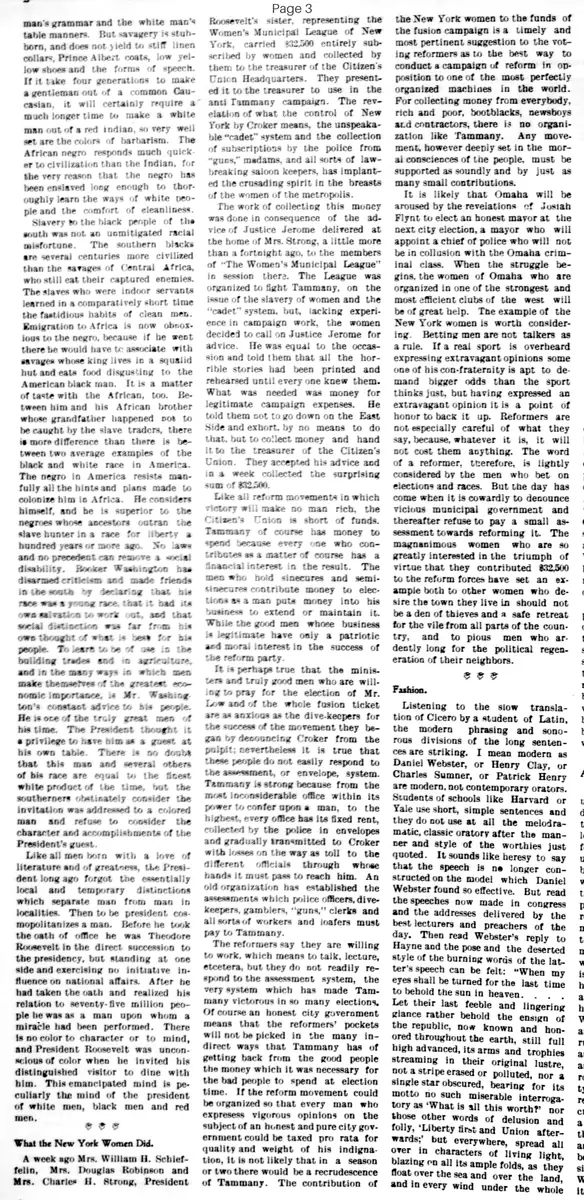
A week ago Mrs. William H. Schieffelin, Mrs. Douglas Robinson and Mrs. Charles H. Strong, President Roosevelt's sister, representing the Women's Municipal League of New York, carried $32,500 entirely subscribed by women and collected by them to the treasurer of the Citizen's Union Headquarters. They presented it to the treasurer to use in the anti-Tammany campaign. The revelation of what the control of New York by Croker means, the unspeakable "cadet" system and the collection of subscriptions by the police from "guns," madams, and all sorts of lawbreaking saloon keepers, has implanted the crusading spirit in the breasts of the women of the metropolis.
The work of collecting this money was done in consequence of the advice of Justice Jerome delivered at the home of Mrs. Strong, a little more than a fortnight ago, to the members of "The Women's Municipal League" in session there. The League was organized to fight Tammany, on the issue of the slavery of women and the "cadet" system, but, lacking experience in campaign work, the women decided to call on Justice Jerome for advice. He was equal to the occasion and told them that all the horrible stories had been printed and rehearsed until every one knew them. What was needed was money for legitimate campaign expenses. He told them not to go down on the East Side and exhort, by no means to do that, but to collect money and hand it to the treasurer of the Citizen's Union. They accepted his advice and in a week collected the surprising sum of $32,500.
Like all reform movements in which victory will make no man rich, the Citizen's Union is short of funds. Tammany of course has money to spend because every one who contributes as a matter of course has a financial interest in the result. The men who hold sinecures and semi-sinecures contribute money to elections as a man puts money into his business to extend or maintain it. While the good men whose business is legitimate have only a patriotic and moral interest in the success of the reform party.
It is perhaps true that the ministers and truly good men who are willing to pray for the election of Mr. Low and of the whole fusion ticket are as anxious as the dive-keepers for the success of the movement they began by denouncing Croker from the pulpit; nevertheless it is true that these people do not easily respond to the assessment, or envelope, system. Tammany is strong because from the most inconsiderable office within its power to confer upon a man, to the highest, every office has its fixed rent, collected by the police in envelopes and gradually transmitted to Croker with losses on the way as toll to the different officials through whose hands it must pass to reach him. An old organization has established the assessments which police officers, dive-keepers, gamblers, "guns," clerks and all sorts of workers and loafers must pay to Tammany.
The reformers say they are willing to work, which means to talk, lecture, etcetera, but they do not readily respond to the assessment system, the very system which has made Tammany victorious in so many elections. Of course an honest city government means that the reformers' pockets will not be picked in the many indirect ways that Tammany has of getting back from the good people the money which it was necessary for the bad people to spend at election time. If the reform movement could be organized so that every man who expresses vigorous opinions on the subject of an honest and pure city government could be taxed pro rata for quality and weight of his indignation, it is not likely that in a season or two there would be a recrudescence of Tammany. The contribution of the New York women to the funds of the fusion campaign is a timely and most pertinent suggestion to the voting reformers as to the best way to conduct a campaign of reform in opposition to one of the most perfectly organized machines in the world. For collecting money from everybody, rich and poor, bootblacks, newsboys and contractors, there is no organization like Tammany. Any movement, however deeply set in the moral consciences of the people, must be supported as soundly and by just as many small contributions.
It is likely that Omaha will be aroused by the revelations of Josiah Flynt to elect an honest mayor at the next city election, a mayor who will appoint a chief of police who will not be in collusion with the Omaha criminal class. When the struggle begins, the women of Omaha who are organized in one of the strongest and most efficient clubs of the west will be of great help. The example of the New York women is worth considering. Betting men are not talkers as a rule. If a real sport is overheard expressing extravagant opinions some one of his confraternity is apt to demand bigger odds than the sport thinks just, but having expressed an extravagant opinion it is a point of honor to back it up. Reformers are not especially careful of what they say, because, whatever it is, it will not cost them anything. The word of a reformer, therefore, is lightly considered by the men who bet on elections and races. But the day has come when it is cowardly to denounce vicious municipal government and thereafter refuse to pay a small assessment towards reforming it. The magnanimous women who are so greatly interested in the triumph of virtue that they contributed $32,500 to the reform forces have set an example both to other women who desire the town they live in should not be a den of thieves and a safe retreat for the vile from all parts of the country, and to pious men who are devotedly long for the political regeneration of their neighbors.
A week ago Mrs. William H. Schieffelin, Mrs. Douglas Robinson and Mrs. Charles H. Strong, President Roosevelt's sister, representing the Women's Municipal League of New York, carried $32,500 entirely subscribed by women and collected by them to the treasurer of the Citizen's Union Headquarters. They presented it to the treasurer to use in the anti-Tammany campaign. The revelation of what the control of New York by Croker means, the unspeakable "cadet" system and the collection of subscriptions by the police from "guns," madams, and all sorts of lawbreaking saloon keepers, has implanted the crusading spirit in the breasts of the women of the metropolis.
The work of collecting this money was done in consequence of the advice of Justice Jerome delivered at the home of Mrs. Strong, a little more than a fortnight ago, to the members of "The Women's Municipal League" in session there. The League was organized to fight Tammany, on the issue of the slavery of women and the "cadet" system, but, lacking experience in campaign work, the women decided to call on Justice Jerome for advice. He was equal to the occasion and told them that all the horrible stories had been printed and rehearsed until every one knew them. What was needed was money for legitimate campaign expenses. He told them not to go down on the East Side and exhort, by no means to do that, but to collect money and hand it to the treasurer of the Citizen's Union. They accepted his advice and in a week collected the surprising sum of $32,500.
Like all reform movements in which victory will make no man rich, the Citizen's Union is short of funds. Tammany of course has money to spend because every one who contributes as a matter of course has a financial interest in the result. The men who hold sinecures and semi-sinecures contribute money to elections as a man puts money into his business to extend or maintain it. While the good men whose business is legitimate have only a patriotic and moral interest in the success of the reform party.
It is perhaps true that the ministers and truly good men who are willing to pray for the election of Mr. Low and of the whole fusion ticket are as anxious as the dive-keepers for the success of the movement they began by denouncing Croker from the pulpit; nevertheless it is true that these people do not easily respond to the assessment, or envelope, system. Tammany is strong because from the most inconsiderable office within its power to confer upon a man, to the highest, every office has its fixed rent, collected by the police in envelopes and gradually transmitted to Croker with losses on the way as toll to the different officials through whose hands it must pass to reach him. An old organization has established the assessments which police officers, dive-keepers, gamblers, "guns," clerks and all sorts of workers and loafers must pay to Tammany.
The reformers say they are willing to work, which means to talk, lecture, etcetera, but they do not readily respond to the assessment system, the very system which has made Tammany victorious in so many elections. Of course an honest city government means that the reformers' pockets will not be picked in the many indirect ways that Tammany has of getting back from the good people the money which it was necessary for the bad people to spend at election time. If the reform movement could be organized so that every man who expresses vigorous opinions on the subject of an honest and pure city government could be taxed pro rata for quality and weight of his indignation, it is not likely that in a season or two there would be a recrudescence of Tammany. The contribution of the New York women to the funds of the fusion campaign is a timely and most pertinent suggestion to the voting reformers as to the best way to conduct a campaign of reform in opposition to one of the most perfectly organized machines in the world. For collecting money from everybody, rich and poor, bootblacks, newsboys and contractors, there is no organization like Tammany. Any movement, however deeply set in the moral consciences of the people, must be supported as soundly and by just as many small contributions.
It is likely that Omaha will be aroused by the revelations of Josiah Flynt to elect an honest mayor at the next city election, a mayor who will appoint a chief of police who will not be in collusion with the Omaha criminal class. When the struggle begins, the women of Omaha who are organized in one of the strongest and most efficient clubs of the west will be of great help. The example of the New York women is worth considering. Betting men are not talkers as a rule. If a real sport is overheard expressing extravagant opinions some one of his confraternity is apt to demand bigger odds than the sport thinks just, but having expressed an extravagant opinion it is a point of honor to back it up. Reformers are not especially careful of what they say, because, whatever it is, it will not cost them anything. The word of a reformer, therefore, is lightly considered by the men who bet on elections and races. But the day has come when it is cowardly to denounce vicious municipal government and thereafter refuse to pay a small assessment towards reforming it. The magnanimous women who are so greatly interested in the triumph of virtue that they contributed $32,500 to the reform forces have set an example both to other women who desire the town they live in should not be a den of thieves and a safe retreat for the vile from all parts of the country, and to pious men who are devotedly long for the political regeneration of their neighbors.
What sub-type of article is it?
Historical Event
Heroic Act
Personal Triumph
What themes does it cover?
Moral Virtue
Justice
Crime Punishment
What keywords are associated?
Womens Municipal League
Anti Tammany Campaign
Citizens Union
Justice Jerome
Croker Corruption
Reform Funding
Cadet System
What entities or persons were involved?
Mrs. William H. Schieffelin
Mrs. Douglas Robinson
Mrs. Charles H. Strong
Justice Jerome
Croker
Mr. Low
Josiah Flynt
Where did it happen?
New York
Story Details
Key Persons
Mrs. William H. Schieffelin
Mrs. Douglas Robinson
Mrs. Charles H. Strong
Justice Jerome
Croker
Mr. Low
Josiah Flynt
Location
New York
Event Date
A Week Ago
Story Details
Women from the Women's Municipal League collected $32,500 for the Citizen's Union to fight Tammany Hall, following Justice Jerome's advice to fund the campaign against corruption like the cadet system and police collections.