Thank you for visiting SNEWPapers!
Sign up free
Editorial
October 25, 1821
Alexandria Gazette & Daily Advertiser
Alexandria, Virginia
What is this article about?
An essay praising Napoleon Bonaparte's civil administration, focusing on his policies that promoted French manufactures and arts through protectionism, scientific guidance, and institutions, crediting the British blockade for boosting national industry against England.
Clipping
OCR Quality
95%
Excellent
Full Text
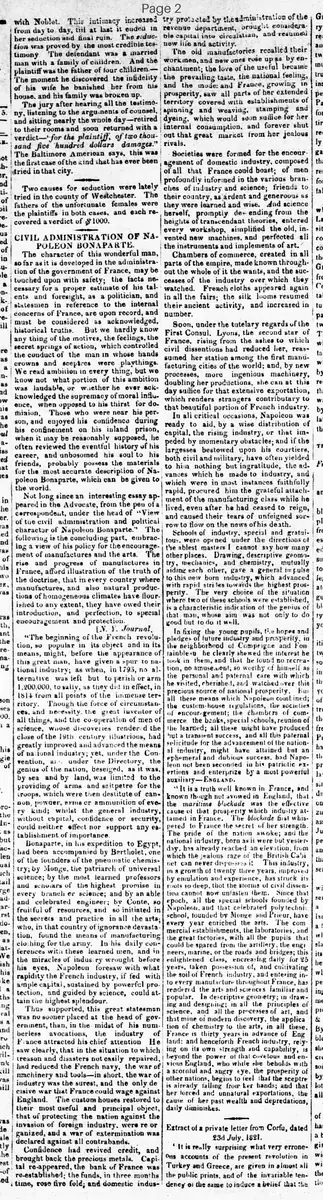
CIVIL ADMINISTRATION OF NAPOLEON BONAPARTE.
The character of this wonderful man, so far as it is developed in the administration of the government of France, may be touched upon with safety: the facts necessary for a proper estimate of his talents and foresight, as a politician, and statesman in reference to the internal concerns of France, are upon record, and must be considered as acknowledged, historical truths. But we hardly know any thing of the motives, the feelings, the secret springs of action, which controuled the conduct of the man in whose hands crowns and sceptres were playthings. We read ambition in everything, but we know not what portion of this ambition was laudable, or whether he ever acknowledged the supremacy of moral influence, when opposed to his thirst for dominion. Those who were near his person, and enjoyed his confidence during his confinement on his inland prison, when it may be reasonably supposed, he often reviewed the eventful history of his career, and unbosomed his soul to his friends, probably possess the materials for the most accurate description of Napoleon Bonaparte, which can be given to the world.
Not long since an interesting essay appeared in the Advocate, from the pen of a correspondent, under the head of "View of the civil administration and political character of Napoleon Bonaparte." The following is the concluding part, embracing a view of his policy for the encouragement of manufactures and the arts.
The rise and progress of manufactures in France, afford illustration of the truth of the doctrine, that in every country where manufactures, and also natural productions of homogeneous climates have flourished to any extent, they have owed their introduction, and perfection, to special encouragement and protection.
N. Y. Journal
"The beginning of the French revolution, so popular in its object and in its means, might, before the appearance of this great man, have given a spur to national industry: as when, in 1793, no alternative was left but to perish or arm 1,200,000, to sally, as they did in effect, in 1794 from all points of the immense territory. Though the force of circumstances, and necessity, the great inventor of all things, and the co-operation of men of science, whose discoveries rendered the close of the 18th century illustrious, had greatly improved and advanced the means of national industry; yet, under the Convention, as under the Directory, the genius of the nation, besieged, as it was, by sea and by land, was limited to the providing of arms and saltpetre for the troops, which were then destitute of cannon, powder, arms or ammunition of every kind; whilst the general industry, without capital, confidence or security, could neither effect nor support any establishment of importance.
Bonaparte, in his expedition to Egypt, had been accompanied by Bertholet, one of the founders of the pneumatic chemistry; by Monge, the patriarch of universal science; by the most learned professors and scholars of the highest promise in every branch of science; and by an able and celebrated engineer; by Conte, so fruitful of resources, and so initiated in the secrets and practice in all the arts; who, in that country of ignorance devastation, found the means of manufacturing clothing for the army. In his daily conferences with these learned men, and in the miracles of industry wrought before his eyes, Napoleon foresaw with what rapidity the French industry, if fed with ample capital, sustained by powerful protection, and guided by science, could attain the highest splendour.
Thus supported, this great statesman was no sooner placed at the head of government, than, in the midst of his numberless avocations, the industry of France attracted his chief attention. He saw clearly, that in the situation to which treason and disasters not easily repaired, had reduced the French navy, the war of machinery and tools—in short, the war of industry was the surest, and the only decisive war that France could wage against England. The custom houses restored to their most useful and principal object, that of protecting the nation against the invasion of foreign industry, were reorganized, and a war of extermination was declared against all contrabands. Confidence had revived credit, and brought back the precious metals. Capital re-appeared, the bank of France was re-established; the funds, in three months time, rose five fold; and domestic industry protected by the administration of the revenue department, brought considerable capital into circulation, and resumed new life and activity.
The old manufactories recalled their workmen, and new ones rose up as by enchantment; the love of the useful became the prevailing taste, the national feeling, and the mode: and France, growing in prosperity, saw all parts of her extended territory covered with establishments of spinning and weaving, stamping and dyeing, which would soon suffice for her internal consumption, and forever shut out that great market from her jealous rivals.
Societies were formed for the encouragement of domestic industry, composed of all that France could boast: of men profoundly informed in the various branches of industry and science: friends to their country, as ardent and generous as they were learned and wise. And science herself, promptly descending from the heights of transcendant theories, entered every workshop, simplified the old, invented new machines, and perfected all the instruments and implements of art.
Chambers of commerce, created in all parts of the empire, made known throughout the whole of it the wants, and the successes of the industry over which they watched. French cloths appeared again in all the fairs: the silk looms resumed their ancient activity, and increased in number.
Soon, under the tutelary regards of the First Consul, Lyons, the second star of France, rising from the ashes to which civil dissensions had reduced her, reassumed her station among the first manufacturing cities of the world; and, by new processes, more ingenious machinery, doubling her productions, she can at this day suffice for that extensive exportation, which renders strangers contributary to that beautiful portion of French industry.
In all critical occasions, Napoleon was ready to aid, by a wise distribution of capital, the rising industry, or that impeded by momentary obstacles; and if the largesses bestowed upon his courtiers, both civil and military, have often yielded to him nothing but ingratitude, the advances which he made to industry, and which were in most instances faithfully repaid, procured him the grateful attachment of the manufacturing class while he lived, even after he had ceased to reign, and caused their tears of unfeigned sorrow to flow on the news of his death.
Schools of industry, special and gratuitous, were opened under the directions of the ablest masters. I cannot say how many other places. Drawing, descriptive geometry, mechanics, and chemistry, mutually aiding each other, gave a general impulse to this new born industry, which advanced with rapid strides towards the highest prosperity. The very choice of the situation where two of these schools were established, is a characteristic indication of the genius of that man, whose aim was not only to do good but to do it well.
In fixing the young pupils, the hopes and pledges of future industry and prosperity, in the neighbourhood of Compeigne and Fontainbleau he clearly shewed the interest he took in them, and that he found no recreation, no amusement, so worthy of himself as the personal and paternal care with which he visited, cherished, and watched over this precious source of national prosperity. But all these means which Napoleon contrived: the custom-house regulations, the societies of encouragement; the chambers of commerce the books, special schools, reunion of the learned: all these might have produced but a transient success, and all this paternal solicitude for the advancement of the national industry, might have attained but an ephemeral and dubious success, had Napoleon not been seconded in his patriotic exertions and enterprize by a most powerful auxiliary—ENGLAND.
"It is a truth well known in France, and known though not avowed in England, that the maritime blockade was the effective cause of that prosperity which industry attained in France. The blockade first whispered to France the secret of her strength. The pride of the nation awoke; and the national industry, born as it were but yesterday, has already reached an elevation, from which the jealous rage of the British Cabinet can never dispossess it. This industry, in a growth of twenty three years, improved by emulation and experience, has struck its roots so deep, that the storms of civil dissension cannot now unfasten them. Since that epoch, all the special schools founded by Napoleon, and that celebrated polytechnic school, founded by Monge and Prieur, have every year enriched the arts. The commercial establishments, the laboratories, and the great factories, with all the pupils that could be spared from the artillery, the engineers, marine, or the roads and bridges; this enlightened class, encreasing daily for 25 years, taken possession of, and cultivating the soil of French industry, and entering into every manufacture throughout France, has rendered the arts and sciences familiar and popular. In descriptive geometry; in drawing and designing; in all the principles of science, and all the processes of art, and that mine of modern discovery, the application of chemistry to the arts, in all these, France is thirty years in advance of England: and henceforth French industry, relying on its own strength and capability, is beyond the power of that covetous and envious England, who while she beholds with a scornful and angry eye, the prosperity of other nations, begins to feel that the sceptre is already falling from her hands; and that her forced and unnatural exportations, the cause of her past wealth and depredations, daily diminishes."
The character of this wonderful man, so far as it is developed in the administration of the government of France, may be touched upon with safety: the facts necessary for a proper estimate of his talents and foresight, as a politician, and statesman in reference to the internal concerns of France, are upon record, and must be considered as acknowledged, historical truths. But we hardly know any thing of the motives, the feelings, the secret springs of action, which controuled the conduct of the man in whose hands crowns and sceptres were playthings. We read ambition in everything, but we know not what portion of this ambition was laudable, or whether he ever acknowledged the supremacy of moral influence, when opposed to his thirst for dominion. Those who were near his person, and enjoyed his confidence during his confinement on his inland prison, when it may be reasonably supposed, he often reviewed the eventful history of his career, and unbosomed his soul to his friends, probably possess the materials for the most accurate description of Napoleon Bonaparte, which can be given to the world.
Not long since an interesting essay appeared in the Advocate, from the pen of a correspondent, under the head of "View of the civil administration and political character of Napoleon Bonaparte." The following is the concluding part, embracing a view of his policy for the encouragement of manufactures and the arts.
The rise and progress of manufactures in France, afford illustration of the truth of the doctrine, that in every country where manufactures, and also natural productions of homogeneous climates have flourished to any extent, they have owed their introduction, and perfection, to special encouragement and protection.
N. Y. Journal
"The beginning of the French revolution, so popular in its object and in its means, might, before the appearance of this great man, have given a spur to national industry: as when, in 1793, no alternative was left but to perish or arm 1,200,000, to sally, as they did in effect, in 1794 from all points of the immense territory. Though the force of circumstances, and necessity, the great inventor of all things, and the co-operation of men of science, whose discoveries rendered the close of the 18th century illustrious, had greatly improved and advanced the means of national industry; yet, under the Convention, as under the Directory, the genius of the nation, besieged, as it was, by sea and by land, was limited to the providing of arms and saltpetre for the troops, which were then destitute of cannon, powder, arms or ammunition of every kind; whilst the general industry, without capital, confidence or security, could neither effect nor support any establishment of importance.
Bonaparte, in his expedition to Egypt, had been accompanied by Bertholet, one of the founders of the pneumatic chemistry; by Monge, the patriarch of universal science; by the most learned professors and scholars of the highest promise in every branch of science; and by an able and celebrated engineer; by Conte, so fruitful of resources, and so initiated in the secrets and practice in all the arts; who, in that country of ignorance devastation, found the means of manufacturing clothing for the army. In his daily conferences with these learned men, and in the miracles of industry wrought before his eyes, Napoleon foresaw with what rapidity the French industry, if fed with ample capital, sustained by powerful protection, and guided by science, could attain the highest splendour.
Thus supported, this great statesman was no sooner placed at the head of government, than, in the midst of his numberless avocations, the industry of France attracted his chief attention. He saw clearly, that in the situation to which treason and disasters not easily repaired, had reduced the French navy, the war of machinery and tools—in short, the war of industry was the surest, and the only decisive war that France could wage against England. The custom houses restored to their most useful and principal object, that of protecting the nation against the invasion of foreign industry, were reorganized, and a war of extermination was declared against all contrabands. Confidence had revived credit, and brought back the precious metals. Capital re-appeared, the bank of France was re-established; the funds, in three months time, rose five fold; and domestic industry protected by the administration of the revenue department, brought considerable capital into circulation, and resumed new life and activity.
The old manufactories recalled their workmen, and new ones rose up as by enchantment; the love of the useful became the prevailing taste, the national feeling, and the mode: and France, growing in prosperity, saw all parts of her extended territory covered with establishments of spinning and weaving, stamping and dyeing, which would soon suffice for her internal consumption, and forever shut out that great market from her jealous rivals.
Societies were formed for the encouragement of domestic industry, composed of all that France could boast: of men profoundly informed in the various branches of industry and science: friends to their country, as ardent and generous as they were learned and wise. And science herself, promptly descending from the heights of transcendant theories, entered every workshop, simplified the old, invented new machines, and perfected all the instruments and implements of art.
Chambers of commerce, created in all parts of the empire, made known throughout the whole of it the wants, and the successes of the industry over which they watched. French cloths appeared again in all the fairs: the silk looms resumed their ancient activity, and increased in number.
Soon, under the tutelary regards of the First Consul, Lyons, the second star of France, rising from the ashes to which civil dissensions had reduced her, reassumed her station among the first manufacturing cities of the world; and, by new processes, more ingenious machinery, doubling her productions, she can at this day suffice for that extensive exportation, which renders strangers contributary to that beautiful portion of French industry.
In all critical occasions, Napoleon was ready to aid, by a wise distribution of capital, the rising industry, or that impeded by momentary obstacles; and if the largesses bestowed upon his courtiers, both civil and military, have often yielded to him nothing but ingratitude, the advances which he made to industry, and which were in most instances faithfully repaid, procured him the grateful attachment of the manufacturing class while he lived, even after he had ceased to reign, and caused their tears of unfeigned sorrow to flow on the news of his death.
Schools of industry, special and gratuitous, were opened under the directions of the ablest masters. I cannot say how many other places. Drawing, descriptive geometry, mechanics, and chemistry, mutually aiding each other, gave a general impulse to this new born industry, which advanced with rapid strides towards the highest prosperity. The very choice of the situation where two of these schools were established, is a characteristic indication of the genius of that man, whose aim was not only to do good but to do it well.
In fixing the young pupils, the hopes and pledges of future industry and prosperity, in the neighbourhood of Compeigne and Fontainbleau he clearly shewed the interest he took in them, and that he found no recreation, no amusement, so worthy of himself as the personal and paternal care with which he visited, cherished, and watched over this precious source of national prosperity. But all these means which Napoleon contrived: the custom-house regulations, the societies of encouragement; the chambers of commerce the books, special schools, reunion of the learned: all these might have produced but a transient success, and all this paternal solicitude for the advancement of the national industry, might have attained but an ephemeral and dubious success, had Napoleon not been seconded in his patriotic exertions and enterprize by a most powerful auxiliary—ENGLAND.
"It is a truth well known in France, and known though not avowed in England, that the maritime blockade was the effective cause of that prosperity which industry attained in France. The blockade first whispered to France the secret of her strength. The pride of the nation awoke; and the national industry, born as it were but yesterday, has already reached an elevation, from which the jealous rage of the British Cabinet can never dispossess it. This industry, in a growth of twenty three years, improved by emulation and experience, has struck its roots so deep, that the storms of civil dissension cannot now unfasten them. Since that epoch, all the special schools founded by Napoleon, and that celebrated polytechnic school, founded by Monge and Prieur, have every year enriched the arts. The commercial establishments, the laboratories, and the great factories, with all the pupils that could be spared from the artillery, the engineers, marine, or the roads and bridges; this enlightened class, encreasing daily for 25 years, taken possession of, and cultivating the soil of French industry, and entering into every manufacture throughout France, has rendered the arts and sciences familiar and popular. In descriptive geometry; in drawing and designing; in all the principles of science, and all the processes of art, and that mine of modern discovery, the application of chemistry to the arts, in all these, France is thirty years in advance of England: and henceforth French industry, relying on its own strength and capability, is beyond the power of that covetous and envious England, who while she beholds with a scornful and angry eye, the prosperity of other nations, begins to feel that the sceptre is already falling from her hands; and that her forced and unnatural exportations, the cause of her past wealth and depredations, daily diminishes."
What sub-type of article is it?
Economic Policy
Trade Or Commerce
What keywords are associated?
Napoleon Bonaparte
French Industry
Manufactures
Protectionism
Arts Encouragement
Continental Blockade
Economic Rivalry
What entities or persons were involved?
Napoleon Bonaparte
France
England
Bertholet
Monge
Conte
Lyons
Editorial Details
Primary Topic
Napoleon's Encouragement Of French Manufactures And Arts
Stance / Tone
Laudatory And Supportive Of Napoleon's Industrial Policies
Key Figures
Napoleon Bonaparte
France
England
Bertholet
Monge
Conte
Lyons
Key Arguments
Napoleon's Policies Spurred National Industry Via Protection And Science
Accompaniment By Scholars In Egypt Inspired Industrial Foresight
Reorganization Of Custom Houses Declared War On Foreign Contraband
Establishment Of Bank Of France Revived Credit And Capital
Formation Of Societies, Chambers Of Commerce, And Schools Advanced Arts And Manufactures
British Maritime Blockade Ultimately Aided French Industrial Prosperity