Thank you for visiting SNEWPapers!
Sign up free
The Enquirer
Richmond, Henrico County, Virginia
What is this article about?
Congressional proceedings in Washington on April 25, 1812: Debate and defeat of recess proposal in House; passage of New York District Judge bill; advancement of seamen protection bill. Senate narrowly approved recess to June 8 amid war preparation concerns but failed in House.
Merged-components note: Sequential components forming a single article on Congressional debate over the recess proposal.
Clipping
OCR Quality
Full Text
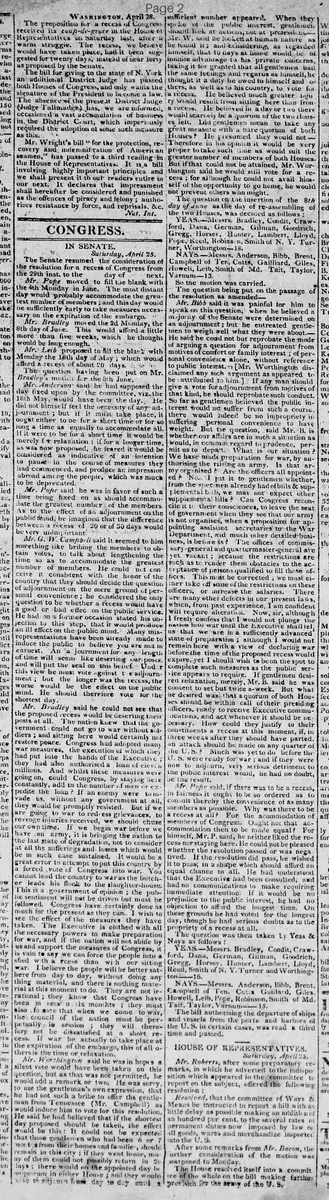
The proposition for a recess of Congress received its coup-de-grace in the House of Representatives on Saturday last, after a warm struggle. The recess, we believe would have taken place, had it been suggested for twenty days, instead of near forty as proposed by the Senate.
The bill for giving to the state of N. York an additional District Judge has passed both Houses of Congress, and only wants the signature of the President to become a law. The absence of the present District Judge Tallmadge has, we are informed, occasioned a vast accumulation of business in the District Court, which imperiously required the adoption of some such measure as this.
Mr. Wright's bill "for the protection, recovery and indemnification of American seamen," has passed to a third reading in the House of Representatives. It is a bill involving highly important principles and we shall present it to our readers entire in our next. It declares that impressment shall hereafter be considered and punished as the offences of piracy and felony; authorises resistance by force, and reprisals, &c.
Natl. Int.
CONGRESS.
IN
SENATE.
Saturday, April 25.
The Senate resumed the consideration of the resolution for a recess of Congress from the 29th inst. to the day of next.
Mr. Pope moved to fill the blank with the 4th Monday in June. The most distant day would probably accommodate the greatest number of members; and this day would be sufficiently early to take measures necessary on the expiration of the embargo.
Mr. Bradley moved the 2d Monday, the 8th day of June. This would afford a little more than five weeks, which he thought would be long enough.
Mr. Leib proposed to fill the blank with Monday the 18th day of May; which would afford a recess of about 20 days.
The question having been put on Mr. Bradley's motion for the 8th June, Mr. Anderson said he had supposed the day fixed upon by the committee, viz. the 18th May, would have been the day. He did not himself feel the necessity of any adjournment; but if it must take place, it ought either to be for a short time or for so long a time as equally to accommodate all. If it were to be for a short time it would be merely for relaxation: if for a longer time, as was now proposed, he feared it would be considered as indicative of an intention to pause in the course of measures they had commenced, and produce an impression abroad among the people, which was much to be deprecated.
Mr. Pope said he was in favor of such a time being fixed on as should accommodate the greatest number of the members. As to the effect of an adjournment on the public mind, he imagined that the difference between a recess of 20 or of 50 days would be very unimportant.
Mr. G. W. Campbell said it seemed to him something like bribing the members to obtain votes, to talk about lengthening the time so as to accommodate the greatest number of members. He could not conceive it consistent with the honor of the country that they should decide the question of adjournment on the mere ground of personal convenience; he considered the only question to be whether a recess would have a good or bad effect on the public service. He had on a former occasion stated his objection to this step, that it would produce an ill effect on the public mind. Many misrepresentations have been already made to induce the public to believe you are not in earnest. An adjournment for any length of time will seem like deserting our posts, and will put the seal on this belief. Under this view he must vote against the adjournment; but the longer was the recess, the worse would be the effect on the public mind. He should therefore vote for the shortest day.
Mr. Bradley said he could not see that the proposed recess would be deserting their posts at all. The nation knew that the government could not go to war without soldiers; and sitting here would certainly not restore peace. Congress had adopted many war measures, the execution of which they had put into the hands of the Executive; they had also authorised a loan of eleven millions. And whilst these measures were going on, could Congress, by staying here constantly, add to the number of men or expedite the loan? If an enemy were to invade us, without any government at all, they would be promptly resisted. But if we are going to war to redress grievances, to revenge injuries received, we should chuse our own time. If we begin war before we have an army, it is bringing the nation to the last state of degradation, not to consider at all the sufferings and losses which would be in such case sustained. It would be a great error to attempt to put this Country by a forced vote of Congress into war. You cannot lead the country to war as the butcher leads his flock to the slaughter-house. This is a government of opinion; the public sentiment will not be driven but must be followed, Congress have, certainly done as much for the present as they can. I wish to see the effect of the measures they have taken. The Executive is clothed with all the necessary powers to make preparation for war, and if the nation will not abide by us and support the measures of Congress, it is vain to say we can force the people into a war. I believe the people will be better satisfied with a recess than with our sitting here from day to day, without doing any thing material, and there is nothing material at this moment to do. They are not irrational; they know that Congress have been in session six months: they must also know that when we come to war, the council of the nation must be perpetually in session; they will therefore not be dissatisfied at a short recess. If war be actually to take place at the expiration of the embargo, this of all others is the time for relaxation.
Mr. Worthington said he was in hopes a silent vote would have been taken on this question, but as that was not permitted, he would add a remark or two. He was sorry, to use the gentleman's own expression, that he had not such a bribe to offer the gentleman from Tennessee (Mr. Campbell) as would induce him to vote for this resolution. He said he had believed that if the shortest day proposed should be taken, the effect would be this: It could not be expected that those gentlemen who had been 6 or 7 months from their homes and families, should remain in this city; if they went home, many of them could not possibly return in 20 days; there would on the appointed day be no quorum in either House; and they would have adjourned from day to day until a sufficient number appeared. When they spoke of the public interest, gentlemen should look at actions, not at professions.
Mr. W. said he looked at human nature as he found it; and considering, as regarded himself, that 20 days at home would be of infinite advantage to his private concerns, taking it for granted that all gentlemen had the same feelings and regards as himself, he thought it a duty he owed to himself and others, as well as to his country, to vote for a recess. He believed much greater injury would result from sitting here than from a recess. He believed in a day or two there would scarcely be a quorum of the two Houses left. Did gentlemen mean to take any great measure with a bare quorum of both Houses? He presumed they would not. Therefore in his opinion it would be very proper to take such time as would suit the greater number of members of both Houses. But if that could not be attained, Mr. Worthington said he would still vote for a recess; for although he could not avail himself of the opportunity to go home, he would not prevent others who might.
The question on the insertion of the 8th day of June as the day of re-assembling of the two Houses, was decided as follows:
YEAS.--Messrs. Bradley, Condit, Crawford, Dana, German, Gilman, Goodrich, Gregg, Horsey, Hunter, Lambert, Lloyd, Pope, Reed, Robinson, Smith of N. Y. Turner, Worthington 18.
NAYS.--Messrs. Anderson, Bibb, Brent, Campbell of Ten. Cutts, Gailliard, Giles, Howell, Leib, Smith of Md. Tait, Taylor, Varnum--13.
So the motion was carried.
The question being put on the passage of the resolution as amended--
Mr. Bibb said it was painful for him to speak on this question, when he believed a majority of the Senate were determined on an adjournment; but he entreated gentlemen to weigh well what they were about. He said he could not but reprobate the mode of arguing a question for adjournment from motives of comfort or family interest; of personal convenience alone, without reference to public interest. [Mr. Worthington disclaimed any such argument as appeared to be attributed to him.] If any man should give a vote for adjournment from motives of that kind, he should reprobate such conduct. So far as gentlemen believed the public interest would not suffer from such a course, there would indeed be no impropriety in suffering personal convenience to have weight. But the question, said Mr. B. is whether our affairs are in such a situation as would, in common regard to prudence, permit us to depart. What is our situation? We have made preparation for war, by authorising the raising an army. Is that army organised? Are the officers all appointed? No. Is it not to gentlemen whether, from the specimen already had of bills & supplemental bills, we may not expect other supplemental bills? Can Congress reconcile it to their consciences, to leave the seat of government when they see that our army is not organised, when a proposition for appointing assistant secretaries to the War Department, and much other detailed business, is before us? The offices of commissary-general and quartermaster-general are yet vacant; because the restrictions are such as to render them obstacles to the acceptance of persons qualified to fill those offices. This must be corrected; we must either take off some of the restrictions on these officers, or increase the salaries. There are many other defects in our present laws, which, from past experience, I am confident will require alteration. Now, sir, although I freely confess that I would not plunge the nation into war until the Executive shall tell us that we are in a sufficiently advanced state of preparation; although I would not remain here with a view of declaring war before the time of the proposed recess would expire, yet I should wish to be on the spot to complete such measures as the public service appears to require. If gentlemen desired relaxation, merely, Mr. B. said he was content to sit but twice a-week. But what he desired was, that a quorum of both Houses should be within call of their presiding officers, ready to receive Executive communications, and act whenever it should be necessary. How could they justify to their constituents a recess at this moment, if, in three weeks after they should have parted, an attack should be made on any quarter of the U. S.? Much was yet to do before the U. S. were ready for war; and if they were now to adjourn, very serious detriment to the public interest would, he had no doubt, be the result.
Mr. Pope said, if there was to be a recess, in fairness it ought to be so ordered as to consult thereby the convenience of as many members as possible. Why was there to be a recess at all? For the accommodation of members of Congress. Ought not that accommodation then to be made equal? For himself, Mr. P. said, he neither liked the recess nor staying here. He could not be pleased whether the resolution passed or was negatived. If the resolution did pass, he wished it to pass in a shape which should afford an equal chance to all. He had understood that the Executive had been consulted, and had no communications to make requiring immediate attention. If it would be no prejudice to the public interest, he had no objection to afford the longest time. On these grounds he had voted for the longest day, though he had serious doubts as to the propriety of a recess at all.
The question was then taken by Yeas & Nays as follows:
YEAS. Messrs. Bradley, Condit, Crawford, Dana, German, Gilman, Goodrich, Gregg, Horsey, Hunter, Lambert, Lloyd, Reed, Smith of N. Y. Turner and Worthington--16.
NAYS.--Messrs. Anderson, Bibb, Brent, Campbell of Ten. Cutts Gaillard, Giles, Howell, Leib, Pope, Robinson, Smith of Md. Tait, Taylor, Varnum--15.
The bill authorising the departure of ships and vessels from the ports and harbors of the U. S. in certain cases, was read a third time and passed.
HOUSE OF REPRESENTATIVES.
Saturday, April 25.
Mr. Roberts, after some preparatory remarks, in which he adverted to the indisposition which appeared in the committee to report on the subject, offered the following resolution:
Resolved, that the committee of Ways & Means be instructed to report a bill with as little delay as possible making an addition of an hundred per cent, to the several rates of permanent duties now imposed by law on all goods, wares and merchandize imported into the U. S.
After some remarks from Mr. Bacon, the further consideration of the motion was postponed to Monday.
The House resolved itself into a committee of the whole on the bill making further provision for the army of the U. S.
What sub-type of article is it?
What keywords are associated?
What entities or persons were involved?
Where did it happen?
Domestic News Details
Primary Location
Washington
Event Date
April 25
Key Persons
Outcome
the proposition for a recess of congress was defeated in the house of representatives after debate. the bill for an additional district judge in new york passed both houses and awaits presidential signature. mr. wright's bill for the protection of american seamen passed to a third reading in the house. in the senate, the recess resolution to june 8 passed narrowly 16-15, but was ultimately defeated in the house. the bill authorizing departure of ships in certain cases passed the senate.
Event Details
Report on congressional proceedings including debate and defeat of a proposed recess in the House, passage of a bill for an additional District Judge in New York due to backlog from Judge Tallmadge's absence, and progress of Mr. Wright's bill treating impressment as piracy. Detailed Senate debate on recess length with speeches by Senators Pope, Bradley, Leib, Anderson, Campbell, Worthington, and Bibb, voting on dates, and narrow passage. House discussion on increasing import duties and committee on army provisions.