Thank you for visiting SNEWPapers!
Sign up free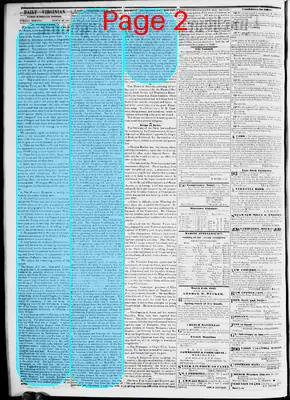
Editorial
March 29, 1853
Lynchburg Daily Virginian
Lynchburg, Virginia
What is this article about?
The editorial praises Edward Everett's Senate speech as a statesmanlike exposition of US foreign policy, emphasizing balanced relations with Britain over Central America, liberal conservatism, and peaceful national growth through population increase rather than conquest. It summarizes key points on Central American states, canal projects, and British protectorate, and includes excerpts advocating peace and progress.
Clipping
OCR Quality
95%
Excellent
Full Text
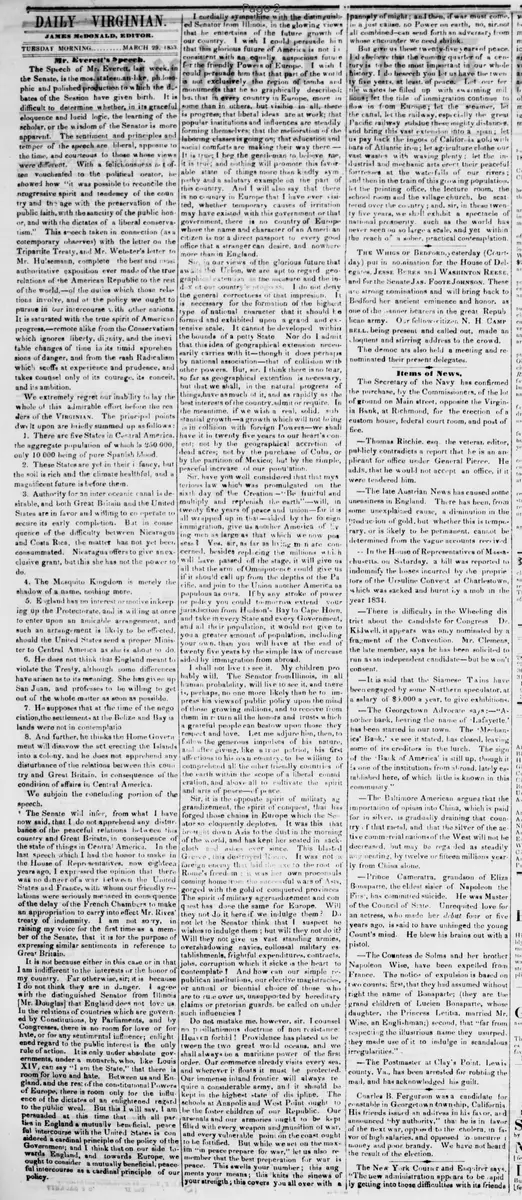
Mr. Everett's Speech.
The Speech of Mr. Everett, last week, in the Senate, is the most statesman-like, philosophic and polished production to which the debates of the Session have given birth. It is difficult to determine whether, in its graceful eloquence and lucid logic, the learning of the scholar, or the wisdom of the Senator is more apparent. The sentiment and principles and temper of the speech are liberal, apposite to the time, and courteous to those whose views were different. With a felicitousness not often vouchsafed to the political orator, he showed how "it was possible to reconcile the progressive spirit and tendency of the country and the age with the preservation of the public faith, with the sanctity of the public honor, and with the dictates of a liberal conservatism." This speech taken in connection (as a cotemporary observes) with the letter on the Tripartite Treaty, and Mr. Webster's letter to Mr. Huelsemann, complete the best and most authoritative exposition ever made of the true relations of the American Republic to the rest of the world, of the duties which those relations involve, and of the policy we ought to pursue in our intercourse with other nations. It is saturated with the true spirit of American progress, remote alike from the Conservatism which ignores liberty, dignity, and the inevitable changes of time in its timid apprehensions of danger, and from the rash Radicalism which scoffs at experience and prudence, and takes counsel only of its courage, its conceit, and its ambition.
We extremely regret our inability to lay the whole of this admirable effort before the readers of the Virginian. The principal points dwelt upon are briefly summed up as follows:
1. There are five States in Central America, the aggregate population of which is 650,000, only 10,000 being of pure Spanish blood.
2. These States are yet in their infancy, but the soil is rich and the climate healthful, and a magnificent future is before them.
3. Authority for an inter oceanic canal is desirable, and both Great Britain and the United States are in favor and willing to co-operate to secure its early completion. But in consequence of the difficulty between Nicaragua and Costa Rico, the matter has not yet been consummated. Nicaragua offers to give an exclusive grant, but this she has not the power to do.
4. The Mosquito Kingdom is merely the shadow of a name, nothing more.
5. England has no interest or motive in keeping up the Protectorate, and is willing at once to enter upon an amicable arrangement, and such an arrangement is likely to be effected, should the United States send a proper Minister to Central America as she is about to do.
6. He does not think that England meant to violate the Treaty, although some differences have arisen as to its meaning. She has given up San Juan, and professes to be willing to get out of the whole matter as soon as possible.
7. He supposes that at the time of the negotiation, the settlements at the Belize and Bay Islands were not in contemplation.
8. And further, he thinks the Home Government will disavow the act erecting the Islands into a colony, and he does not apprehend any disturbance of the relations between this country and Great Britain, in consequence of the condition of affairs in Central America.
We subjoin the concluding portion of the speech.
The Senate will infer, from what I have now said, that I do not apprehend any disturbance of the peaceful relations between this country and Great Britain, in consequence of the state of things in Central America. In the last speech which I had the honor to make in the House of Representatives, now eighteen years ago, I expressed the opinion that there was no danger of a war between the United States and France, with whom our friendly relations were seriously menaced in consequence of the delay of the French Chambers to make an appropriation to carry into effect Mr. Rives' treaty of indemnity. I am not sorry, in raising my voice for the first time as a member of the Senate, that it is for the purpose of expressing similar sentiments in reference to Great Britain.
It is not because either in this case or in that I am indifferent to the interests or the honor of my country. Far otherwise, sir; it is because I do not think they are in danger. I agree with the distinguished Senator from Illinois [Mr. Douglas] that England does not love us. In the relations of countries which are governed by Constitutions, by Parliaments, and by Congresses, there is no room for love or for hate, or for any sentimental influence; enlightened regard to the public interest is the only rule of action. It is only under absolute governments, under a monarch, who, like Louis XIV, can say "I am the State," that there is room for love and hate. Between us and England, and the rest of the constitutional Powers of Europe, there is room only for the influence of the dictates of an enlightened regard to the public weal. But this I will say. I am persuaded at this time that with all parties in England a mutually beneficial, peaceful intercourse with the United States is considered a cardinal principle of the policy of the Government; and I think that on our side towards England, and towards Europe, we ought to consider a mutually beneficial, peace ful intercourse as a cardinal principle of our policy.
I cordially sympathise with the distinguished Senator from Illinois, in the glowing views that he entertains of the future growth of our Country. I wish I could persuade him that this glorious future of America is not inconsistent with an equally auspicious future for the friendly Powers of Europe. I wish I could persuade him that that part of the world is not exclusively the region of tombs and monuments that he so graphically described; but that in every country in Europe, more in some than in others, but visible in all, there is progress; that liberal ideas are at work; that popular institutions and influences are steadily forming themselves; that the melioration of the laboring classes is going on; that education and social comforts are making their way there.
It is true: I beg the gentleman to believe me, it is true; and nothing will promote this favorable state of things more than kindly sympathy and a salutary example on the part of this country. And I will also say that there is no country in Europe that I have ever visited, whether temporary causes of irritation may have existed with this government or that government, there is no Country of Europe where the name and character of an American citizen is not a direct passport to every good office that a stranger can desire, and nowhere more than in England.
Sir, in our views of the glorious future that awaits the Union, we are apt to regard geographical extension as the measure and the index of our country's progress. I do not deny the general correctness of that impression. It is necessary for the formation of the highest type of national character that it should be formed and exhibited upon a grand and extensive scale. It cannot be developed within the bounds of a petty State. Nor do I admit that this idea of geographical extension necessarily carries with it—though it does perhaps by national association—that of collision with other powers. But, sir, I think there is no fear so far as geographical extension is necessary, but that we shall, in the natural progress of things, have as much of it, and as rapidly as the best interests of the country admit or require. In the meantime, if we wish a real, solid, substantial growth—a growth which will not bring us in collision with foreign Powers—we shall have it in twenty five years to our heart's content; not by the geographical accretion of dead acres; not by the purchase of Cuba, or by the partition of Mexico; but by the simple, peaceful increase of our population.
Sir, have you well considered that that mysterious law which was promulgated on the sixth day of the Creation—"Be fruitful and multiply and replenish the earth"—will, in twenty five years of peace and union—for it is all wrapped up in that—aid by the foreign immigration, give us another America of living men as large as that which we now possess? Yes, sir, as far as living men are concerned, besides replacing the millions who will have passed off the stage, it will give us all that the arm of Omnipotence could give us if it should call up from the depths of the Pacific, and join to the Union another America as populous as ours. If by any stroke of power or policy you could to-morrow extend your jurisdiction from Hudson's Bay to Cape Horn, and take in every State and every Government, and all their population, it would not give to you a greater amount of population, including your own, than you will have at the end of twenty five years by the simple law of increase aided by immigration from abroad.
I shall not live to see it. My children probably will. The Senator from Illinois, in all human probability, will live to see it, and there it, perhaps, no one more likely than he to impress his views of public policy upon the mind of those growing millions, and to receive from them in return all the honors and trusts which a grateful people can bestow upon those they respect and love. Let me adjure him, then, to follow the generous impulses of his nature, and after giving, like a true patriot, his first affections to his own country, to be willing to comprehend all the other friendly countries of the earth within the scope of a liberal consideration, and above all to cultivate the spirit and arts of peace—of peace.
Sir, it is the opposite spirit of military aggrandizement, the spirit of conquest, that has forged those chains in Europe which the Senator so eloquently deplores. It was this that brought down Asia to the dust in the morning of the world, and has kept her seated in sackcloth and ashes ever since. This blasted Greece, this destroyed Rome. It was not a foreign enemy that laid the axe to the root of Rome's freedom: it was her own proconsuls coming home from the successful wars of Asia, gorged with the gold of conquered provinces. The spirit of military aggrandizement and conquest has done the same for Europe. Will they not do it here if we indulge them? Do not let the Senator think that I suspect he wishes to indulge them; but will they not do it? Will they not give us vast standing armies, overshadowing navies, colossal military establishments, frightful expenditures, contracts, jobs, corruption which it sickens the heart to contemplate? And how can our simple republican institutions, our elective magistracies, or annual or biennial choice of those who are to rule over us, unsupported by hereditary claims or praetorian guards, be called on under such influences?
Do not mistake me, however, sir. I counsel no pusillanimous doctrine of non-resistance. Heaven forbid! Providence has placed us between the two great world oceans, and we shall always be a maritime power of the first order. Our commerce already visits every sea, and wherever it floats it must be protected. Our immense inland frontier will always require a considerable army, and it should be kept in the highest state of discipline. The schools at Annapolis and West Point ought to be the foster children of our Republic. Our arsenals and our armories ought to be kept filled with every weapon and munition of war, and every vulnerable point on the coast ought to be fortified. But while we act on the maxim "in peace prepare for war," let us also remember that the best preparation for war is peace. This swells your numbers; this augments your means; this knits the sinews of your strength; this covers you all over with a panoply of might; and then, if war must come in a just cause, no Power on earth, no, sir, not all combined, can send forth an adversary from whose encounter we need shrink.
But give us these twenty-five years of peace. I do believe that the coming quarter of a century is to be the most important in our whole history. I do beseech you let us have the twenty five years, at least, of peace. Let our fertile wastes be filled up with swarming millions; let the tide of immigration continue to flow in from Europe; let the steamer, let the canal, let the railway, especially the great Pacific railway subdue these mighty distances, and bring this vast extension into a span; let us pay back the ingots of California gold with bars of Atlantic iron; let agriculture clothe our vast wastes with waving plenty; let the industrial and mechanic arts erect their peaceful fortresses at the waterfalls of our rivers; and then in the train of this growing population, let the printing office, the lecture room, the school room and the village church, be scattered over the country; and, sir, in these twenty five years, we shall exhibit a spectacle of national prosperity, such as the world has never seen on so large a scale, and yet within the reach of a sober, practical contemplation.
The Speech of Mr. Everett, last week, in the Senate, is the most statesman-like, philosophic and polished production to which the debates of the Session have given birth. It is difficult to determine whether, in its graceful eloquence and lucid logic, the learning of the scholar, or the wisdom of the Senator is more apparent. The sentiment and principles and temper of the speech are liberal, apposite to the time, and courteous to those whose views were different. With a felicitousness not often vouchsafed to the political orator, he showed how "it was possible to reconcile the progressive spirit and tendency of the country and the age with the preservation of the public faith, with the sanctity of the public honor, and with the dictates of a liberal conservatism." This speech taken in connection (as a cotemporary observes) with the letter on the Tripartite Treaty, and Mr. Webster's letter to Mr. Huelsemann, complete the best and most authoritative exposition ever made of the true relations of the American Republic to the rest of the world, of the duties which those relations involve, and of the policy we ought to pursue in our intercourse with other nations. It is saturated with the true spirit of American progress, remote alike from the Conservatism which ignores liberty, dignity, and the inevitable changes of time in its timid apprehensions of danger, and from the rash Radicalism which scoffs at experience and prudence, and takes counsel only of its courage, its conceit, and its ambition.
We extremely regret our inability to lay the whole of this admirable effort before the readers of the Virginian. The principal points dwelt upon are briefly summed up as follows:
1. There are five States in Central America, the aggregate population of which is 650,000, only 10,000 being of pure Spanish blood.
2. These States are yet in their infancy, but the soil is rich and the climate healthful, and a magnificent future is before them.
3. Authority for an inter oceanic canal is desirable, and both Great Britain and the United States are in favor and willing to co-operate to secure its early completion. But in consequence of the difficulty between Nicaragua and Costa Rico, the matter has not yet been consummated. Nicaragua offers to give an exclusive grant, but this she has not the power to do.
4. The Mosquito Kingdom is merely the shadow of a name, nothing more.
5. England has no interest or motive in keeping up the Protectorate, and is willing at once to enter upon an amicable arrangement, and such an arrangement is likely to be effected, should the United States send a proper Minister to Central America as she is about to do.
6. He does not think that England meant to violate the Treaty, although some differences have arisen as to its meaning. She has given up San Juan, and professes to be willing to get out of the whole matter as soon as possible.
7. He supposes that at the time of the negotiation, the settlements at the Belize and Bay Islands were not in contemplation.
8. And further, he thinks the Home Government will disavow the act erecting the Islands into a colony, and he does not apprehend any disturbance of the relations between this country and Great Britain, in consequence of the condition of affairs in Central America.
We subjoin the concluding portion of the speech.
The Senate will infer, from what I have now said, that I do not apprehend any disturbance of the peaceful relations between this country and Great Britain, in consequence of the state of things in Central America. In the last speech which I had the honor to make in the House of Representatives, now eighteen years ago, I expressed the opinion that there was no danger of a war between the United States and France, with whom our friendly relations were seriously menaced in consequence of the delay of the French Chambers to make an appropriation to carry into effect Mr. Rives' treaty of indemnity. I am not sorry, in raising my voice for the first time as a member of the Senate, that it is for the purpose of expressing similar sentiments in reference to Great Britain.
It is not because either in this case or in that I am indifferent to the interests or the honor of my country. Far otherwise, sir; it is because I do not think they are in danger. I agree with the distinguished Senator from Illinois [Mr. Douglas] that England does not love us. In the relations of countries which are governed by Constitutions, by Parliaments, and by Congresses, there is no room for love or for hate, or for any sentimental influence; enlightened regard to the public interest is the only rule of action. It is only under absolute governments, under a monarch, who, like Louis XIV, can say "I am the State," that there is room for love and hate. Between us and England, and the rest of the constitutional Powers of Europe, there is room only for the influence of the dictates of an enlightened regard to the public weal. But this I will say. I am persuaded at this time that with all parties in England a mutually beneficial, peaceful intercourse with the United States is considered a cardinal principle of the policy of the Government; and I think that on our side towards England, and towards Europe, we ought to consider a mutually beneficial, peace ful intercourse as a cardinal principle of our policy.
I cordially sympathise with the distinguished Senator from Illinois, in the glowing views that he entertains of the future growth of our Country. I wish I could persuade him that this glorious future of America is not inconsistent with an equally auspicious future for the friendly Powers of Europe. I wish I could persuade him that that part of the world is not exclusively the region of tombs and monuments that he so graphically described; but that in every country in Europe, more in some than in others, but visible in all, there is progress; that liberal ideas are at work; that popular institutions and influences are steadily forming themselves; that the melioration of the laboring classes is going on; that education and social comforts are making their way there.
It is true: I beg the gentleman to believe me, it is true; and nothing will promote this favorable state of things more than kindly sympathy and a salutary example on the part of this country. And I will also say that there is no country in Europe that I have ever visited, whether temporary causes of irritation may have existed with this government or that government, there is no Country of Europe where the name and character of an American citizen is not a direct passport to every good office that a stranger can desire, and nowhere more than in England.
Sir, in our views of the glorious future that awaits the Union, we are apt to regard geographical extension as the measure and the index of our country's progress. I do not deny the general correctness of that impression. It is necessary for the formation of the highest type of national character that it should be formed and exhibited upon a grand and extensive scale. It cannot be developed within the bounds of a petty State. Nor do I admit that this idea of geographical extension necessarily carries with it—though it does perhaps by national association—that of collision with other powers. But, sir, I think there is no fear so far as geographical extension is necessary, but that we shall, in the natural progress of things, have as much of it, and as rapidly as the best interests of the country admit or require. In the meantime, if we wish a real, solid, substantial growth—a growth which will not bring us in collision with foreign Powers—we shall have it in twenty five years to our heart's content; not by the geographical accretion of dead acres; not by the purchase of Cuba, or by the partition of Mexico; but by the simple, peaceful increase of our population.
Sir, have you well considered that that mysterious law which was promulgated on the sixth day of the Creation—"Be fruitful and multiply and replenish the earth"—will, in twenty five years of peace and union—for it is all wrapped up in that—aid by the foreign immigration, give us another America of living men as large as that which we now possess? Yes, sir, as far as living men are concerned, besides replacing the millions who will have passed off the stage, it will give us all that the arm of Omnipotence could give us if it should call up from the depths of the Pacific, and join to the Union another America as populous as ours. If by any stroke of power or policy you could to-morrow extend your jurisdiction from Hudson's Bay to Cape Horn, and take in every State and every Government, and all their population, it would not give to you a greater amount of population, including your own, than you will have at the end of twenty five years by the simple law of increase aided by immigration from abroad.
I shall not live to see it. My children probably will. The Senator from Illinois, in all human probability, will live to see it, and there it, perhaps, no one more likely than he to impress his views of public policy upon the mind of those growing millions, and to receive from them in return all the honors and trusts which a grateful people can bestow upon those they respect and love. Let me adjure him, then, to follow the generous impulses of his nature, and after giving, like a true patriot, his first affections to his own country, to be willing to comprehend all the other friendly countries of the earth within the scope of a liberal consideration, and above all to cultivate the spirit and arts of peace—of peace.
Sir, it is the opposite spirit of military aggrandizement, the spirit of conquest, that has forged those chains in Europe which the Senator so eloquently deplores. It was this that brought down Asia to the dust in the morning of the world, and has kept her seated in sackcloth and ashes ever since. This blasted Greece, this destroyed Rome. It was not a foreign enemy that laid the axe to the root of Rome's freedom: it was her own proconsuls coming home from the successful wars of Asia, gorged with the gold of conquered provinces. The spirit of military aggrandizement and conquest has done the same for Europe. Will they not do it here if we indulge them? Do not let the Senator think that I suspect he wishes to indulge them; but will they not do it? Will they not give us vast standing armies, overshadowing navies, colossal military establishments, frightful expenditures, contracts, jobs, corruption which it sickens the heart to contemplate? And how can our simple republican institutions, our elective magistracies, or annual or biennial choice of those who are to rule over us, unsupported by hereditary claims or praetorian guards, be called on under such influences?
Do not mistake me, however, sir. I counsel no pusillanimous doctrine of non-resistance. Heaven forbid! Providence has placed us between the two great world oceans, and we shall always be a maritime power of the first order. Our commerce already visits every sea, and wherever it floats it must be protected. Our immense inland frontier will always require a considerable army, and it should be kept in the highest state of discipline. The schools at Annapolis and West Point ought to be the foster children of our Republic. Our arsenals and our armories ought to be kept filled with every weapon and munition of war, and every vulnerable point on the coast ought to be fortified. But while we act on the maxim "in peace prepare for war," let us also remember that the best preparation for war is peace. This swells your numbers; this augments your means; this knits the sinews of your strength; this covers you all over with a panoply of might; and then, if war must come in a just cause, no Power on earth, no, sir, not all combined, can send forth an adversary from whose encounter we need shrink.
But give us these twenty-five years of peace. I do believe that the coming quarter of a century is to be the most important in our whole history. I do beseech you let us have the twenty five years, at least, of peace. Let our fertile wastes be filled up with swarming millions; let the tide of immigration continue to flow in from Europe; let the steamer, let the canal, let the railway, especially the great Pacific railway subdue these mighty distances, and bring this vast extension into a span; let us pay back the ingots of California gold with bars of Atlantic iron; let agriculture clothe our vast wastes with waving plenty; let the industrial and mechanic arts erect their peaceful fortresses at the waterfalls of our rivers; and then in the train of this growing population, let the printing office, the lecture room, the school room and the village church, be scattered over the country; and, sir, in these twenty five years, we shall exhibit a spectacle of national prosperity, such as the world has never seen on so large a scale, and yet within the reach of a sober, practical contemplation.
What sub-type of article is it?
Foreign Affairs
War Or Peace
What keywords are associated?
Everett Speech
Central America
Us Britain Relations
Foreign Policy
Peaceful Expansion
Inter Oceanic Canal
Mosquito Kingdom
What entities or persons were involved?
Mr. Everett
Mr. Webster
Mr. Douglas
Great Britain
Central America
Nicaragua
Costa Rica
Mosquito Kingdom
Editorial Details
Primary Topic
Edward Everett's Senate Speech On Us Britain Relations In Central America And Peaceful Foreign Policy
Stance / Tone
Admiring And Supportive Of Balanced Liberal Conservatism In Foreign Affairs
Key Figures
Mr. Everett
Mr. Webster
Mr. Douglas
Great Britain
Central America
Nicaragua
Costa Rica
Mosquito Kingdom
Key Arguments
Central American States Have Promising Future With Rich Soil And Healthful Climate
Us And Britain Favor Inter Oceanic Canal But Face Nicaragua Costa Rica Difficulties
England Willing To End Protectorate Amicably With Us Cooperation
No Apprehension Of War With Britain Over Central America
Us Future Growth Through Peaceful Population Increase, Not Conquest
Mutual Beneficial Intercourse As Cardinal Policy With Europe
Peace Best Preparation For War And National Strength
Avoid Military Aggrandizement To Preserve Republican Institutions