Thank you for visiting SNEWPapers!
Sign up free
The Charlotte Democrat
Charlotte, Mecklenburg County, North Carolina
What is this article about?
19th-century explorations by Stanley, Speke, Livingstone, and others unveiled Africa's interior, discovering Nile and Congo sources, vast lakes, and kingdoms amid savages and natural wonders, solving ancient geographical mysteries.
Merged-components note: Merged continued article on 'The Mystery of Africa' across three sequential components in reading order
Clipping
OCR Quality
Full Text
From Harper's Weekly.
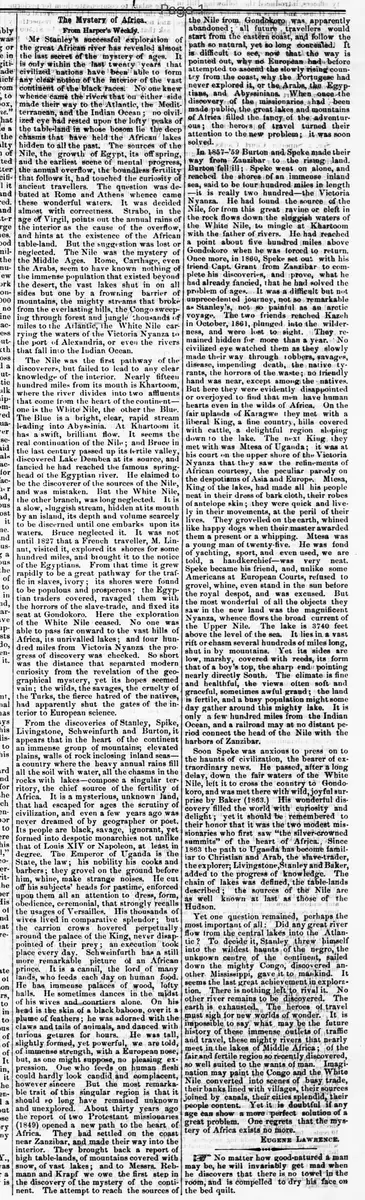
Mr. Stanley's successful exploration of the great African river has revealed almost the last secret of the mystery of ages. It is only within the last twenty years that civilized nations have been able to form any clear notion of the interior of the vast continent of the black races! No one knew whence came the rivers that on either side made their way to the Atlantic, the Mediterranean, and the Indian Ocean; no civilized eye had rested upon the lofty peaks of the table-land in whose bosom lie the deep chasms that have held the African lakes hidden to all the past. The sources of the Nile, the growth of Egypt, its offspring, and the earliest scene of mental progress, the annual overflow, the boundless fertility that follows it, had touched the curiosity of ancient travellers. The question was debated at Rome and Athens whence came these wonderful waters. It was decided almost with correctness. Strabo, in the age of Virgil, points out the annual rains of the interior as the cause of the overflow, and hints at the existence of the African table-land. But the suggestion was lost or neglected. The Nile was the mystery of the Middle Ages. Rome, Carthage, even the Arabs, seem to have known nothing of the immense population that existed beyond the desert, the vast lakes shut in on all sides but one by a frowning barrier of mountains, the mighty streams that broke from the everlasting hills, the Congo sweeping through forest and jungle thousands of miles to the Atlantic, The White Nile carrying the waters of the Victoria Nyanza to the port of Alexandria, or even the rivers that fall into the Indian Ocean.
The Nile was the first pathway of the discoverers, but failed to lead to any clear knowledge of the interior. Nearly fifteen hundred miles from its mouth is Khartoum, where the river divides into two affluents that come from the heart of the continent—one is the White Nile. the other the Blue. The Blue is a bright, clear, rapid stream leading into Abyssinia. At Khartoum it has a swift, brilliant flow. It seems the real continuation of the Nile; and Bruce in the last century passed up its fertile valley, discovered Lake Tana at its source, and fancied he had reached the famous spring head of the Egyptian river. He claimed to be the discoverer of the sources of the Nile, and was mistaken. But the White Nile, the other branch, was long neglected. It is a slow, sluggish stream, hidden at its mouth by an island, its depth and volume scarcely to be discerned until one embarks upon its waters. Bruce neglected it. It was not until 1827 that a French traveller. M. Linant, visited it, explored its shores for some hundred miles, and brought it to the notice of the Egyptians. From that time it grew rapidly to be a great pathway for the traffic in slaves, ivory; its shores were found to be populous and prosperous; the Egyptian traders covered, ravaged them with the horrors of the slave-trade. and fixed its seat at Gondokoro. Here the exploration of the White Nile ceased. No one was able to pass far onward to the vast hills of Africa. its unrivalled lakes: and four hundred miles from Victoria Nyanza the progress of discovery was checked. So short was the distance that separated modern curiosity from the revelation of the geographical mystery, yet its hopes seemed vain: the wilds, the savages, the cruelty of the Turks, the fierce hatred of the natives, had apparently shut the gates of the interior to European science.
From the discoveries of Stanley. Speke, Livingstone, Schweinfurth and Burton, it appears that in the heart of the continent an immense group of mountains; elevated plains, walls of rock inclosing inland seas—a country where the heavy annual rains fill all the soil with water, all the chasms in the rocks with lakes—compose a singular territory, the chief source of the fertility of Africa. It is a mysterious, unknown land, that had escaped for ages the scrutiny of civilization, and even a few years ago was never dreamed of by geographer or poet. Its people are black, savage, ignorant, yet formed into despotic monarchies not unlike that of Louis XIV or Napoleon. at least in degree. The Emperor of Uganda is the State, the law: his nobility his cooks and barbers; they grovel on the ground before him, whine, make strange noises. He cut off his subjects' heads for pastime, enforced upon them all an attention to dress, form, obedience, ceremonial, that strongly recalls the usages of Versailles. His thousands of wives lived in comparative splendor; but the carrion crows hovered perpetually around the palace of the King, never disappointed of their prey; an execution took place every day. Schweinfurth has a still more remarkable picture of an African prince. It is a cannibal, the lord of many lands, who feeds each day on human food. He has immense palaces of wood, lofty halls. He sometimes dances in the midst of his wives and courtiers alone. On his head is the skin of a black baboon, over it a plume of feathers; he was adorned with the claws and tails of animals, and danced with furious gestures for hours. He was tall, slightly formed, yet powerful, we are told, of immense strength, with a European nose, but, as one might suppose, no pleasing expression. One who feeds on human flesh could hardly look candid and complacent, however sincere But the most remarkable trait of this singular region is that it should so long have remained unknown and unexplored. About thirty years ago the report of two Protestant missionaries (1849) opened a new path to the heart of Africa. They had settled on the coast near Zanzibar, and made their way into the interior. They brought back a report of high table-lands, of mountains covered with snow, of vast lakes; and to Messrs. Rebmann and Krapf we owe the first step in the discovery of the mystery of the continent. The attempt to reach the sources of the Nile from Gondokoro, was apparently abandoned; all future travellers would start from the eastern coast, and follow the path so natural, yet so long concealed. It is difficult to see, not that the way is pointed out, why no European had before attempted to ascend the slowly rising country from the coast, why the Portuguese had never explored it, or the Arabs, the Egyptians, and Abyssinians. When once the discovery of the missionaries had been made public, the great lakes and mountains of Africa filled the fancy of the adventurous; the heroes of travel turned their attention to the new problem; it was soon solved.
In 1857-'59 Burton and Speke made their way from Zanzibar to the rising land. Burton fell ill; Speke went on alone, and reached the shores of an immense inland sea, said to be four hundred miles in length—it is really two hundred—the Victoria Nyanza. He had found the source of the Nile, for from this great ravine or cleft in the rock flows down the sluggish waters of the White Nile, to mingle at Khartoum with the father of rivers. He had reached a point about five hundred miles above Gondokoro when he was forced to return. Once more, in 1860, Speke set out with his friend Capt. Grant from Zanzibar to complete his discoveries, and prove, what he had already fancied, that he had solved the problem of ages. It was a difficult but not unprecedented journey. not so remarkable as Stanley's, not so painful as an arctic voyage. The two friends reached Kazeh in October, 1861, plunged into the wilderness, and were lost to sight. They remained hidden for more than a year. No civilized eye watched them as they slowly made their way through robbers, savages, disease, impending death, the native tyrants, the horrors of the waste; no friendly hand was near, except among the natives But here they were evidently disappointed or overjoyed to find that men have human hearts even in the wilds of Africa. On the fair uplands of Karagwe they met with a liberal King, a fine country, hills covered with cattle, a delightful region sloping down to the lake. The next King they met with was Mtesa of Uganda; it was at his court on the upper shore of the Victoria Nyanza that they saw the refinements of African courtesy, the peculiar parody on the despotisms of Asia and Europe. Mtesa, King of the lakes, had made all his people neat in their dress of bark cloth, their robes of antelope skin: they were quick and lively in their movements, at the peril of their lives. They grovelled on the earth, whined like happy dogs when their master awarded them a present or a whipping. Mtesa was a young man of twenty-five. He was fond of yachting, sport, and even used, we are told, a handkerchief—was very neat. Speke became his friend, and, unlike some Americans at European Courts. refused to grovel, whine, even stand in the sun before the royal despot, and was excused. But the most wonderful of all the objects they saw in the new land was the magnificent Nyanza. whence flows the broad current of the Upper Nile. The lake is 3,740 feet above the level of the sea. It lies in a vast rift or chasm several hundreds of miles long, shut in by mountains. Yet its sides are low, marshy, covered with reeds, its form that of a boy's top, the sharp ends pointing nearly directly South. The climate is fine and healthful, the views often soft and graceful, sometimes awful grand; the land is fertile, and a busy population might some day gather around this mighty lake. It is only a few hundred miles from the Indian Ocean. and a railroad may at no distant period connect the head of the Nile with the harbors of Zanzibar,
Soon Speke was anxious to press on to the haunts of civilization, the bearer of extraordinary news. He passed, after a long delay, down the fair waters of the White Nile, left it to cross the country to Gondokoro, and was met there with wild, joyful surprise by Baker (1863.) His wonderful discovery filled the world with curiosity and delight; yet it should be remembered to their honor that it was the two modest missionaries who first saw "the silver-crowned summits" of the heart of Africa. Since 1863 the path to Uganda has become familiar to Christian and Arab, the slave-trader, the explorer; Livingstone, Stanley and Baker, added to the progress of knowledge. The chain of lakes was defined, the table-lands described; the sources of the Nile are as well known at last as those of the Hudson.
Yet one question remained, perhaps the most important of all : Did any great river flow from the central lakes into the Atlantic ? To decide it, Stanley threw himself into the wildest haunts of the negro, the unknown centre of the continent, sailed down the mighty Congo, 'discovered another Mississippi, gave it to mankind. It seems the last great achievement in exploration. There is nothing left to rival it. No other river remains to be discovered. The earth is exhausted. The heroes of travel must sigh for new worlds of wonder. It is impossible to say what may be the future history of these immense outlets of traffic and travel, these mighty rivers that nearly meet in the lakes of Middle Africa; of the fair and fertile region so recently discovered so well suited to the wants of man. Imagination may paint the Congo and the White Nile converted into scenes of busy trade, their banks lined with villages, their sources joined by canals, their cities splendid, their people content. Yet it is doubtful if any age can show a more perfect solution of a great problem. One regrets that the mystery of Africa exists no more.
EUGENE LAWRENCE.
What sub-type of article is it?
What themes does it cover?
What keywords are associated?
What entities or persons were involved?
Where did it happen?
Story Details
Key Persons
Location
Interior Of Africa, Nile River, Congo River, Victoria Nyanza
Event Date
19th Century
Story Details
Historical account of European explorations revealing Africa's interior mysteries, including sources of the Nile and Congo rivers, through efforts of missionaries and explorers like Speke, Burton, Stanley, and Livingstone, overcoming savages, diseases, and natural barriers.