Thank you for visiting SNEWPapers!
Sign up free
Jenks's Portland Gazette
Portland, Cumberland County, Maine
What is this article about?
Mr. Harper delivers a speech in the US House of Representatives defending the renewal of the Sedition Law, refuting opponents' claims of oppression in trials under the law in Philadelphia (Cooper case), Boston (printer's case), and Richmond, arguing no denials of defense occurred and exposing tricks by defendants.
Merged-components note: Continuation of Mr. Harper's speech on the renewal of the Sedition Law across pages.
Clippings
1 of 2
OCR Quality
Full Text
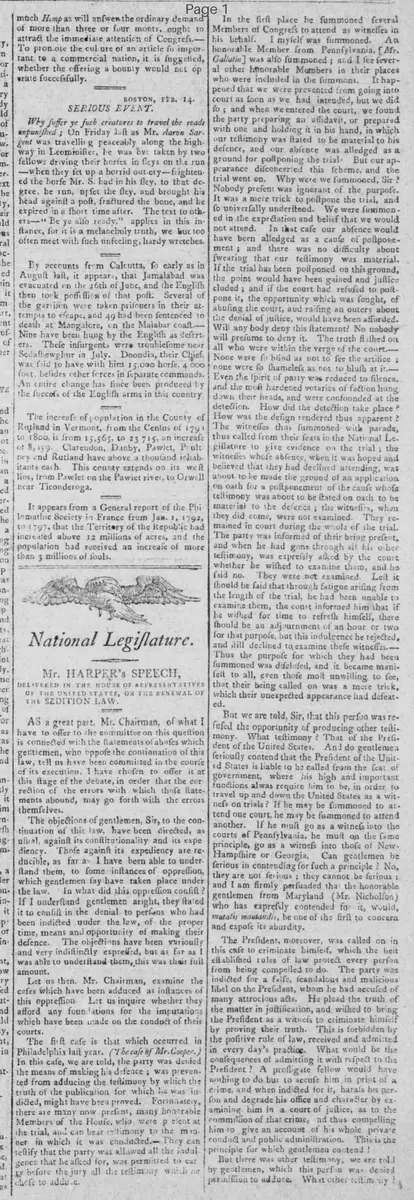
Mr. HARPER's SPEECH,
DELIVERED IN THE HOUSE OF REPRESENTATIVES OF THE UNITED STATES, ON THE RENEWAL OF THE SEDITION LAW.
AS a great part, Mr. Chairman, of what I have to offer to the committee on this question is connected with the statements of abuses which gentlemen, who oppose the continuation of this law, tell us have been committed in the course of its execution, I have chosen to offer it at this stage of the debate, in order that the correction of the errors with which those statements abound, may go forth with the errors themselves.
The objections of gentlemen, Sir, to the continuation of this law, have been directed, as usual, against its constitutionality and its expediency. Those against its expediency are reducible, as far as I have been able to understand them, to some instances of oppression, which gentlemen say have taken place under the law. In what did this oppression consist? If I understand gentlemen aright, they stated it to consist in the denial to persons who had been indicted under the law, of the proper time, means and opportunity of making their defence. The objections have been variously and very indistinctly expressed, but as far as I was able to understand them, this was their full amount.
Let us then, Mr. Chairman, examine the cases which have been adduced as instances of this oppression. Let us inquire whether they afford any foundations for the imputations which have been urged on the conduct of their courts.
The first case is that which occurred in Philadelphia last year. (The case of Mr. Cooper.) In this case, we are told, the party was denied the means of making his defence; was prevented from adducing the testimony by which the truth of the publication for which he was indicted, might have been proved. Fortunately, there are many now present, many honorable Members of the House, who were present at the trial, and can bear testimony to the manner in which it was conducted.— They can testify that the party was allowed all the indulgence that he asked for, was permitted to carry before the jury all the testimony which he chose to adduce.
In the first place he summoned several Members of Congress to attend as witnesses in his behalf. I myself was summoned. An honorable Member from Pennsylvania, Mr. Gallatin] was also summoned; and I see several other honorable Members in their places who were included in the summons. It happened that we were prevented from going into court as soon as we had intended, but we did so; and when we entered the court, we found the party preparing an affidavit, or prepared with one and holding it in his hand, in which our testimony was stated to be material to his defence, and our absence was alleged as a ground for postponing the trial. But our appearance disconcerted this scheme, and the trial went on. Why were we summoned, Sir? Nobody present was ignorant of the purpose. It was a mere trick to postpone the trial, and so universally understood. We were summoned in the expectation and belief that we would not attend. In that case our absence would have been alleged as a cause of postponement; and there was no difficulty about swearing that our testimony was material. If the trial had been postponed on this ground, the point would have been gained and justice eluded; and if the court had refused to postpone it, the opportunity which was sought, of abusing the court, and raising an outcry about the denial of justice, would have been afforded. Will any body deny this statement? No nobody will presume to deny it. The truth shed on all who were within the verge of the court.— None were so blind as not to see the artifice: none were so shameless as not to blush at it.— Even the spirit of party was reduced to silence, and the most hardened votaries of faction hung down their heads, and were confounded at the detection. How did the detection take place? How was the design rendered thus apparent? The witnesses thus summoned with parade, thus called from their seats in the National Legislature to give evidence on the trial; the witnesses whose absence, when it was hoped and believed that they had declined attending, was about to be made the ground of an application on oath for a postponement of the cause whose testimony was about to be stated on oath to be material to the defence: the witnesses, when they did come, were not examined. They remained in court during the whole of the trial. The party was informed of their being present, and when he had gone through all his other testimony, was expressly asked by the court whether he wished to examine them, and he said no. They were not examined. Lest it should be said that through fatigue arising from the length of the trial, he had been unable to examine them, the court informed him that if he wished for time to refresh himself, there should be an adjournment of an hour or two for that purpose, but this indulgence he rejected, and still declined to examine these witnesses.— Thus the purpose for which they had been summoned was disclosed, and it became manifest to all, even those most unwilling to see, that their being called on was a mere trick, which their unexpected appearance had defeated.
But we are told, Sir, that this person was refused the opportunity of producing other testimony. What testimony? That of the President of the United States. And do gentlemen seriously contend that the President of the United States is liable to be called from the seat of government, where his high and important functions always require him to be, in order to travel up and down the United States as a witness on trials? If he may be summoned to attend one court, he may be summoned to attend another. If he must go as a witness into the courts of Pennsylvania, he must on the same principle, go as a witness into those of New Hampshire or Georgia. Can gentlemen be serious in contending for such a principle? No, they are not serious: they cannot be serious: and I am firmly persuaded that the honorable gentlemen from Maryland (Mr. Nicholson) who has expressly contended for it, would, mutatis mutandis, be one of the first to condemn and expose its absurdity.
The President, moreover, was called on in this case to criminate himself, which the best established rules of law protect every person from being compelled to do. The party was indicted for a false, scandalous and malicious libel on the President, whom he had accused of many atrocious acts. He plead the truth of the matter in justification, and wished to bring the President as a witness to criminate himself by proving their truth. This is forbidden by the positive rule of law, received and admitted in every day's practice. What would be the consequences of admitting it with respect to the President? A profligate fellow would have nothing to do but to accuse him in print of a crime, and when indicted for it, harass his person and degrade his office and character by examining him in a court of justice, as to the commission of that crime, and thus compelling him to give an account of his whole private conduct and public administration. This is the principle for which gentlemen contend!
But there was other testimony, we are told by gentlemen, which this person was denied permission to adduce. What other testimony?
Certain publications extracted from sundry newspapers, and purporting to be answers of the President to various addresses, were prevented from being adduced? No. He was, on the contrary, permitted to adduce them. He was indeed told by the court, and most truly told, that these extracts from newspapers were not legal evidence; but that under the particular circumstances of the case, they should be allowed to give them in evidence. He was told that he might read in evidence whatever he thought proper. He availed himself of this permission in its full extent. He read those extracts in evidence. Indeed, far the greater part of his defence, which lasted for nearly three hours, consisted in reading and commenting on the President's answers to addresses!
Will any one deny this fact? No: it will not be denied. It cannot be denied. It took place in the presence of many witnesses; of many who now hear me. And it proves incontestably, that greater latitude of indulgence could not possibly be given in making a defence, than was given to this person. And yet, this is one of the instances adduced, of oppression, of denial of justice, under the sedition act.
The next instance is brought from Boston. We are told a melancholy story, decorated with all the graces of the pathetic, about a poor innocent printer in Boston, who was indicted under this law for a libel on the federal government, convicted, imprisoned, and at length sunk under the cold and dreary dampness of a dungeon, and yielded up his life a victim to the tyranny of the sedition act. This dismal tale, thus piteously told, is found to be completely destitute of truth in all its parts. This poor wretch, whose life fell a sacrifice to the rigors of imprisonment under sedition act, turns out to be still alive and in health. He is found to have been indicted in a state court, under the state law, and for a libel on the government. By a most singular infelicity of exactness, the fact appears, in every point, to be precisely the reverse of the story.
The last instance brought from Richmond. There too, according to gentlemen, a person indicted under this act, was denied the opportunity of producing evidence in support of his justification. Let it be recollected Mr. Chairman, that this person was indicted for a libel so atrocious, that no person, except its author, has yet been found profligate enough to defend or even quote it. A libel not on the administration merely of this government, or on the government itself, but on the nation, the constitution, our independence, the war of our revolution, the patriots who conducted it, the character of our people and country, and on the American name. A libel on every person and thing that is American, except one individual, whom alone it dishonors, by its praise; whom it disgraces as far as disgrace can be inflicted by the commendations of the wicked, whom it places alone on that bad eminence, where not even a generous enemy could wish to see him stand. A libel, Sir, which has made its supporters blush; which they sedulously endeavored to suppress, lest it should dishonor the cause which it intended to defend; which they have made to shun the light, and passed secretly from hand to hand, lest it should produce repulsion in the minds of those whom it was their wish to seduce. This, Sir, was the libel for which the person in question was indicted, and which he had the effrontery to say that he wished to prove, by the testimony of honorable men. He wished to call men of character into court, and insult them by asking them on their oaths, whether "The Prophet before Us," was true. Is there one man on earth, Sir, profligate and hardened enough, to say that he believes it? Would the gentlemen whom he pretended that it was his wish to summon, have appeared in court and said they believed what the book contained? No, Sir. One of them was in Richmond, and was summoned. He, Sir, is a man of honorable feelings, of a manly character, whose political prejudices and party animosities, strong as they are, never betrayed him into a mean or paltry action. He was summoned, and what did he answer? "Let the Scoundrel run away and I will pay his recognizance; but as to appearing for him in court that would be too much." This is said to have been his answer: and whether he gave it or not certain it is that he did not attend. The other persons proposed to be summoned were within reach, and might have been had. What did the court say? "You shall have a continuance till the next term, if you entitle yourself to it according to the rules of law, by disclosing to the court, on affidavit the matter which you expect to prove by these witnesses, and shewing that it is material. Even without complying with these terms, you shall have a postponement from day to day in order to procure your witnesses as long as the time allowed for the sitting of the Court will admit." But of this indulgence no use was made. No effort was made to procure the witnesses during the sitting of the court. That was not the object. The object was to postpone the trial till the next Court, under the pretence of the absence of witnesses; and the Court recollecting the Philadelphia case, where an attempt was made to practice a similar trick, were on their guard, and very properly resolved to defeat it. They resolved to bring on the trial, unless proper and legal grounds for a continuance should be shewn. As this could not be done, the trial was brought on and the party convicted by an honest, responsible, and independent jury.
So much, Mr. Chairman, for the oppressions exercised under this law, and for the objections to its expediency.
The Prophet before Us.
What sub-type of article is it?
What themes does it cover?
What keywords are associated?
What entities or persons were involved?
Where did it happen?
Story Details
Key Persons
Location
House Of Representatives Of The United States; Philadelphia; Boston; Richmond
Event Date
Last Year (Philadelphia Case)
Story Details
Mr. Harper refutes claims of oppression under the Sedition Law by detailing fair trials in Philadelphia (Cooper denied no testimony, used tricks), Boston (printer alive, state case), and Richmond (defendant convicted after failing to procure witnesses for atrocious libel 'The Prophet before Us').