Thank you for visiting SNEWPapers!
Sign up free
Gazette Of The United States, & Daily Advertiser
Philadelphia, Philadelphia County, Pennsylvania
What is this article about?
Two editorials: one denounces pro-French Jacobin sentiments in the Baltimore American as traitorous, urging exclusion from office; the other defends Alexander Hamilton against accusations of monarchism, British bias, and opposition to Adams.
Merged-components note: Merged across pages as continuation of the same editorial criticizing a paragraph from the Baltimore American regarding French success and British faction; coherent topic and flow.
Clippings
1 of 2
OCR Quality
Full Text
This is Event 1 of 2. The full text below covers all events in this component.
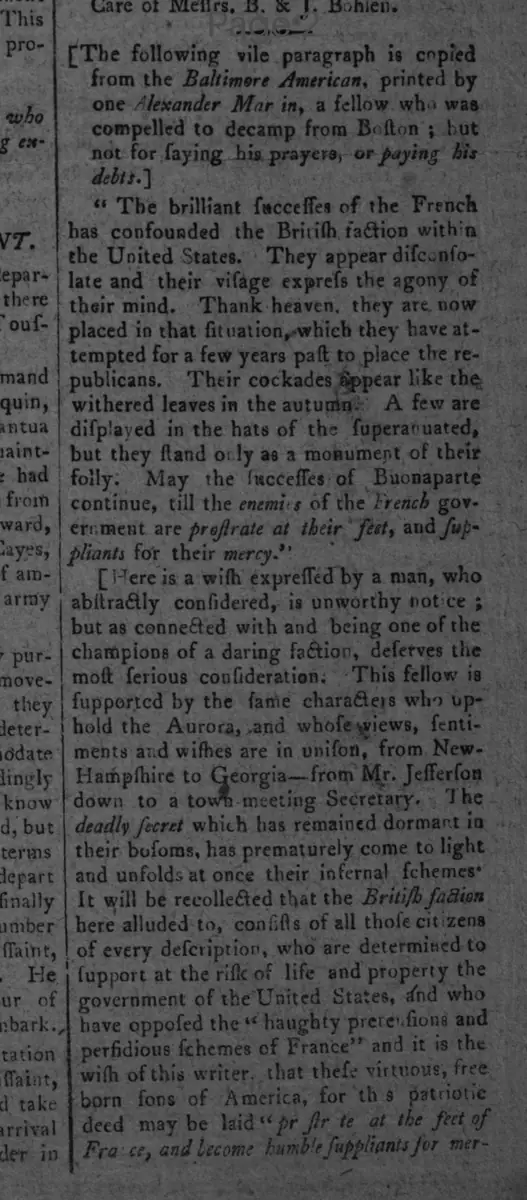
" The brilliant success of the French has confounded the British faction within the United States. They appear disconsolate and their visage express the agony of their mind. Thanks be heaven, they are now placed in that situation, which they have attempted for a few years past to place the republicans. Their cockades appear like the withered leaves in the autumn. A few are displayed in the hats of the superannuated. but they stand or lie as a monument of their folly: May the success of Buonaparte continue, till the enemies of the French government are prostrate at their feet, and suppliants for their mercy."
Here is a wish expressed by a man, who abstractly considered, is unworthy notice; but as connected with and being one of the champions of a daring faction, deserves the most serious consideration: This fellow is supported by the same characters who uphold the Aurora, and whose views, sentiments and wishes are in union, from New-Hampshire to Georgia—from Mr. Jefferson down to a town meeting Secretary. The deadly secret which has remained dormant in their bosoms, has prematurely come to light and unfolds at once their infernal schemes
It will be recollected that the British faction here alluded to, consists of all those citizens of every description, who are determined to support at the risk of life and property the government of the United States, and who have opposed the " haughty pretensions and perfidious schemes of France" and it is the wish of this writer. that these virtuous, free born sons of America, for this patriotic deed may be laid " prostrate at the feet of France, and become humble suppliants for mercy."
Say "Never were more traitorous sentiments uttered or a more daring, insulting and hostile wish expressed. Yet these men tell you they are "friends to the people" but they should add being in slavery to France, for this is declared to be their intention, and they hope Buonaparte's success may continue till all his enemies are reduced to that degrading situation. There is one way, and only one, for Americans to prevent their wishes being realized, and that is, by keeping out of office all those characters who, under pretence of being "Friends to the People" are advocating a foreign government, and exultingly proclaim the wish that your enemy's victories may not cease till you are "laid prostrate at their feet and become humble suppliants for mercy."
Should the Jacobins once obtain ascendancy in the Councils of our country, the people of America will be compelled to gratify their wish, to its utmost extent.
From the (Boston) Commercial Gazette.
THE CHARACTER OF
General ALEXANDER HAMILTON
Considered and Vindicated.
[Continuation]
IT has been asserted, with as much boldness and effrontery, as if it had the semblance of truth, that General Hamilton is a friend to monarchy, and some have carried this political figure of speech to so ridiculous an extent, as to contend that he aimed to establish royalty in his own person. So long as this absurd calumny was confined to jacobins, it was suffered to pass unnoticed, with the charges of the same nature, exhibited and so often repeated against Washington, Adams, and all the other strenuous supporters of government. But when writers in so respectable a paper as the Commercial Gazette, assume the allegations and calumnies of jacobins, as truths, when they assert as proved, charges which are notoriously false, it becomes important to check the dangerous torrent, and to prevent the pollution of the few pure streams of public information. What evidence exists, or what shadow of evidence has ever been adduced to prove, that General Hamilton is averse to a republican government and attached to a monarchical one. Has he ever expressed an opinion of this kind in any of his numerous public writings, or ever in the more retired moments of confidential conversation? If he has, let his enemies declare; (for he has enemies enough who are sufficiently embittered) to whom were the declarations made, on what occasion, and what their import? I pass by, as undeserving notice the allegations of Junius Americanus and others, of speeches made by Gen. Hamilton, or they are notoriously false, and even the anonymous scribblers are ashamed to avow the baseness of their origin. But the defence of such a man as Hamilton, need not be reposed on the feebleness of his enemies - his character does not seek shelter under a negative defence; he has given to the world, noble, unequivocal evidence of his love of liberty, and of republican government; proofs more durable than the malicious, slanders of his opponents. In our revolutionary war, he fought the battles of freedom - he bared his breast to the bayonets of an enemy, whom some of his calumniators dare not face. After the peace, he partook of the labours of government in the Congress of the United States. In the convention of 1787, which framed the present federal constitution, and which his enemies affect to admire, he was a distinguished, powerful and important member. Whatever there is of freedom, of stability, of wisdom in that fabric, Hamilton has his full share of the merit of it. He was the only member from the important state of New-York, who signed the constitution after its adoption, he wrote in conjunction with Gov. Jay and Mr. Madison, (who has since apostatized) those most excellent essays under the title of the Federalist and the signature of Publius - a work, confessedly, the first ever published in America, for profoundness, for perspicuity and elegance. His fellow labourers have had the generosity to confess that it is principally the work of Alexander Hamilton. -- And is it credible that a man who so largely and powerfully contributed to produce our excellent constitution, is hostile to its principles. From whom does the charge come? From the very men, who opposed the constitution, although it has been supported lately by some who have acted, and still think more correctly. Would not Gen. Hamilton have prevented the proposition of so excellent a constitution, would he not have attempted to increase the confusions and disasters of the country, instead of attempting to alleviate them, if he had really wished a government of more force and less freedom? Did he take the measures which tyrants have always successfully pursued, to produce civil wars and insurrections, in order that they may ride upon the whirlwind and direct the storm? No. - The whole life of General Hamilton, has been devoted most disinterestedly, to protect, secure and maintain the liberties of the people, on the only solid foundation, that of law and regular organized government. Many men in their closets may have written, but no man has done more for the preservation of liberty order and good government.
Another charge of similar complexion in point both of malignity and falsehood which has been bestowed upon Gen. Hamilton, is that he is a partizan of Great Britain, that he is one of a British faction. Jefferson in his letter to Mazzei, makes this same charge against President Washington, Vice President Adams, and a majority of the Senate. The Chronicle, Aurora, and Argus, have reechoed these charges, but all honest men knew that they were introduced to ward off an enquiry into French influence and French intrigue. Of late, certain zealots of another description have borrowed the slanders of jacobins, uttered them with an impudence and boldness, which has astonished even the fabricators of them. But is not this last manifestly as illfounded as the other? In what one act, has Gen Hamilton manifested a partiality for Great Britain? In the conduct of so distinguished a man, nothing escapes remark, and nothing improper eludes severe crimination Yet his worst enemies have never dared to specify a charge. a single fact on this head. Will Federalists quarrel with the proclamation of neutrality, which Hamilton so ably supported in the cabinet against Jefferson and. which the partizans of France so loudly condemned as a violation of our treaty with France? Will they assume the language of opposition and contend that we ought to have armed on the side of the French Republic? If not will they censure the eloquent and able author of Pacificus, who vindicated Washington's proclamation of neutrality, and who contributed so much to keep the nation out of the vortex of French revolutionary principles? If these are evidences of a partiality for Great Britain - if fighting by the side of Washington, when the Auditors of our Country were skulking in safety, and the Fellows, were claiming the protection of Great Britain; if retaining the undiminished confidence of our greatest and first of citizens till his death, are proofs of Gen. Hamilton's attachment to Great Britain, then stigmatize him as the leader of a British faction, I shall glory in being marked as one of such a faction under such a leader.
The last charge which the malicious industry of his enemies has conjured up against him. is that Gen. Hamilton is opposed to the re-election of President Adams. This is that which has given all the bitterness which has communicated all the venom to the slanders against this distinguished patriot - With the language of patriotism in their mouths, these calumniators have been governed wholly by the narrow considerations and feelings of personal resentment. The public, however, before they undertake to decide will consider coolly and calmly the truth, the nature and the merits of the charge. 'Is the charge true? What evidence have they furnished to the public that Gen. Hamilton is opposed to Mr. Adams? Facts would speak a different language - President Adams appointed Gen. Hamilton to the elevated office which he now holds - This is at once a proof of Gen. Hamilton's superior merits, and of the improbability of their being at variance. Is Gen. Hamilton a candidate? No - are any of his friends candidates? No what interest can he have in a change of that office? None— If any, let his enemies declare it - But if it were true. that Gen. Hamilton is of opinion that another man would be better fitted to fill that important office, is that a crime, which is to strip him. of all his hard earned laurels? Is a man, to be abused and vilified because he does not agree with us in the qualifications and merit of our favourite candidate. though he has supported our principles through a long laborious, and useful life? Is the constitution a dead letter, which provides for a peaceable and orderly rotation in office? and is that man republican, who censures another for exercising his rights in a peaceable orderly and constitutional manner? But it is said, that Gen. Hamilton tried to prevent the election of Mr. Adams at the last election- that this is a crime of deep dye, for which he ought to be abused as a Royalist and a partizan of Britain - I am glad, that this case has been mentioned, because it will elucidate and justify, most fully. the conduct of Gen Hamilton at the last and present election.
Upon the resignation of Gen. Washington, it was extremely doubtful who would be his successor. It was well known that deep and violent prejudices, inflamed and embittered for the space of eight years. existed against Mr. Adams in the Southern States. He had been abused as Hamilton now is as a royalist.. His excellent defence on the American constitutions. had been garbled, distorted, perverted and misrepresented as the speeches of Gen. Hamilton, now are, by Junius Americanus, and other jacobinic writers, and he was generally, tho' falsely believed to be an advocate for titles. and an hereditary aristocracy - his manners never were conciliatory to his enemies, nor very flattering to his friends - He was conceived to. have too much both of Cato and Cicero in his composition to render him popular. All honest men, therefore, who were not personally attached to him, thought it the wisest policy to set up with him, a southern federalist, who might unite southern prejudices with federal principles in his favour, and thus effectually guard against the introduction of that worst of all calamities, a jacobin President. It was also believed that this was the honest and fair practice upon the constitution, and that it was important to secure a federal Vice President, who would have all the powers in case of vacancy. That General Hamilton might patriotically have entertained these sentiments is very possible. The event showed the correctness and patriotism of this conduct; Massachusetts and Connecticut by departing from this system put at hazard the constitution and government. Mr. Adams had but one vote to spare, and yet he had one in Pennsylvania and one in Virginia, out of 34 in those states --if those two electors had not possessed the uncommon, unexpected fortitude to vote against all their colleagues, the election would have been lost; Jefferson would have been our President; France our mother country; Buonaparte our Chief Consul. Was not this a miraculous escape? Was it wise or prudent to play this desperate game? Was it not like a gameter who takes his fortune
What sub-type of article is it?
What keywords are associated?
What entities or persons were involved?
Editorial Details
Primary Topic
Criticism Of Pro French Sentiments In The Baltimore American
Stance / Tone
Strongly Anti Jacobin And Anti French Influence, Pro Federalist Government
Key Figures
Key Arguments