Thank you for visiting SNEWPapers!
Sign up free
Editorial
March 8, 1950
Atlanta Daily World
Atlanta, Fulton County, Georgia
What is this article about?
John H. Harris argues for enhancing roadside aesthetics in North Carolina by conserving natural beauty, removing junk, grading and seeding areas, and planting trees and shrubs to counter urbanization's ugliness.
Clipping
OCR Quality
98%
Excellent
Full Text
TARHEEL
GARDENER
By
JOHN H. HARRIS
RALEIGH, N. C. — (ANP)
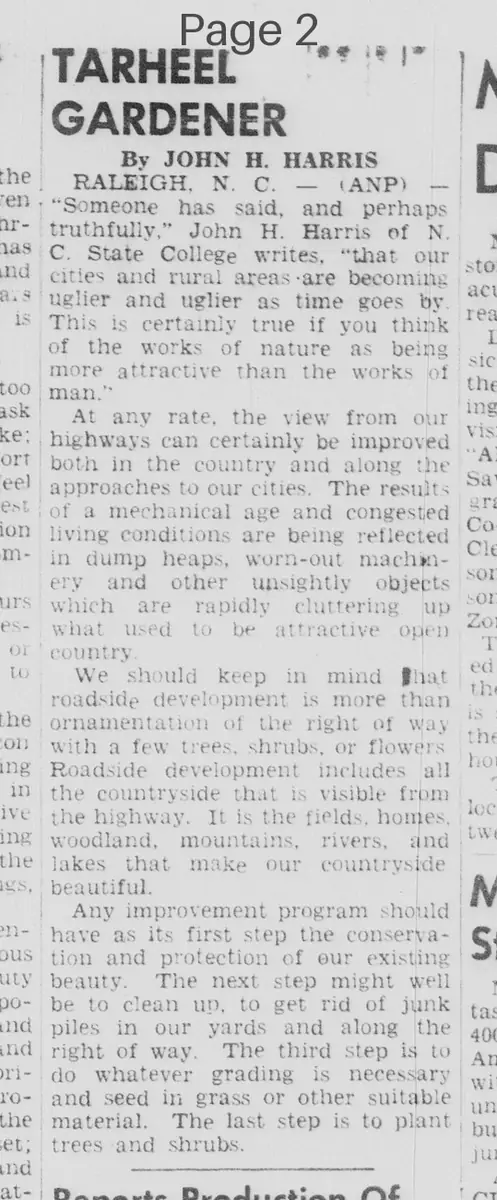
"Someone has said, and perhaps truthfully," John H. Harris of N. C. State College writes. "that our cities and rural areas are becoming uglier and uglier as time goes by. This is certainly true if you think of the works of nature as being more attractive than the works of man."
At any rate, the view from our highways can certainly be improved both in the country and along the approaches to our cities. The result of a mechanical age and congested living conditions are being reflected in dump heaps, worn-out machinery and other unsightly objects which are rapidly cluttering up what used to be attractive open country.
We should keep in mind that roadside development is more than ornamentation of the right of way with a few trees, shrubs, or flowers. Roadside development includes all the countryside that is visible from the highway. It is the fields, homes, woodland, mountains, rivers, and lakes that make our countryside beautiful.
Any improvement program should have as its first step the conservation and protection of our existing beauty. The next step might well be to clean up, to get rid of junk piles in our yards and along the right of way. The third step is to do whatever grading is necessary and seed in grass or other suitable material. The last step is to plant trees and shrubs.
GARDENER
By
JOHN H. HARRIS
RALEIGH, N. C. — (ANP)
"Someone has said, and perhaps truthfully," John H. Harris of N. C. State College writes. "that our cities and rural areas are becoming uglier and uglier as time goes by. This is certainly true if you think of the works of nature as being more attractive than the works of man."
At any rate, the view from our highways can certainly be improved both in the country and along the approaches to our cities. The result of a mechanical age and congested living conditions are being reflected in dump heaps, worn-out machinery and other unsightly objects which are rapidly cluttering up what used to be attractive open country.
We should keep in mind that roadside development is more than ornamentation of the right of way with a few trees, shrubs, or flowers. Roadside development includes all the countryside that is visible from the highway. It is the fields, homes, woodland, mountains, rivers, and lakes that make our countryside beautiful.
Any improvement program should have as its first step the conservation and protection of our existing beauty. The next step might well be to clean up, to get rid of junk piles in our yards and along the right of way. The third step is to do whatever grading is necessary and seed in grass or other suitable material. The last step is to plant trees and shrubs.
What sub-type of article is it?
Agriculture
Infrastructure
Social Reform
What keywords are associated?
Roadside Development
Countryside Beauty
Landscape Conservation
Rural Improvement
Junk Cleanup
Tree Planting
What entities or persons were involved?
John H. Harris
N. C. State College
Editorial Details
Primary Topic
Roadside Beautification And Countryside Conservation
Stance / Tone
Advocatory For Landscape Improvement
Key Figures
John H. Harris
N. C. State College
Key Arguments
Cities And Rural Areas Are Becoming Uglier Due To Human Works Overshadowing Nature
Highway Views Can Be Improved In Country And City Approaches
Roadside Development Encompasses All Visible Countryside Including Fields, Homes, Woodlands, Mountains, Rivers, And Lakes
First Step: Conservation And Protection Of Existing Beauty
Second Step: Clean Up Junk Piles In Yards And Along Right Of Way
Third Step: Grading And Seeding With Grass Or Suitable Material
Fourth Step: Planting Trees And Shrubs