Thank you for visiting SNEWPapers!
Sign up free
Literary
March 20, 1835
The Hillsborough Recorder
Hillsboro, Orange County, North Carolina
What is this article about?
A grieving young Earl of Derby, disillusioned with nobility after losing his child and wife, disguises himself as a commoner and falls in love with Lucy, a kind country girl of low birth. He marries her secretly before revealing his identity, leading to her elevation as Countess.
Clipping
OCR Quality
75%
Good
Full Text
From the New York Mirror
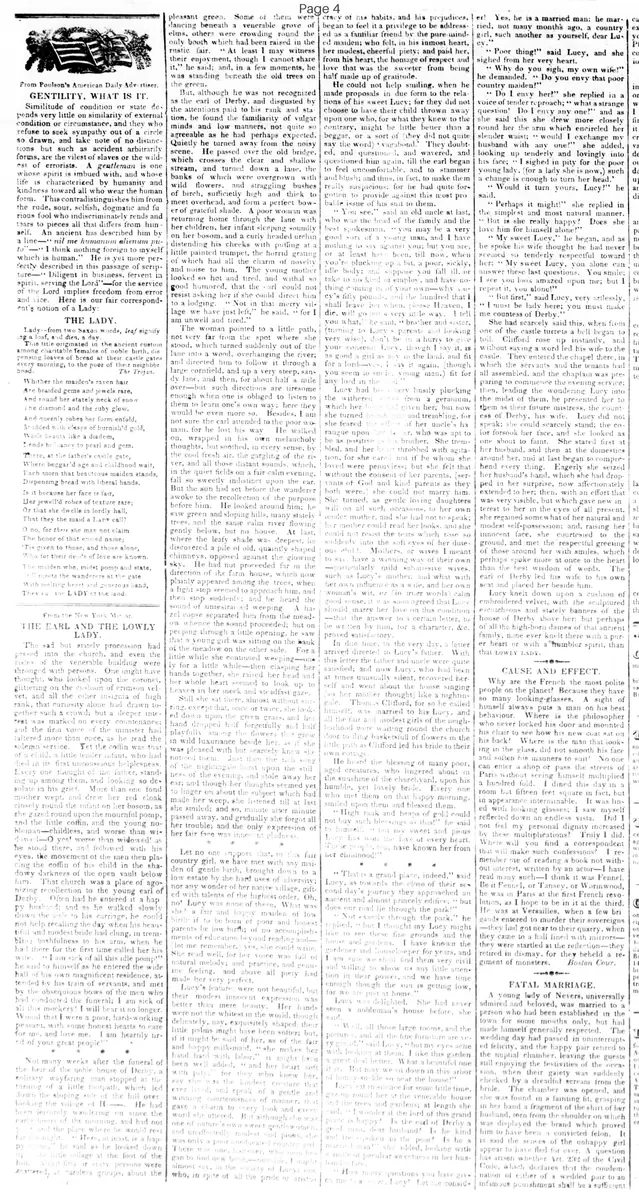
THE EARL AND THE LOWLY LADY.
The sad but stately procession had passed into the church, and even the aisles of the venerable building were thronged with persons. One might have thought, who looked upon the coronet, glittering on the cushion of crimson velvet, and all the other insignia of high rank, that curiosity alone had drawn together such a crowd: but a deeper interest was marked on every countenance; and the firm voice of the minister had faltered more than once, as he read the solemn service. Yet the coffin was that of a child, a little tender infant, who had died in its first unconscious helplessness. Every one thought of the father, standing up among them, and looking so desolate in his grief. More than one fond mother wept, and drew her red cloak closely round the infant on her bosom, as she gazed round upon the mournful pomp, and the little coffin, and the young nobleman—childless, and worse than widowed—O yes! worse than widowed! as he stood there, and followed with his eyes, the movement of the men then placing the coffin of his child in the shadowy darkness of the open vault below him. That church was a place of agonizing recollection to the young earl of Derby. Often had he entered it a happy husband: and as he walked slowly down the aisle, to his carriage, he could not help recalling the day when his beautiful and modest bride had clung, in trembling bashfulness to his arm, when he had there for the first time called her his wife. "I am sick of all this idle pomp!" he said to himself as he entered the wide hall of his own magnificent residence, attended by his train of servants, and met by the obsequious bows of the men who had conducted the funeral: I am sick of all this mockery: I will bear it no longer. Would that I were a poor, hard-working peasant, with some honest hearts to care for me, and love me. I am heartily tired of your great people"
Not many weeks after the funeral of the heir of the noble house of Derby, a solitary wayfaring man stopped at the turning of a little footpath, which led down the sloping side of the hill overlooking the village of I-en. He had been leisurely wandering on since the early hour of the morning, and had not so foot the place where he would rest yorde night. "There, at least, re a happy cen," he said as he looked down upon that little village at the foot of the hill. Zu few or lazy persons were scattered, or careless groups, about the pleasant green. Some of them were dancing beneath a venerable grove of elms, others were crowding round the only booth which had been raised in the rustic fair. "At least I may witness their enjoyment, though I cannot share it," he said: and, in a few moments, he was standing beneath the old trees on the green.
But, although he was not recognized as the earl of Derby, and disgusted by the attentions paid to his rank and station, he found the familiarity of vulgar minds and low manners, not quite so agreeable as he had perhaps expected. Quietly he turned away from the noisy scene. He passed over the old bridge, which crosses the clear and shallow stream, and turned down a lane, the banks of which were overgrown with wild flowers, and straggling bushes of birch, sufficiently high and thick to meet overhead, and form a perfect bower of grateful shade. A poor woman was returning home through the lane with her children, her infant sleeping soundly on her bosom, and a curly headed urchin distending his cheeks with puffing at a little painted trumpet, the horrid grating of which had all the charm of novelty and noise to him. The young mother looked so hot and tired, and withal so good humored, that the earl could not resist asking her if she could direct him to a lodging. "Not in that merry village we have just left," he said, "for I am unwell and tired."
The woman pointed to a little path, not very far from the spot where she stood, which turned suddenly out of the lane into a wood, overhanging the river: and directed him to follow it through a large cornfield, and up a very steep, sandy lane, and then, for about half a mile over—but such directions are tiresome enough when one is obliged to listen to them to learn one's own way; here they would be even more so. Besides, I am not sure the earl attended to the poor woman, for he lost his way. He walked on, wrapped in his own melancholy thoughts, but soothed, in every sense, by the cool fresh air, the gargling of the river, and all those distant sounds, which, in the quiet fields on a fair calm evening, fall so sweetly indistinct upon the ear. But the sun had set before the wanderer awoke to the recollection of the purpose before him. He looked around him: he saw green and sloping hills, many stately trees, and the same calm river flowing gently below, but no house. At last, where the leafy shade was deepest, he discovered a pile of old, quaintly shaped chimneys, opposed against the glowing sky. He had not proceeded far in the direction of the farm house, which now plainly appeared among the trees, when a light step seemed to approach him, and then stop suddenly: and he heard the sound of unrestrained weeping. A hazel copse separated him from the meadow whence the sound proceeded; but on peeping through a little opening, he saw that a young girl was sitting on the bank of the meadow on the other side. For a little while she continued weeping—only for a little while—then clasping her hands together, she raised her head and her whole heart seemed to look up to heaven in her meek and steadfast gaze. Still she sat there, almost without stirring, except that, once or twice, she looked down upon the green grass, and her hand dropped half forgetfully and half playfully among the flowers that grew in wild luxuriance beside her, as if she was pleased with but scarcely noticed them. Just then the full song of the nightingale burst upon the stillness of the evening, and stole away her ear: and though her thoughts seemed yet to linger on about the subject which had made her weep, she listened till at last she smiled; and so, minute after minute passed away, and gradually she forgot all her trouble; and the only expression of her fair face was innocent gladness.
Let no one suppose that, in this fair country girl, we have met with any maiden of gentle birth, brought down to a low estate by the hard uses of adversity: nor any wonder of her native village, gifted with talents of the highest order. Oh, no! Lucy was none of these. What was she? a fair and happy maiden of low birth: if to be born of poor and honest parents be low birth; of no accomplishments of education beyond reading and—let me remember, yes, she could write. She read well, for her voice was full of natural melody: and practice, and genuine feeling, and above all piety had made her very perfect. Lucy's features were not beautiful, but their modest innocent expression was better than mere beauty. Her hands were not the whitest in the world, though delicately, nay, exquisitely shaped: their little palms might have been softer; but, if it might be said of her, as of the fair and happy milk-maid, "she makes her hand hard with labor." It might have been well added, "and her heart soft with pity," for they who knew her, say she was the kindest creature that ever lived, and speak of a gentle and winning courteousness of manner, that gave a charm to every look and every word she uttered. But although she was one of nature's own sweet gentlewomen, and unaffectedly modest and pious, she was only a poor and datd contrgur. There was one, however, who soon began to find new hope,—her hope, I am almost sure, on the generosity of Lucy's on who, in spite of all the pride or aristocracy of his habits, and his prejudices, began to feel it a privilege to be addressed as a familiar friend by the pure-minded maiden; who felt, in his inmost heart, her modest, cheerful piety; and paid her, from his heart, the homage of respect and love that was the sweeter from being half made up of gratitude.
He could not help smiling, when he made proposals, in due form to the relations of his sweet Lucy: for they did not choose to have their child thrown away upon one who, for what they knew to the contrary, might be little better than a beggar, or a sort of (they did not quite say the word) vagrant. They doubted, and questioned, and wavered, and questioned him again, till the earl began to feel uncomfortable, and to stammer and blush; and thus, in fact, to make them really suspicious: for he had quite forgotten to provide against this most probable issue of his suit to them.
"You see," said an old uncle at last, who was the head of the family and the best spokesman, "you may be a very good sort of a young man, and I have nothing to say against you: but you are, or at least have been, till now, when you're plucking up a bit, a poor, sickly, idle body: and suppose you fall ill, or take to no kind of employment, and have nothing coming in of your own—why Lucy's fifty pounds, and the hundred that I shall leave her when, please Heaven, I die, will go on a very little way. I tell you what," he said, brother and sister, (turning to Lucy's parents and looking very wise), "don't be in a hurry to give your consent: Lucy, though I say it, is as good a girl as any in the land, and fit for a lord—aye, I say it again, (though you seem to smile, young man,) fit for any lord in the land."
Lucy had been very busily plucking the withered from a geranium, which her given her; but now she turned and trembling, for she feared the of her uncle's harangue upon er, who was apt to be as positive brother. She trembled, and her eyes throbbed with agitation, for she cared not if he whom she loved were penniless: but she felt that without the consent of her parents, (servants of God and kind parents as they both were,) she could not marry him. She turned, as gentle loving daughters will on all such occasions, to her own tender mother, and she had not to speak; but rapture could read her looks, and she could not resist the tears which rose so suddenly into the soft eyes of her daughter. Mothers, or wives I meant to say, have a winning way of their own—particularly mild submissive wives, such as Lucy's mother, and what with her own influence as a wife, and her own woman's wit, or in truer words) calm good sense, it was soon agreed that Lucy should marry her love on this condition—that the answer to a certain letter, to be written by him, for a character, &c., proved satisfactory.
In due time, in the very day, a letter arrived directed to Lucy's father. With this letter the father and uncle were quite satisfied; and now Lucy, who had been at times unusually silent, recovered herself and went about the house singing (so her mother thought) like a nightingale. Thomas Clifford, for so he called himself, was married to his Lucy, and all the shy and modest girls of the neighborhood were waiting round the church door to throw basketfull of flowers in the little path as Clifford led his bride to their own cottage. He heard the blessing of many poor, aged creatures, who lingered about in the sunshine of the churchyard, upon his humble, yet lovely bride. Every one who met them on that happy morning, smiled upon them and blessed them.
"High rank and heaps of gold could not buy such blessings as this!" he said to himself, "but my sweet and pious Lucy has won the love of every heart. The poor too, have known her from her childhood!"
"That is a grand place, indeed," said Lucy, as towards the close of their second day's journey they approached an ancient and almost princely edifice. "but does our road lie through the park?"
"Not exactly through the park," he replied, "but I thought my Lucy might like to see these fine grounds and the house and gardens. I have known the gardener and housekeeper for years, and I am sure we should find them very civil and willing to show us any little attention in their power, and we have time enough though the sun is getting low, for we are just at home."
Lucy was delighted. She had never seen a nobleman's house before, she nd "Well, all those large rooms, and the pictures, and all the fine furniture are very grand," said Lucy, "but my eyes ache with looking at them: I like this garden a great deal better. What a beautiful one it is. But may we sit down in this arbor of honey suckle so near the house?"
Lucy sat in silence for some little time, gazing round her at the venerable house and fine trees and gardens: at length she said, "I wonder if the lord of this grand place is happy? Is the earl of Derby a good man, dear husband? Is he kind and well spoken to the poor? Is he a married man?" she added, joking with a way of playful sweetness in her eyes.
"How many questions you have given on me, O my Lucy! Let me consider! Yes, he is a married man: he married, not many months ago, a country girl, such another as yourself, dear Lucy."
"Poor thing!" said Lucy, and she sighed from her very heart.
"Why do you sigh, my own wife?" he demanded. "Do you envy that poor country maiden?"
"Do I envy her?" she replied in a voice of tender reproach; "what a strange question! Do I envy any one?" and as she said this she drew more closely round her the arm which encircled her slender waist; "would I exchange my husband with any one?" she added, looking up tenderly and lovingly into his face; "I sighed in pity for the poor young lady, (for a lady she is now,) such a change is enough to turn her head."
"Would it turn yours, Lucy?" he said.
"Perhaps it might!" she replied in the simplest and most natural manner.
"But is she really happy? Does she love him for himself alone?"
"My sweet Lucy," he began, and as he spoke his wife thought he had never seemed so tenderly respectful toward her: "My sweet Lucy, you alone can answer these last questions. You smile; I see you look amazed upon me; but I repeat it, you alone!"
"But first," said Lucy, very artlessly, "I must be lady here: you must make me countess of Derby."
She had scarcely said this, when from one of the castle turrets a bell began to toll. Clifford rose up instantly, and without saying a word led his wife to the castle. They entered the chapel there, in which the servants and the tenants had all assembled, and the chaplain was preparing to commence the evening service: then, leading the wondering Lucy into the midst of them, he presented her to them as their future mistress, the countess of Derby, his wife. Lucy did not speak: she could scarcely stand; the color forsook her face, and she looked as one about to faint. She stared first at her husband, and then at the domestics around her, and at last began to comprehend every thing. Eagerly she seized her husband's hand, which she had dropped in her surprise, now affectionately extended to her: then, with an effort that was very visible, but which gave new interest to her in the eyes of all present, she regained somewhat of her natural and modest self-possession: and, raising her innocent face, she courtesied to the ground, and met the respectful greeting of those around her with smiles, which perhaps spoke more at once to the heart than the best wisdom of words. The earl of Derby led his wife to his own seat and placed her beside him. Lucy knelt down upon a cushion of embroidered velvet, with the sculptured escutcheons and stately banners of the house of Derby above her: but perhaps of all the high-born dames of that ancient family, none ever knelt there with a purer heart or with a humbler spirit, than that LOWLY LADY.
THE EARL AND THE LOWLY LADY.
The sad but stately procession had passed into the church, and even the aisles of the venerable building were thronged with persons. One might have thought, who looked upon the coronet, glittering on the cushion of crimson velvet, and all the other insignia of high rank, that curiosity alone had drawn together such a crowd: but a deeper interest was marked on every countenance; and the firm voice of the minister had faltered more than once, as he read the solemn service. Yet the coffin was that of a child, a little tender infant, who had died in its first unconscious helplessness. Every one thought of the father, standing up among them, and looking so desolate in his grief. More than one fond mother wept, and drew her red cloak closely round the infant on her bosom, as she gazed round upon the mournful pomp, and the little coffin, and the young nobleman—childless, and worse than widowed—O yes! worse than widowed! as he stood there, and followed with his eyes, the movement of the men then placing the coffin of his child in the shadowy darkness of the open vault below him. That church was a place of agonizing recollection to the young earl of Derby. Often had he entered it a happy husband: and as he walked slowly down the aisle, to his carriage, he could not help recalling the day when his beautiful and modest bride had clung, in trembling bashfulness to his arm, when he had there for the first time called her his wife. "I am sick of all this idle pomp!" he said to himself as he entered the wide hall of his own magnificent residence, attended by his train of servants, and met by the obsequious bows of the men who had conducted the funeral: I am sick of all this mockery: I will bear it no longer. Would that I were a poor, hard-working peasant, with some honest hearts to care for me, and love me. I am heartily tired of your great people"
Not many weeks after the funeral of the heir of the noble house of Derby, a solitary wayfaring man stopped at the turning of a little footpath, which led down the sloping side of the hill overlooking the village of I-en. He had been leisurely wandering on since the early hour of the morning, and had not so foot the place where he would rest yorde night. "There, at least, re a happy cen," he said as he looked down upon that little village at the foot of the hill. Zu few or lazy persons were scattered, or careless groups, about the pleasant green. Some of them were dancing beneath a venerable grove of elms, others were crowding round the only booth which had been raised in the rustic fair. "At least I may witness their enjoyment, though I cannot share it," he said: and, in a few moments, he was standing beneath the old trees on the green.
But, although he was not recognized as the earl of Derby, and disgusted by the attentions paid to his rank and station, he found the familiarity of vulgar minds and low manners, not quite so agreeable as he had perhaps expected. Quietly he turned away from the noisy scene. He passed over the old bridge, which crosses the clear and shallow stream, and turned down a lane, the banks of which were overgrown with wild flowers, and straggling bushes of birch, sufficiently high and thick to meet overhead, and form a perfect bower of grateful shade. A poor woman was returning home through the lane with her children, her infant sleeping soundly on her bosom, and a curly headed urchin distending his cheeks with puffing at a little painted trumpet, the horrid grating of which had all the charm of novelty and noise to him. The young mother looked so hot and tired, and withal so good humored, that the earl could not resist asking her if she could direct him to a lodging. "Not in that merry village we have just left," he said, "for I am unwell and tired."
The woman pointed to a little path, not very far from the spot where she stood, which turned suddenly out of the lane into a wood, overhanging the river: and directed him to follow it through a large cornfield, and up a very steep, sandy lane, and then, for about half a mile over—but such directions are tiresome enough when one is obliged to listen to them to learn one's own way; here they would be even more so. Besides, I am not sure the earl attended to the poor woman, for he lost his way. He walked on, wrapped in his own melancholy thoughts, but soothed, in every sense, by the cool fresh air, the gargling of the river, and all those distant sounds, which, in the quiet fields on a fair calm evening, fall so sweetly indistinct upon the ear. But the sun had set before the wanderer awoke to the recollection of the purpose before him. He looked around him: he saw green and sloping hills, many stately trees, and the same calm river flowing gently below, but no house. At last, where the leafy shade was deepest, he discovered a pile of old, quaintly shaped chimneys, opposed against the glowing sky. He had not proceeded far in the direction of the farm house, which now plainly appeared among the trees, when a light step seemed to approach him, and then stop suddenly: and he heard the sound of unrestrained weeping. A hazel copse separated him from the meadow whence the sound proceeded; but on peeping through a little opening, he saw that a young girl was sitting on the bank of the meadow on the other side. For a little while she continued weeping—only for a little while—then clasping her hands together, she raised her head and her whole heart seemed to look up to heaven in her meek and steadfast gaze. Still she sat there, almost without stirring, except that, once or twice, she looked down upon the green grass, and her hand dropped half forgetfully and half playfully among the flowers that grew in wild luxuriance beside her, as if she was pleased with but scarcely noticed them. Just then the full song of the nightingale burst upon the stillness of the evening, and stole away her ear: and though her thoughts seemed yet to linger on about the subject which had made her weep, she listened till at last she smiled; and so, minute after minute passed away, and gradually she forgot all her trouble; and the only expression of her fair face was innocent gladness.
Let no one suppose that, in this fair country girl, we have met with any maiden of gentle birth, brought down to a low estate by the hard uses of adversity: nor any wonder of her native village, gifted with talents of the highest order. Oh, no! Lucy was none of these. What was she? a fair and happy maiden of low birth: if to be born of poor and honest parents be low birth; of no accomplishments of education beyond reading and—let me remember, yes, she could write. She read well, for her voice was full of natural melody: and practice, and genuine feeling, and above all piety had made her very perfect. Lucy's features were not beautiful, but their modest innocent expression was better than mere beauty. Her hands were not the whitest in the world, though delicately, nay, exquisitely shaped: their little palms might have been softer; but, if it might be said of her, as of the fair and happy milk-maid, "she makes her hand hard with labor." It might have been well added, "and her heart soft with pity," for they who knew her, say she was the kindest creature that ever lived, and speak of a gentle and winning courteousness of manner, that gave a charm to every look and every word she uttered. But although she was one of nature's own sweet gentlewomen, and unaffectedly modest and pious, she was only a poor and datd contrgur. There was one, however, who soon began to find new hope,—her hope, I am almost sure, on the generosity of Lucy's on who, in spite of all the pride or aristocracy of his habits, and his prejudices, began to feel it a privilege to be addressed as a familiar friend by the pure-minded maiden; who felt, in his inmost heart, her modest, cheerful piety; and paid her, from his heart, the homage of respect and love that was the sweeter from being half made up of gratitude.
He could not help smiling, when he made proposals, in due form to the relations of his sweet Lucy: for they did not choose to have their child thrown away upon one who, for what they knew to the contrary, might be little better than a beggar, or a sort of (they did not quite say the word) vagrant. They doubted, and questioned, and wavered, and questioned him again, till the earl began to feel uncomfortable, and to stammer and blush; and thus, in fact, to make them really suspicious: for he had quite forgotten to provide against this most probable issue of his suit to them.
"You see," said an old uncle at last, who was the head of the family and the best spokesman, "you may be a very good sort of a young man, and I have nothing to say against you: but you are, or at least have been, till now, when you're plucking up a bit, a poor, sickly, idle body: and suppose you fall ill, or take to no kind of employment, and have nothing coming in of your own—why Lucy's fifty pounds, and the hundred that I shall leave her when, please Heaven, I die, will go on a very little way. I tell you what," he said, brother and sister, (turning to Lucy's parents and looking very wise), "don't be in a hurry to give your consent: Lucy, though I say it, is as good a girl as any in the land, and fit for a lord—aye, I say it again, (though you seem to smile, young man,) fit for any lord in the land."
Lucy had been very busily plucking the withered from a geranium, which her given her; but now she turned and trembling, for she feared the of her uncle's harangue upon er, who was apt to be as positive brother. She trembled, and her eyes throbbed with agitation, for she cared not if he whom she loved were penniless: but she felt that without the consent of her parents, (servants of God and kind parents as they both were,) she could not marry him. She turned, as gentle loving daughters will on all such occasions, to her own tender mother, and she had not to speak; but rapture could read her looks, and she could not resist the tears which rose so suddenly into the soft eyes of her daughter. Mothers, or wives I meant to say, have a winning way of their own—particularly mild submissive wives, such as Lucy's mother, and what with her own influence as a wife, and her own woman's wit, or in truer words) calm good sense, it was soon agreed that Lucy should marry her love on this condition—that the answer to a certain letter, to be written by him, for a character, &c., proved satisfactory.
In due time, in the very day, a letter arrived directed to Lucy's father. With this letter the father and uncle were quite satisfied; and now Lucy, who had been at times unusually silent, recovered herself and went about the house singing (so her mother thought) like a nightingale. Thomas Clifford, for so he called himself, was married to his Lucy, and all the shy and modest girls of the neighborhood were waiting round the church door to throw basketfull of flowers in the little path as Clifford led his bride to their own cottage. He heard the blessing of many poor, aged creatures, who lingered about in the sunshine of the churchyard, upon his humble, yet lovely bride. Every one who met them on that happy morning, smiled upon them and blessed them.
"High rank and heaps of gold could not buy such blessings as this!" he said to himself, "but my sweet and pious Lucy has won the love of every heart. The poor too, have known her from her childhood!"
"That is a grand place, indeed," said Lucy, as towards the close of their second day's journey they approached an ancient and almost princely edifice. "but does our road lie through the park?"
"Not exactly through the park," he replied, "but I thought my Lucy might like to see these fine grounds and the house and gardens. I have known the gardener and housekeeper for years, and I am sure we should find them very civil and willing to show us any little attention in their power, and we have time enough though the sun is getting low, for we are just at home."
Lucy was delighted. She had never seen a nobleman's house before, she nd "Well, all those large rooms, and the pictures, and all the fine furniture are very grand," said Lucy, "but my eyes ache with looking at them: I like this garden a great deal better. What a beautiful one it is. But may we sit down in this arbor of honey suckle so near the house?"
Lucy sat in silence for some little time, gazing round her at the venerable house and fine trees and gardens: at length she said, "I wonder if the lord of this grand place is happy? Is the earl of Derby a good man, dear husband? Is he kind and well spoken to the poor? Is he a married man?" she added, joking with a way of playful sweetness in her eyes.
"How many questions you have given on me, O my Lucy! Let me consider! Yes, he is a married man: he married, not many months ago, a country girl, such another as yourself, dear Lucy."
"Poor thing!" said Lucy, and she sighed from her very heart.
"Why do you sigh, my own wife?" he demanded. "Do you envy that poor country maiden?"
"Do I envy her?" she replied in a voice of tender reproach; "what a strange question! Do I envy any one?" and as she said this she drew more closely round her the arm which encircled her slender waist; "would I exchange my husband with any one?" she added, looking up tenderly and lovingly into his face; "I sighed in pity for the poor young lady, (for a lady she is now,) such a change is enough to turn her head."
"Would it turn yours, Lucy?" he said.
"Perhaps it might!" she replied in the simplest and most natural manner.
"But is she really happy? Does she love him for himself alone?"
"My sweet Lucy," he began, and as he spoke his wife thought he had never seemed so tenderly respectful toward her: "My sweet Lucy, you alone can answer these last questions. You smile; I see you look amazed upon me; but I repeat it, you alone!"
"But first," said Lucy, very artlessly, "I must be lady here: you must make me countess of Derby."
She had scarcely said this, when from one of the castle turrets a bell began to toll. Clifford rose up instantly, and without saying a word led his wife to the castle. They entered the chapel there, in which the servants and the tenants had all assembled, and the chaplain was preparing to commence the evening service: then, leading the wondering Lucy into the midst of them, he presented her to them as their future mistress, the countess of Derby, his wife. Lucy did not speak: she could scarcely stand; the color forsook her face, and she looked as one about to faint. She stared first at her husband, and then at the domestics around her, and at last began to comprehend every thing. Eagerly she seized her husband's hand, which she had dropped in her surprise, now affectionately extended to her: then, with an effort that was very visible, but which gave new interest to her in the eyes of all present, she regained somewhat of her natural and modest self-possession: and, raising her innocent face, she courtesied to the ground, and met the respectful greeting of those around her with smiles, which perhaps spoke more at once to the heart than the best wisdom of words. The earl of Derby led his wife to his own seat and placed her beside him. Lucy knelt down upon a cushion of embroidered velvet, with the sculptured escutcheons and stately banners of the house of Derby above her: but perhaps of all the high-born dames of that ancient family, none ever knelt there with a purer heart or with a humbler spirit, than that LOWLY LADY.
What sub-type of article is it?
Prose Fiction
What themes does it cover?
Love Romance
Social Manners
Moral Virtue
What keywords are associated?
Earl Derby
Lowly Lady
Class Marriage
Rural Love
Noble Disguise
Humble Virtue
Pious Maiden
Literary Details
Title
The Earl And The Lowly Lady.
Key Lines
I Am Sick Of All This Idle Pomp!" He Said To Himself As He Entered The Wide Hall Of His Own Magnificent Residence... I Am Heartily Tired Of Your Great People"
What Was She? A Fair And Happy Maiden Of Low Birth: If To Be Born Of Poor And Honest Parents Be Low Birth;
High Rank And Heaps Of Gold Could Not Buy Such Blessings As This!" He Said To Himself, "But My Sweet And Pious Lucy Has Won The Love Of Every Heart.
Would It Turn Yours, Lucy?" He Said.
None Ever Knelt There With A Purer Heart Or With A Humbler Spirit, Than That Lowly Lady.