Thank you for visiting SNEWPapers!
Sign up free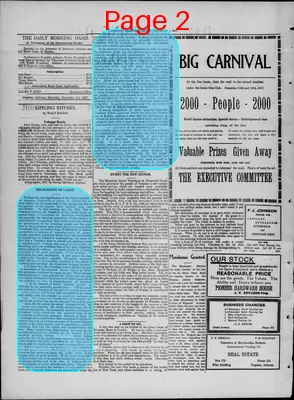
Editorial
December 4, 1917
The Daily Morning Oasis
Nogales, Santa Cruz County, Arizona
What is this article about?
President Wilson's historic address to the American Federation of Labor convention in Buffalo establishes formal recognition of organized labor by the U.S. government, a new era essential for securing workers' cooperation in World War I efforts and reorganizing industry against profiteering excesses.
Clipping
OCR Quality
95%
Excellent
Full Text
RECOGNITION OF LABOR.
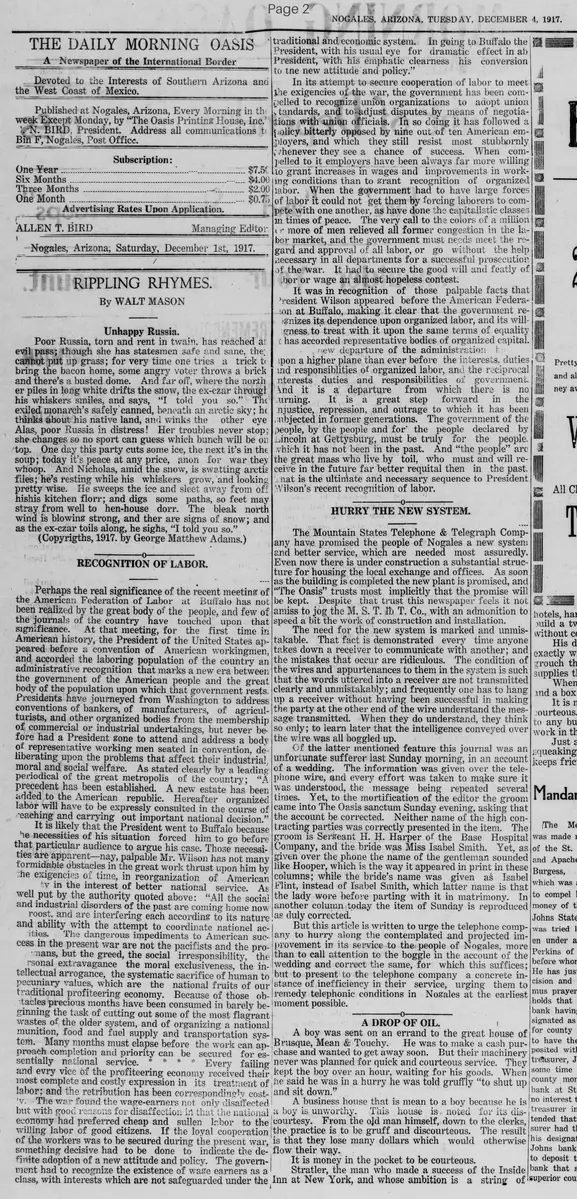
Perhaps the real significance of the recent meeting of the American Federation of Labor at Buffalo has not been realized by the great body of the people, and few of the journals of the country have touched upon that significance. At that meeting, for the first time in American history, the President of the United States appeared before a convention of American workingmen, and accorded the laboring population of the country an administrative recognition that marks a new era between the government of the American people and the great body of the population upon which that government rests.
Presidents have journeyed from Washington to address conventions of bankers, of manufacturers, of agriculturists, and other organized bodies from the membership of commercial or industrial undertakings, but never before had a President gone to attend and address a body of representative working men seated in convention, deliberating upon the problems that affect their industrial, moral and social welfare. As stated clearly by a leading periodical of the great metropolis of the country; "A precedent has been established. A new estate has been added to the American republic. Hereafter organized labor will have to be expressly consulted in the course of reaching and carrying out important national decision."
It is likely that the President went to Buffalo because the necessities of his situation forced him to go before that particular audience to argue his case. Those necessities are apparent--nay, palpable. Mr. Wilson has not many formidable obstacles in the great work thrust upon him by the exigencies of time, in reorganization of American industry in the interest of better national service. As well put by the authority quoted above: "All the social and industrial disorders of the past are coming home now to roost, and are interfering each according to its nature and ability with the attempt to coordinate national activities. The dangerous impediments to American success in the present war are not the pacifists and the pro-Germans, but the greed, the social irresponsibility, the personal extravagance the moral exclusiveness, the intellectual arrogance, the systematic sacrifice of human to pecuniary values, which are the national fruits of our traditional profiteering economy. Because of those obstacles precious months have been consumed in barely beginning the task of cutting out some of the most flagrant wastes of the older system, and of organizing a national munition, food and fuel supply and transportation system. Many months must elapse before the work can approach completion and priority can be secured for essentially national service.
Every failing and every vice of the profiteering economy received their most complete and costly expression in its treatment of labor: and the retribution has been correspondingly costly. The war found the wage-earners not only disaffected but with good reasons for disaffection in that the national economy had preferred cheap and sullen labor to the willing labor of good citizens. If the loyal cooperation of the workers was to be secured during the present war, something decisive had to be done to indicate the definite adoption of a new attitude and policy. The government had to recognize the existence of wage earners as a class, with interests which are not safeguarded under the traditional and economic system. In going to Buffalo the President, with his usual eye for dramatic effect in announcing important things, made with emphatic clearness his conversion to the new attitude and policy."
In its attempt to secure cooperation of labor to meet the exigencies of the war, the government has been compelled to recognize union organizations to adopt union standards, and to adjust disputes by means of negotiations with union officials. In so doing it has followed a policy bitterly opposed by nine out of ten American employers, and which they still resist most stubbornly whenever they see a chance of success. When compelled to it employers have been always far more willing to grant increases in wages and improvements in working conditions than to grant recognition of organized labor. When the government had to have large forces of labor it could not get them by forcing laborers to compete with one another, as have done the capitalistic classes in times of peace. The very call to the colors of a million or more of men relieved all former congestion in the labor market, and the government must needs meet the regard and approval of all labor, or go without the help necessary in all departments for a successful prosecution of the war. It had to secure the good will and fealty of labor or wage an almost hopeless contest.
It was in recognition of those palpable facts that President Wilson appeared before the American Federation at Buffalo, making it clear that the government recognizes its dependence upon organized labor, and its willingness to treat with it upon the same terms of equality it has accorded representative bodies of organized capital.
New departure of the administration upon a higher plane than ever before the interests, duties and responsibilities of organized labor, and the reciprocal interests duties and responsibilities of government.
And it is a departure from which there is no returning.
It is a great step forward in the injustice, repression, and outrage to which it has been subjected in former generations. The government of the people, by the people and for the people declared by Lincoln at Gettysburg, must be truly for the people. which it has not been in the past. And "the people" are the great mass who live by toil, who must and will receive in the future far better requital than in the past that is the ultimate and necessary sequence to President Wilson's recent recognition of labor.
Al
Perhaps the real significance of the recent meeting of the American Federation of Labor at Buffalo has not been realized by the great body of the people, and few of the journals of the country have touched upon that significance. At that meeting, for the first time in American history, the President of the United States appeared before a convention of American workingmen, and accorded the laboring population of the country an administrative recognition that marks a new era between the government of the American people and the great body of the population upon which that government rests.
Presidents have journeyed from Washington to address conventions of bankers, of manufacturers, of agriculturists, and other organized bodies from the membership of commercial or industrial undertakings, but never before had a President gone to attend and address a body of representative working men seated in convention, deliberating upon the problems that affect their industrial, moral and social welfare. As stated clearly by a leading periodical of the great metropolis of the country; "A precedent has been established. A new estate has been added to the American republic. Hereafter organized labor will have to be expressly consulted in the course of reaching and carrying out important national decision."
It is likely that the President went to Buffalo because the necessities of his situation forced him to go before that particular audience to argue his case. Those necessities are apparent--nay, palpable. Mr. Wilson has not many formidable obstacles in the great work thrust upon him by the exigencies of time, in reorganization of American industry in the interest of better national service. As well put by the authority quoted above: "All the social and industrial disorders of the past are coming home now to roost, and are interfering each according to its nature and ability with the attempt to coordinate national activities. The dangerous impediments to American success in the present war are not the pacifists and the pro-Germans, but the greed, the social irresponsibility, the personal extravagance the moral exclusiveness, the intellectual arrogance, the systematic sacrifice of human to pecuniary values, which are the national fruits of our traditional profiteering economy. Because of those obstacles precious months have been consumed in barely beginning the task of cutting out some of the most flagrant wastes of the older system, and of organizing a national munition, food and fuel supply and transportation system. Many months must elapse before the work can approach completion and priority can be secured for essentially national service.
Every failing and every vice of the profiteering economy received their most complete and costly expression in its treatment of labor: and the retribution has been correspondingly costly. The war found the wage-earners not only disaffected but with good reasons for disaffection in that the national economy had preferred cheap and sullen labor to the willing labor of good citizens. If the loyal cooperation of the workers was to be secured during the present war, something decisive had to be done to indicate the definite adoption of a new attitude and policy. The government had to recognize the existence of wage earners as a class, with interests which are not safeguarded under the traditional and economic system. In going to Buffalo the President, with his usual eye for dramatic effect in announcing important things, made with emphatic clearness his conversion to the new attitude and policy."
In its attempt to secure cooperation of labor to meet the exigencies of the war, the government has been compelled to recognize union organizations to adopt union standards, and to adjust disputes by means of negotiations with union officials. In so doing it has followed a policy bitterly opposed by nine out of ten American employers, and which they still resist most stubbornly whenever they see a chance of success. When compelled to it employers have been always far more willing to grant increases in wages and improvements in working conditions than to grant recognition of organized labor. When the government had to have large forces of labor it could not get them by forcing laborers to compete with one another, as have done the capitalistic classes in times of peace. The very call to the colors of a million or more of men relieved all former congestion in the labor market, and the government must needs meet the regard and approval of all labor, or go without the help necessary in all departments for a successful prosecution of the war. It had to secure the good will and fealty of labor or wage an almost hopeless contest.
It was in recognition of those palpable facts that President Wilson appeared before the American Federation at Buffalo, making it clear that the government recognizes its dependence upon organized labor, and its willingness to treat with it upon the same terms of equality it has accorded representative bodies of organized capital.
New departure of the administration upon a higher plane than ever before the interests, duties and responsibilities of organized labor, and the reciprocal interests duties and responsibilities of government.
And it is a departure from which there is no returning.
It is a great step forward in the injustice, repression, and outrage to which it has been subjected in former generations. The government of the people, by the people and for the people declared by Lincoln at Gettysburg, must be truly for the people. which it has not been in the past. And "the people" are the great mass who live by toil, who must and will receive in the future far better requital than in the past that is the ultimate and necessary sequence to President Wilson's recent recognition of labor.
Al
What sub-type of article is it?
Labor
Economic Policy
War Or Peace
What keywords are associated?
Labor Recognition
Afl Convention
President Wilson
War Cooperation
Organized Labor
Industrial Reorganization
Profiteering Economy
What entities or persons were involved?
President Wilson
American Federation Of Labor
Buffalo Convention
U.S. Government
Organized Labor
Employers
Wage Earners
Editorial Details
Primary Topic
President Wilson's Recognition Of Organized Labor At Afl Convention In Buffalo
Stance / Tone
Supportive Of Labor Recognition And New Government Policy
Key Figures
President Wilson
American Federation Of Labor
Buffalo Convention
U.S. Government
Organized Labor
Employers
Wage Earners
Key Arguments
First Presidential Address To A Labor Convention Establishes Precedent
Organized Labor Now A Recognized Estate In The Republic
Necessary For War Effort To Secure Workers' Cooperation
Critiques Profiteering Economy's Treatment Of Labor
Government Must Adopt New Attitude Towards Labor Class
Opposed By Employers But Compelled By War Necessities
Leads To Better Requital For Toiling Masses