Thank you for visiting SNEWPapers!
Sign up free
Editorial
March 18, 1763
The New Hampshire Gazette And Historical Chronicle
Portsmouth, Greenland, Rockingham County, New Hampshire
What is this article about?
Editorial argues against permanently conquering Spanish America after Britain's 1762 capture of Havana, using the 'goose that lays golden eggs' fable to advocate preserving Spanish control for ongoing trade benefits, citing historical precedents like Elizabeth I, Cromwell's failures, and treaties upholding Spanish indivisibility.
Clipping
OCR Quality
98%
Excellent
Full Text
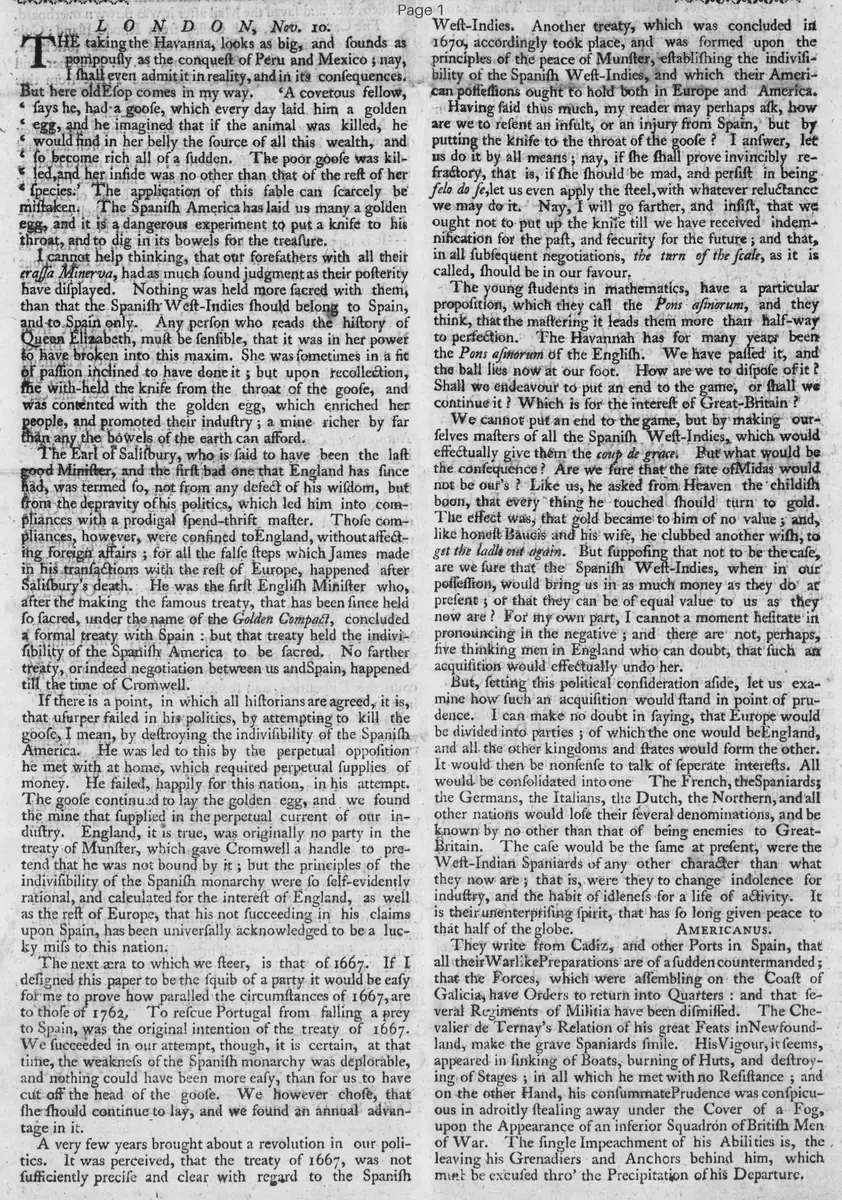
The taking of the Havanna, looks as big, and sounds as pompously as the conquest of Peru and Mexico; nay, I shall even admit it in reality, and in its consequences.
But here old Æsop comes in my way. A covetous fellow, says he, had a goose, which every day laid him a golden egg, and he imagined that if the animal was killed, he would find in her belly the source of all this wealth, and so become rich all of a sudden. The poor goose was killed, and her inside was no other than that of the rest of her species. The application of this fable can scarcely be mistaken: The Spanish America has laid us many a golden egg, and it is a dangerous experiment to put a knife to his throat, and to dig in its bowels for the treasure.
I cannot help thinking, that our forefathers with all their classical Minerva, had as much sound judgment as their posterity have displayed. Nothing was held more sacred with them than that the Spanish West-Indies should belong to Spain, and to Spain only. Any person who reads the history of Queen Elizabeth, must be sensible, that it was in her power to have broken into this maxim. She was sometimes in a fit of passion inclined to have done it; but upon recollection, she withheld the knife from the throat of the goose, and was contented with the golden egg, which enriched her people, and promoted their industry; a mine richer by far than any the bowels of the earth can afford.
The Earl of Salisbury, who is said to have been the last good Minister, and the first bad one that England has since had, was termed so, not from any defect of his wisdom, but from the depravity of his politics, which led him into compliances with a prodigal spend-thrift master. Those compliances, however, were confined to England, without affecting foreign affairs; for all the false steps which James made in his transactions with the rest of Europe, happened after Salisbury's death. He was the first English Minister who, after the making the famous treaty, that has been since held so sacred, under the name of the Golden Compact, concluded a formal treaty with Spain: but that treaty held the indivisibility of the Spanish America to be sacred. No farther treaty, or indeed negotiation between us and Spain, happened till the time of Cromwell.
If there is a point, in which all historians are agreed, it is, that usurper failed in his politics, by attempting to kill the goose, I mean, by destroying the indivisibility of the Spanish America. He was led to this by the perpetual opposition he met with at home, which required perpetual supplies of money. He failed, happily for this nation, in his attempt. The goose continued to lay the golden egg, and we found the mine that supplied in the perpetual current of our industry. England, it is true, was originally no party in the treaty of Munster, which gave Cromwell a handle to pretend that he was not bound by it; but the principles of the indivisibility of the Spanish monarchy were so self-evidently rational, and calculated for the interest of England, as well as the rest of Europe, that his not succeeding in his claims upon Spain, has been universally acknowledged to be a lucky miss to this nation:
The next æra to which we steer, is that of 1667. If I designed this paper to be the quiz of a party it would be easy for me to prove how parallel the circumstances of 1667, are to those of 1762. To rescue Portugal from falling a prey to Spain, was the original intention of the treaty of 1667. We succeeded in our attempt, though, it is certain, at that time, the weakness of the Spanish monarchy was deplorable, and nothing could have been more easy, than for us to have cut off the head of the goose. We however chose, that she should continue to lay, and we found an annual advantage in it.
A very few years brought about a revolution in our politics. It was perceived, that the treaty of 1667, was not sufficiently precise and clear with regard to the Spanish West-Indies. Another treaty, which was concluded in 1670, accordingly took place, and was formed upon the principles of the peace of Munster, establishing the indivisibility of the Spanish West-Indies. and which their American possessions ought to hold both in Europe and America.
Having said thus much, my reader may perhaps ask, how are we to resent an insult. or an injury from Spain, but by putting the knife to the throat of the goose ? I answer, let us do it by all means : nay, if she shall prove invincibly refractory, that is, if she should be mad, and persist in being felo de se, let us even apply the steel, with whatever reluctance we may do it. Nay, I will go farther, and insist, that we ought not to put up the knife till we have received indemnification for the past. and security for the future ; and that, in all subsequent negotiations, the turn of the scale, as it is called, should be in our favour.
The young students in mathematics, have a particular proposition, which they call the Pons asinorum, and they think, that the mastering it leads them more than half-way to perfection. The Havannah has for many years been the Pons asinorum of the English. We have passed it, and the ball lies now at our foot. How are we to dispose of it ? Shall we endeavour to put an end to the game, or shall we continue it ? Which is for the interest of Great-Britain ?
We cannot put an end to the game, but by making ourselves masters of all the Spanish West-Indies, which would effectually give them the coup de grace. But what would be, the consequence? Are we sure that the fate of Midas would not be ours ? Like us. he asked from Heaven the childish boon, that every thing he touched should turn to gold. The effect was, that gold became to him of no value ; and, like honest Baucis and his wife. he clubbed another wish, to get the ladle out again. But supposing that not to be the case, are we sure that the Spanish West-Indies, when in our possession, would bring us in as much money as they do at present ; or that they can be of equal value to us as they now are ? For my own part, I cannot a moment hesitate in pronouncing in the negative ; and there are not, perhaps, five thinking men in England who can doubt, that such an acquisition would effectually undo her.
But, setting this political consideration aside, let us examine how such an acquisition would stand in point of prudence. I can make no doubt in saying, that Europe would be divided into parties ; of which the one would be England. and all. the other kingdoms and states would form the other. It would then be nonsense to talk of separate interests. All would be consolidated into one The French, the Spaniards, the Germans, the Italians, the Dutch, the Northern, and all other nations would lose their several denominations, and be known by no other than that of being enemies to Great-Britain. The case would be the same at present, were the West-Indian Spaniards of any other character than what they now are ; that is, were they to change indolence for industry, and the habit of idleness for a life of activity. It is their unenterprising spirit, that has so long given peace to that half of the globe.
AMERICANUS.
But here old Æsop comes in my way. A covetous fellow, says he, had a goose, which every day laid him a golden egg, and he imagined that if the animal was killed, he would find in her belly the source of all this wealth, and so become rich all of a sudden. The poor goose was killed, and her inside was no other than that of the rest of her species. The application of this fable can scarcely be mistaken: The Spanish America has laid us many a golden egg, and it is a dangerous experiment to put a knife to his throat, and to dig in its bowels for the treasure.
I cannot help thinking, that our forefathers with all their classical Minerva, had as much sound judgment as their posterity have displayed. Nothing was held more sacred with them than that the Spanish West-Indies should belong to Spain, and to Spain only. Any person who reads the history of Queen Elizabeth, must be sensible, that it was in her power to have broken into this maxim. She was sometimes in a fit of passion inclined to have done it; but upon recollection, she withheld the knife from the throat of the goose, and was contented with the golden egg, which enriched her people, and promoted their industry; a mine richer by far than any the bowels of the earth can afford.
The Earl of Salisbury, who is said to have been the last good Minister, and the first bad one that England has since had, was termed so, not from any defect of his wisdom, but from the depravity of his politics, which led him into compliances with a prodigal spend-thrift master. Those compliances, however, were confined to England, without affecting foreign affairs; for all the false steps which James made in his transactions with the rest of Europe, happened after Salisbury's death. He was the first English Minister who, after the making the famous treaty, that has been since held so sacred, under the name of the Golden Compact, concluded a formal treaty with Spain: but that treaty held the indivisibility of the Spanish America to be sacred. No farther treaty, or indeed negotiation between us and Spain, happened till the time of Cromwell.
If there is a point, in which all historians are agreed, it is, that usurper failed in his politics, by attempting to kill the goose, I mean, by destroying the indivisibility of the Spanish America. He was led to this by the perpetual opposition he met with at home, which required perpetual supplies of money. He failed, happily for this nation, in his attempt. The goose continued to lay the golden egg, and we found the mine that supplied in the perpetual current of our industry. England, it is true, was originally no party in the treaty of Munster, which gave Cromwell a handle to pretend that he was not bound by it; but the principles of the indivisibility of the Spanish monarchy were so self-evidently rational, and calculated for the interest of England, as well as the rest of Europe, that his not succeeding in his claims upon Spain, has been universally acknowledged to be a lucky miss to this nation:
The next æra to which we steer, is that of 1667. If I designed this paper to be the quiz of a party it would be easy for me to prove how parallel the circumstances of 1667, are to those of 1762. To rescue Portugal from falling a prey to Spain, was the original intention of the treaty of 1667. We succeeded in our attempt, though, it is certain, at that time, the weakness of the Spanish monarchy was deplorable, and nothing could have been more easy, than for us to have cut off the head of the goose. We however chose, that she should continue to lay, and we found an annual advantage in it.
A very few years brought about a revolution in our politics. It was perceived, that the treaty of 1667, was not sufficiently precise and clear with regard to the Spanish West-Indies. Another treaty, which was concluded in 1670, accordingly took place, and was formed upon the principles of the peace of Munster, establishing the indivisibility of the Spanish West-Indies. and which their American possessions ought to hold both in Europe and America.
Having said thus much, my reader may perhaps ask, how are we to resent an insult. or an injury from Spain, but by putting the knife to the throat of the goose ? I answer, let us do it by all means : nay, if she shall prove invincibly refractory, that is, if she should be mad, and persist in being felo de se, let us even apply the steel, with whatever reluctance we may do it. Nay, I will go farther, and insist, that we ought not to put up the knife till we have received indemnification for the past. and security for the future ; and that, in all subsequent negotiations, the turn of the scale, as it is called, should be in our favour.
The young students in mathematics, have a particular proposition, which they call the Pons asinorum, and they think, that the mastering it leads them more than half-way to perfection. The Havannah has for many years been the Pons asinorum of the English. We have passed it, and the ball lies now at our foot. How are we to dispose of it ? Shall we endeavour to put an end to the game, or shall we continue it ? Which is for the interest of Great-Britain ?
We cannot put an end to the game, but by making ourselves masters of all the Spanish West-Indies, which would effectually give them the coup de grace. But what would be, the consequence? Are we sure that the fate of Midas would not be ours ? Like us. he asked from Heaven the childish boon, that every thing he touched should turn to gold. The effect was, that gold became to him of no value ; and, like honest Baucis and his wife. he clubbed another wish, to get the ladle out again. But supposing that not to be the case, are we sure that the Spanish West-Indies, when in our possession, would bring us in as much money as they do at present ; or that they can be of equal value to us as they now are ? For my own part, I cannot a moment hesitate in pronouncing in the negative ; and there are not, perhaps, five thinking men in England who can doubt, that such an acquisition would effectually undo her.
But, setting this political consideration aside, let us examine how such an acquisition would stand in point of prudence. I can make no doubt in saying, that Europe would be divided into parties ; of which the one would be England. and all. the other kingdoms and states would form the other. It would then be nonsense to talk of separate interests. All would be consolidated into one The French, the Spaniards, the Germans, the Italians, the Dutch, the Northern, and all other nations would lose their several denominations, and be known by no other than that of being enemies to Great-Britain. The case would be the same at present, were the West-Indian Spaniards of any other character than what they now are ; that is, were they to change indolence for industry, and the habit of idleness for a life of activity. It is their unenterprising spirit, that has so long given peace to that half of the globe.
AMERICANUS.
What sub-type of article is it?
Foreign Affairs
Economic Policy
Imperialism
What keywords are associated?
Havana Capture
Spanish America
Golden Goose
West Indies Trade
Imperial Indivisibility
Historical Treaties
British Foreign Policy
What entities or persons were involved?
Queen Elizabeth
Earl Of Salisbury
Cromwell
Spain
Spanish West Indies
England
Editorial Details
Primary Topic
Opposition To Conquering Spanish America After Havana Capture
Stance / Tone
Strongly Against Permanent Conquest, Favoring Trade Preservation
Key Figures
Queen Elizabeth
Earl Of Salisbury
Cromwell
Spain
Spanish West Indies
England
Key Arguments
Spanish America Provides Ongoing Trade Benefits Like The Golden Eggs From The Goose
Historical Leaders Like Elizabeth I Preserved Spanish Control For Economic Gain
Cromwell's Attempt To Conquer Failed And Was Beneficially Avoided
Treaties Like Munster And 1670 Upheld Indivisibility Of Spanish Possessions
Conquest Would Unite Europe Against England And Devalue The Wealth
Indemnification And Security Should Be Sought Without Full Conquest