Thank you for visiting SNEWPapers!
Sign up free
Literary
April 24, 1820
Daily National Intelligencer
Washington, District Of Columbia
What is this article about?
Article summarizes positive British reviews of American literature, including Irving's 'Sketch Book' in Edinburgh Magazine and Eclectic Review, critiques of Walsh's 'Appeal' in Literary Gazette, and praise for Paulding's 'Backwoodsman' in Monthly Magazine, emphasizing promise of American genius.
Clipping
OCR Quality
95%
Excellent
Full Text
LITERARY.
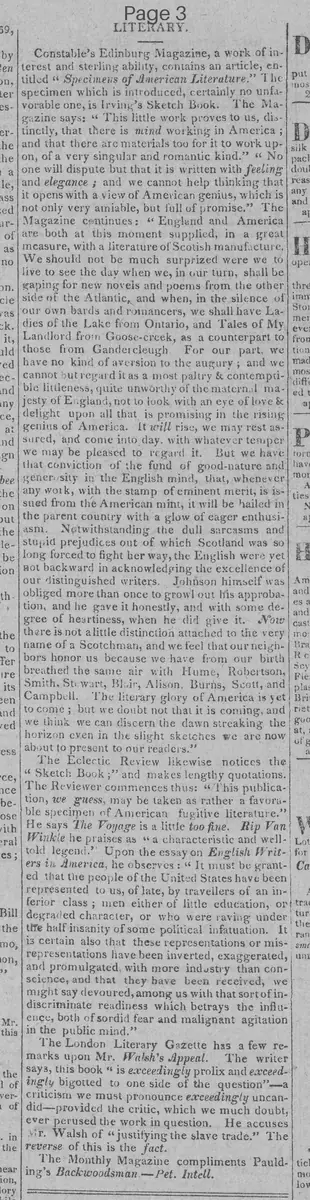
Constable's Edinburgh Magazine, a work of interest and sterling ability, contains an article, entitled "Specimens of American Literature." The specimen which is introduced, certainly no unfavorable one, is Irving's Sketch Book. The Magazine says: "This little work proves to us, distinctly, that there is mind working in America; and that there are materials too for it to work upon, of a very singular and romantic kind." "No one will dispute but that it is written with feeling and elegance; and we cannot help thinking that it opens with a view of American genius, which is not only very amiable, but full of promise." The Magazine continues: "England and America are both at this moment supplied, in a great measure, with a literature of Scottish manufacture. We should not be much surprised were we to live to see the day when we, in our turn, shall be gaping for new novels and poems from the other side of the Atlantic, and when, in the silence of our own bards and romancers, we shall have Ladies of the Lake from Ontario, and Tales of My Landlord from Goose-creek, as a counterpart to those from Gandercleugh. For our part, we have no kind of aversion to the augury; and we cannot but regard it as a most paltry & contemptible littleness, quite unworthy of the maternal majesty of England, not to look with an eye of love & delight upon all that is promising in the rising genius of America. It will rise, we may rest assured, and come into day, with whatever temper we may be pleased to regard it. But we have that conviction of the fund of good-nature and generosity in the English mind, that, whenever any work, with the stamp of eminent merit, is issued from the American mint, it will be hailed in the parent country with a glow of eager enthusiasm. Notwithstanding the dull sarcasms and stupid prejudices out of which Scotland was so long forced to fight her way, the English were yet not backward in acknowledging the excellence of our distinguished writers. Johnson himself was obliged more than once to growl out his approbation, and he gave it honestly, and with some degree of heartiness, when he did give it. Now there is not a little distinction attached to the very name of a Scotchman, and we feel that our neighbors honor us because we have from our birth breathed the same air with Hume, Robertson, Smith, Stewart, Blair, Alison, Burns, Scott, and Campbell. The literary glory of America is yet to come; but we doubt not that it is coming, and we think we can discern the dawn streaking the horizon even in the slight sketches we are now about to present to our readers."
The Eclectic Review likewise notices the "Sketch Book;" and makes lengthy quotations.
The Reviewer commences thus: "This publication, we guess, may be taken as rather a favorable specimen of American fugitive literature."
He says The Voyage is a little too fine. Rip Van Winkle he praises as "a characteristic and well-told legend.' Upon the essay on English Writers in America, he observes: "It must be granted that the people of the United States have been represented to us, of late, by travellers of an inferior class; men either of little education, or degraded character, or who were raving under the half insanity of some political infatuation. It is certain also that these representations or misrepresentations have been invented, exaggerated, and promulgated, with more industry than conscience, and that they have been received, we might say devoured, among us with that sort of indiscriminate readiness which betrays the influence, both of sordid fear and malignant agitation in the public mind."
The London Literary Gazette has a few remarks upon Mr. Walsh's Appeal. The writer says, this book "is exceedingly prolix and exceedingly bigotted to one side of the question"—a criticism we must pronounce exceedingly uncandid—provided the critic, which we much doubt, ever perused the work in question. He accuses Mr. Walsh of "justifying the slave trade." The reverse of this is the fact.
The Monthly Magazine compliments Paulding's Backwoodsman—Nat. Intell.
Constable's Edinburgh Magazine, a work of interest and sterling ability, contains an article, entitled "Specimens of American Literature." The specimen which is introduced, certainly no unfavorable one, is Irving's Sketch Book. The Magazine says: "This little work proves to us, distinctly, that there is mind working in America; and that there are materials too for it to work upon, of a very singular and romantic kind." "No one will dispute but that it is written with feeling and elegance; and we cannot help thinking that it opens with a view of American genius, which is not only very amiable, but full of promise." The Magazine continues: "England and America are both at this moment supplied, in a great measure, with a literature of Scottish manufacture. We should not be much surprised were we to live to see the day when we, in our turn, shall be gaping for new novels and poems from the other side of the Atlantic, and when, in the silence of our own bards and romancers, we shall have Ladies of the Lake from Ontario, and Tales of My Landlord from Goose-creek, as a counterpart to those from Gandercleugh. For our part, we have no kind of aversion to the augury; and we cannot but regard it as a most paltry & contemptible littleness, quite unworthy of the maternal majesty of England, not to look with an eye of love & delight upon all that is promising in the rising genius of America. It will rise, we may rest assured, and come into day, with whatever temper we may be pleased to regard it. But we have that conviction of the fund of good-nature and generosity in the English mind, that, whenever any work, with the stamp of eminent merit, is issued from the American mint, it will be hailed in the parent country with a glow of eager enthusiasm. Notwithstanding the dull sarcasms and stupid prejudices out of which Scotland was so long forced to fight her way, the English were yet not backward in acknowledging the excellence of our distinguished writers. Johnson himself was obliged more than once to growl out his approbation, and he gave it honestly, and with some degree of heartiness, when he did give it. Now there is not a little distinction attached to the very name of a Scotchman, and we feel that our neighbors honor us because we have from our birth breathed the same air with Hume, Robertson, Smith, Stewart, Blair, Alison, Burns, Scott, and Campbell. The literary glory of America is yet to come; but we doubt not that it is coming, and we think we can discern the dawn streaking the horizon even in the slight sketches we are now about to present to our readers."
The Eclectic Review likewise notices the "Sketch Book;" and makes lengthy quotations.
The Reviewer commences thus: "This publication, we guess, may be taken as rather a favorable specimen of American fugitive literature."
He says The Voyage is a little too fine. Rip Van Winkle he praises as "a characteristic and well-told legend.' Upon the essay on English Writers in America, he observes: "It must be granted that the people of the United States have been represented to us, of late, by travellers of an inferior class; men either of little education, or degraded character, or who were raving under the half insanity of some political infatuation. It is certain also that these representations or misrepresentations have been invented, exaggerated, and promulgated, with more industry than conscience, and that they have been received, we might say devoured, among us with that sort of indiscriminate readiness which betrays the influence, both of sordid fear and malignant agitation in the public mind."
The London Literary Gazette has a few remarks upon Mr. Walsh's Appeal. The writer says, this book "is exceedingly prolix and exceedingly bigotted to one side of the question"—a criticism we must pronounce exceedingly uncandid—provided the critic, which we much doubt, ever perused the work in question. He accuses Mr. Walsh of "justifying the slave trade." The reverse of this is the fact.
The Monthly Magazine compliments Paulding's Backwoodsman—Nat. Intell.
What sub-type of article is it?
Essay
What themes does it cover?
Patriotism
Political
What keywords are associated?
American Literature
Irving Sketch Book
Edinburgh Magazine
Eclectic Review
Walsh Appeal
Paulding Backwoodsman
Literary Details
Title
Literary
Subject
British Reviews Of American Literature
Key Lines
This Little Work Proves To Us, Distinctly, That There Is Mind Working In America; And That There Are Materials Too For It To Work Upon, Of A Very Singular And Romantic Kind.
No One Will Dispute But That It Is Written With Feeling And Elegance; And We Cannot Help Thinking That It Opens With A View Of American Genius, Which Is Not Only Very Amiable, But Full Of Promise.
The Literary Glory Of America Is Yet To Come; But We Doubt Not That It Is Coming, And We Think We Can Discern The Dawn Streaking The Horizon Even In The Slight Sketches We Are Now About To Present To Our Readers.