Thank you for visiting SNEWPapers!
Sign up free
Literary
February 9, 1831
Morning Star
Limerick, York County, Maine
What is this article about?
Excerpt from James Gilrattnick's dissertation on Ministerial Fidelity, emphasizing that preaching should be plain to reach all hearers, solemn given its eternal stakes, affectionate like the gospel's compassion, and earnest to convey the importance of salvation.
Clipping
OCR Quality
95%
Excellent
Full Text
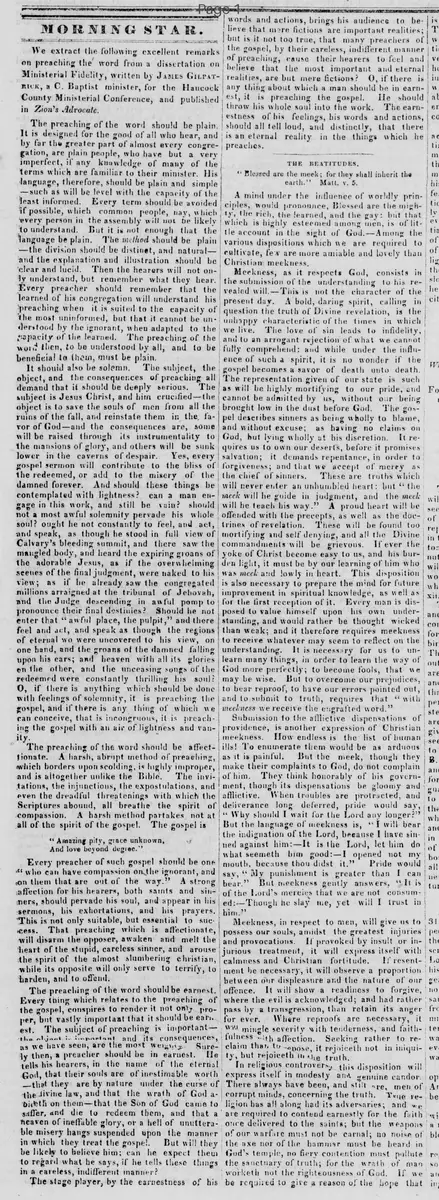
We extract the following excellent remarks on preaching the word from a dissertation on Ministerial Fidelity, written by James Gilrattnick, a C. Baptist minister, for the Hancock County Ministerial Conference, and published in Zion's Advocate.
The preaching of the word should be plain. It is designed for the good of all who hear, and by far the greater part of almost every congregation, are plain people, who have but a very imperfect, if any knowledge of many of the terms which are familiar to their minister. His language, therefore, should be plain and simple—such as will be level with the capacity of the least informed. Every term should be avoided if possible, which common people, nay, which every person in the assembly will not be likely to understand. But it is not enough that the language be plain. The method should be plain—the division should be distinct, and natural—and the explanation and illustration should be clear and lucid. Then the hearers will not only understand, but remember what they hear.
Every preacher should remember that the learned of his congregation will understand his preaching when it is suited to the capacity of the most uninformed, but that it cannot be understood by the ignorant, when adapted to the capacity of the learned. The preaching of the word then, to be understood by all, and to be beneficial to them, must be plain.
It should also be solemn. The subject, the object, and the consequences of preaching all demand that it should be deeply serious. The subject is Jesus Christ, and him crucified—the object is to save the souls of men from all the ruins of the fall, and reinstate them in the favor of God—and the consequences are, some will be raised through its instrumentality to the mansions of glory, and others will be sunk lower in the caverns of despair. Yes, every gospel sermon will contribute to the bliss of the redeemed, or add to the misery of the damned forever. And should these things be contemplated with lightness? can a man engage in this work, and still be vain? should not a most awful solemnity pervade his whole soul? ought he not constantly to feel, and act, and speak, as though he stood in full view of Calvary's bleeding summit, and there saw the mangled body, and heard the expiring groans of the adorable Jesus, as if the overwhelming scenes of the final judgment, were naked to his view; as if he already saw the congregated millions arraigned at the tribunal of Jehovah, and the Judge descending in awful pomp to pronounce their final destinies? Should he not enter that "awful place, the pulpit," and there feel and act, and speak as though the regions of eternal wo were uncovered to his view, on one hand, and the groans of the damned falling upon his ears; and heaven with all its glories on the other, and the unceasing songs of the redeemed were constantly thrilling his soul? O, if there is anything which should be done with feelings of solemnity, it is preaching the gospel, and if there is anything of which we can conceive, that is incongruous, it is preaching the gospel with an air of lightness and vanity.
The preaching of the word should be affectionate. A harsh, abrupt method of preaching, which borders upon scolding, is highly improper, and is altogether unlike the Bible. The invitations, the injunctions, the expostulations, and even the dreadful threatenings with which the Scriptures abound, all breathe the spirit of compassion. A harsh method partakes not at all of the spirit of the gospel. The gospel is
"Amazing pity! grace unknown,
And love beyond degree."
Every preacher of such gospel should be one who can have compassion on the ignorant, and on them that are out of the way. A strong affection for his hearers, both saints and sinners, should pervade his soul, and appear in his sermons, his exhortations, and his prayers. This is not only suitable, but essential to success. That preaching which is affectionate, will disarm the opposer, awaken and melt the heart of the stupid, careless sinner, and arouse the spirit of the almost slumbering christian, while its opposite will only serve to terrify, to harden, and to offend.
The preaching of the word should be earnest. Everything which relates to the preaching of the gospel, conspires to render it not only proper, but vastly important that it should be earnest. The subject of preaching is important—the object important and its consequences, as we have seen, are the most weighty. Surely then, a preacher should be in earnest. He tells his hearers, in the name of the eternal God, that their souls are of inestimable worth—that they are by nature under the curse of the divine law, and that the wrath of God abideth on them—that the Son of God came to suffer, and die to redeem them, and that a heaven of ineffable glory, or a hell of unutterable misery hangs suspended upon the manner in which they treat the gospel. But will they be likely to believe him; can he expect them to regard what he says, if he tells these things in a careless, indifferent manner?
The stage player, by the earnestness of his
The preaching of the word should be plain. It is designed for the good of all who hear, and by far the greater part of almost every congregation, are plain people, who have but a very imperfect, if any knowledge of many of the terms which are familiar to their minister. His language, therefore, should be plain and simple—such as will be level with the capacity of the least informed. Every term should be avoided if possible, which common people, nay, which every person in the assembly will not be likely to understand. But it is not enough that the language be plain. The method should be plain—the division should be distinct, and natural—and the explanation and illustration should be clear and lucid. Then the hearers will not only understand, but remember what they hear.
Every preacher should remember that the learned of his congregation will understand his preaching when it is suited to the capacity of the most uninformed, but that it cannot be understood by the ignorant, when adapted to the capacity of the learned. The preaching of the word then, to be understood by all, and to be beneficial to them, must be plain.
It should also be solemn. The subject, the object, and the consequences of preaching all demand that it should be deeply serious. The subject is Jesus Christ, and him crucified—the object is to save the souls of men from all the ruins of the fall, and reinstate them in the favor of God—and the consequences are, some will be raised through its instrumentality to the mansions of glory, and others will be sunk lower in the caverns of despair. Yes, every gospel sermon will contribute to the bliss of the redeemed, or add to the misery of the damned forever. And should these things be contemplated with lightness? can a man engage in this work, and still be vain? should not a most awful solemnity pervade his whole soul? ought he not constantly to feel, and act, and speak, as though he stood in full view of Calvary's bleeding summit, and there saw the mangled body, and heard the expiring groans of the adorable Jesus, as if the overwhelming scenes of the final judgment, were naked to his view; as if he already saw the congregated millions arraigned at the tribunal of Jehovah, and the Judge descending in awful pomp to pronounce their final destinies? Should he not enter that "awful place, the pulpit," and there feel and act, and speak as though the regions of eternal wo were uncovered to his view, on one hand, and the groans of the damned falling upon his ears; and heaven with all its glories on the other, and the unceasing songs of the redeemed were constantly thrilling his soul? O, if there is anything which should be done with feelings of solemnity, it is preaching the gospel, and if there is anything of which we can conceive, that is incongruous, it is preaching the gospel with an air of lightness and vanity.
The preaching of the word should be affectionate. A harsh, abrupt method of preaching, which borders upon scolding, is highly improper, and is altogether unlike the Bible. The invitations, the injunctions, the expostulations, and even the dreadful threatenings with which the Scriptures abound, all breathe the spirit of compassion. A harsh method partakes not at all of the spirit of the gospel. The gospel is
"Amazing pity! grace unknown,
And love beyond degree."
Every preacher of such gospel should be one who can have compassion on the ignorant, and on them that are out of the way. A strong affection for his hearers, both saints and sinners, should pervade his soul, and appear in his sermons, his exhortations, and his prayers. This is not only suitable, but essential to success. That preaching which is affectionate, will disarm the opposer, awaken and melt the heart of the stupid, careless sinner, and arouse the spirit of the almost slumbering christian, while its opposite will only serve to terrify, to harden, and to offend.
The preaching of the word should be earnest. Everything which relates to the preaching of the gospel, conspires to render it not only proper, but vastly important that it should be earnest. The subject of preaching is important—the object important and its consequences, as we have seen, are the most weighty. Surely then, a preacher should be in earnest. He tells his hearers, in the name of the eternal God, that their souls are of inestimable worth—that they are by nature under the curse of the divine law, and that the wrath of God abideth on them—that the Son of God came to suffer, and die to redeem them, and that a heaven of ineffable glory, or a hell of unutterable misery hangs suspended upon the manner in which they treat the gospel. But will they be likely to believe him; can he expect them to regard what he says, if he tells these things in a careless, indifferent manner?
The stage player, by the earnestness of his
What sub-type of article is it?
Essay
What themes does it cover?
Religious
Moral Virtue
What keywords are associated?
Preaching
Ministerial Fidelity
Gospel
Sermon
Solemnity
Affection
Earnestness
What entities or persons were involved?
James Gilrattnick, A C. Baptist Minister
Literary Details
Title
Remarks On Preaching The Word From A Dissertation On Ministerial Fidelity
Author
James Gilrattnick, A C. Baptist Minister
Subject
For The Hancock County Ministerial Conference
Form / Style
Prose Essay On Preaching Qualities
Key Lines
"Amazing Pity! Grace Unknown, And Love Beyond Degree."
The Subject Is Jesus Christ, And Him Crucified—The Object Is To Save The Souls Of Men From All The Ruins Of The Fall, And Reinstate Them In The Favor Of God