Thank you for visiting SNEWPapers!
Sign up free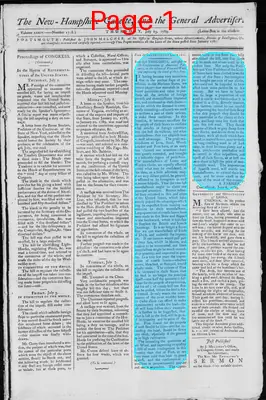
Editorial
July 23, 1789
The New Hampshire Gazette And General Advertiser
Portsmouth, Rockingham County, New Hampshire
What is this article about?
An editorial from Connecticut Courant urges American farmers to cultivate flax for linen and improve wool production for woolen cloths to achieve self-sufficiency and reduce imports. It discusses techniques for better yields and sheep breeding, citing successful local manufactures that supply even national leaders.
Clipping
OCR Quality
95%
Excellent
Full Text
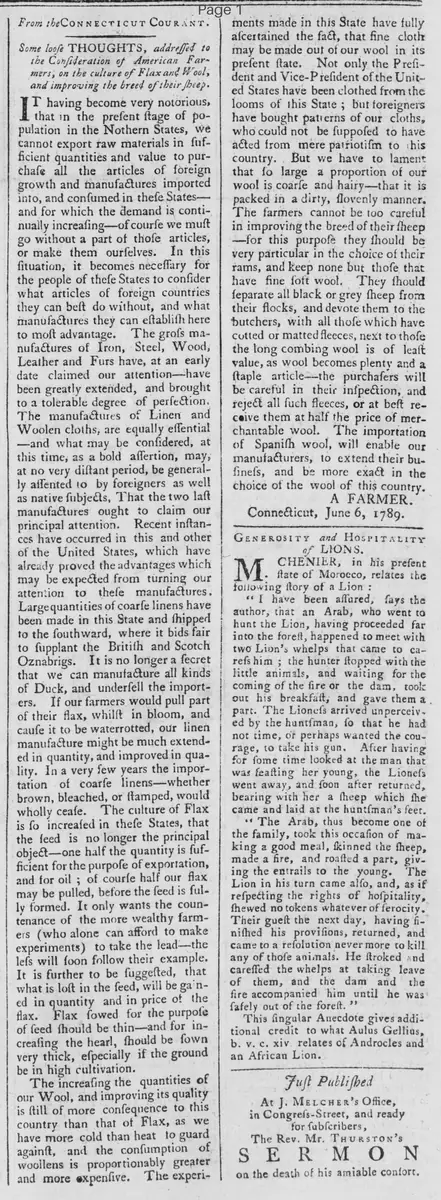
From the Connecticut Courant:
Some loose THOUGHTS, addressed to the Consideration of American Farmers; on the culture of Flax and Wool, and improving the breed of their sheep.
It having become very notorious, that in the present stage of population in the Northern States, we cannot export raw materials in sufficient quantities and value to purchase all the articles of foreign growth and manufactures imported into, and consumed in these States-- and for which the demand is continually increasing--of course we must go without a part of those articles, or make them ourselves. In this situation, it becomes necessary for the people of these States to consider what articles of foreign countries they can best do without, and what manufactures they can establish here to most advantage. The gross manufactures of Iron, Steel, Wood, Leather and Furs have, at an early date claimed our attention--have been greatly extended, and brought to a tolerable degree of perfection.
The manufactures of Linen and Woolen cloths, are equally essential --and what may be considered, at this time, as a bold assertion, may, at no very distant period, be generally assented to by foreigners as well as native subjects, That the two last manufactures ought to claim our principal attention. Recent instances have occurred in this and other of the United States, which have already proved the advantages which may be expected from turning our attention to these manufactures.
Large quantities of coarse linens have been made in this State and shipped to the southward, where it bids fair to supplant the British and Scotch Oznabrigs. It is no longer a secret that we can manufacture all kinds of Duck, and undersell the importers. If our farmers would pull part of their flax, whilst in bloom, and cause it to be water-rotted, our linen manufacture might be much extended in quantity, and improved in quality. In a very few years the importation of coarse linens--whether brown, bleached, or stamped, would wholly cease. The culture of Flax is so increased in these States, that the seed is no longer the principal object--one half the quantity is sufficient for the purpose of exportation, and for oil; of course half our flax may be pulled, before the seed is fully formed. It only wants the countenance of the more wealthy farmers (who alone can afford to make experiments) to take the lead --the less will soon follow their example.
It is further to be suggested, that what is lost in the seed, will be gained in quantity and in price of the flax. Flax sowed for the purpose of seed should be thin--and for increasing the hurd, should be sown very thick, especially if the ground be in high cultivation.
The increasing the quantities of our Wool, and improving its quality is still of more consequence to this country than that of Flax, as we have more cold than heat to guard against, and the consumption of woollens is proportionably greater and more expensive. The experiments made in this State have fully ascertained the fact, that fine cloth may be made out of our wool in its present state. Not only the President and Vice-President of the United States have been clothed from the looms of this State; but foreigners have bought patterns of our cloths, who could not be supposed to have acted from mere patriotism to his country. But we have to lament that so large a proportion of our wool is coarse and hairy--that it is packed in a dirty, slovenly manner. The farmers cannot be too careful in improving the breed of their sheep --for this purpose they should be very particular in the choice of their rams, and keep none but those that have fine soft wool. They should separate all black or grey sheep from their flocks, and devote them to the butchers, with all those which have cotted or matted fleeces, next to those the long combing wool is of least value, as wool becomes plenty and a staple article --the purchasers will be careful in their inspection, and reject all such fleeces, or at best receive them at half the price of merchantable wool. The importation of Spanish wool, will enable our manufacturers, to extend their business, and be more exact in the choice of the wool of this country.
A FARMER.
Connecticut, June 6, 1789.
Some loose THOUGHTS, addressed to the Consideration of American Farmers; on the culture of Flax and Wool, and improving the breed of their sheep.
It having become very notorious, that in the present stage of population in the Northern States, we cannot export raw materials in sufficient quantities and value to purchase all the articles of foreign growth and manufactures imported into, and consumed in these States-- and for which the demand is continually increasing--of course we must go without a part of those articles, or make them ourselves. In this situation, it becomes necessary for the people of these States to consider what articles of foreign countries they can best do without, and what manufactures they can establish here to most advantage. The gross manufactures of Iron, Steel, Wood, Leather and Furs have, at an early date claimed our attention--have been greatly extended, and brought to a tolerable degree of perfection.
The manufactures of Linen and Woolen cloths, are equally essential --and what may be considered, at this time, as a bold assertion, may, at no very distant period, be generally assented to by foreigners as well as native subjects, That the two last manufactures ought to claim our principal attention. Recent instances have occurred in this and other of the United States, which have already proved the advantages which may be expected from turning our attention to these manufactures.
Large quantities of coarse linens have been made in this State and shipped to the southward, where it bids fair to supplant the British and Scotch Oznabrigs. It is no longer a secret that we can manufacture all kinds of Duck, and undersell the importers. If our farmers would pull part of their flax, whilst in bloom, and cause it to be water-rotted, our linen manufacture might be much extended in quantity, and improved in quality. In a very few years the importation of coarse linens--whether brown, bleached, or stamped, would wholly cease. The culture of Flax is so increased in these States, that the seed is no longer the principal object--one half the quantity is sufficient for the purpose of exportation, and for oil; of course half our flax may be pulled, before the seed is fully formed. It only wants the countenance of the more wealthy farmers (who alone can afford to make experiments) to take the lead --the less will soon follow their example.
It is further to be suggested, that what is lost in the seed, will be gained in quantity and in price of the flax. Flax sowed for the purpose of seed should be thin--and for increasing the hurd, should be sown very thick, especially if the ground be in high cultivation.
The increasing the quantities of our Wool, and improving its quality is still of more consequence to this country than that of Flax, as we have more cold than heat to guard against, and the consumption of woollens is proportionably greater and more expensive. The experiments made in this State have fully ascertained the fact, that fine cloth may be made out of our wool in its present state. Not only the President and Vice-President of the United States have been clothed from the looms of this State; but foreigners have bought patterns of our cloths, who could not be supposed to have acted from mere patriotism to his country. But we have to lament that so large a proportion of our wool is coarse and hairy--that it is packed in a dirty, slovenly manner. The farmers cannot be too careful in improving the breed of their sheep --for this purpose they should be very particular in the choice of their rams, and keep none but those that have fine soft wool. They should separate all black or grey sheep from their flocks, and devote them to the butchers, with all those which have cotted or matted fleeces, next to those the long combing wool is of least value, as wool becomes plenty and a staple article --the purchasers will be careful in their inspection, and reject all such fleeces, or at best receive them at half the price of merchantable wool. The importation of Spanish wool, will enable our manufacturers, to extend their business, and be more exact in the choice of the wool of this country.
A FARMER.
Connecticut, June 6, 1789.
What sub-type of article is it?
Agriculture
Economic Policy
What keywords are associated?
Flax Cultivation
Wool Improvement
Domestic Manufacturing
Linen Production
Sheep Breeding
Economic Self Sufficiency
Northern States Agriculture
What entities or persons were involved?
American Farmers
President Of The United States
Vice President Of The United States
Editorial Details
Primary Topic
Promoting Flax And Wool Cultivation For Domestic Textile Manufacturing
Stance / Tone
Encouraging And Advisory To Farmers For Self Sufficiency
Key Figures
American Farmers
President Of The United States
Vice President Of The United States
Key Arguments
Northern States Cannot Export Enough Raw Materials To Buy All Imports, Must Manufacture Domestically
Linen And Woolen Manufactures Are Essential And Should Claim Principal Attention
Coarse Linens From Connecticut Supplant British And Scotch Imports
Pull Flax In Bloom And Water Rot For Better Linen Quality And Quantity
Wealthy Farmers Should Lead Experiments In Flax Cultivation
Improve Wool Quantity And Quality More Important Due To Climate And Consumption
Fine Cloth Can Be Made From Current American Wool, As Shown By Clothing National Leaders
Selectively Breed Sheep For Fine Soft Wool, Cull Inferior Ones
Import Spanish Wool To Aid Manufacturers