Thank you for visiting SNEWPapers!
Sign up free
Editorial
December 11, 1813
Alexandria Gazette, Commercial And Political
Alexandria, Virginia
What is this article about?
Editorial critiques the President's appointment of acting Secretary of the Treasury during the incumbent's voluntary trip to St. Petersburg, arguing it exceeds 1792 law and constitutional limits on appointments and delegation of sensitive fiscal and judicial powers, performed nominally by Secretary of the Navy Jones.
Clipping
OCR Quality
95%
Excellent
Full Text
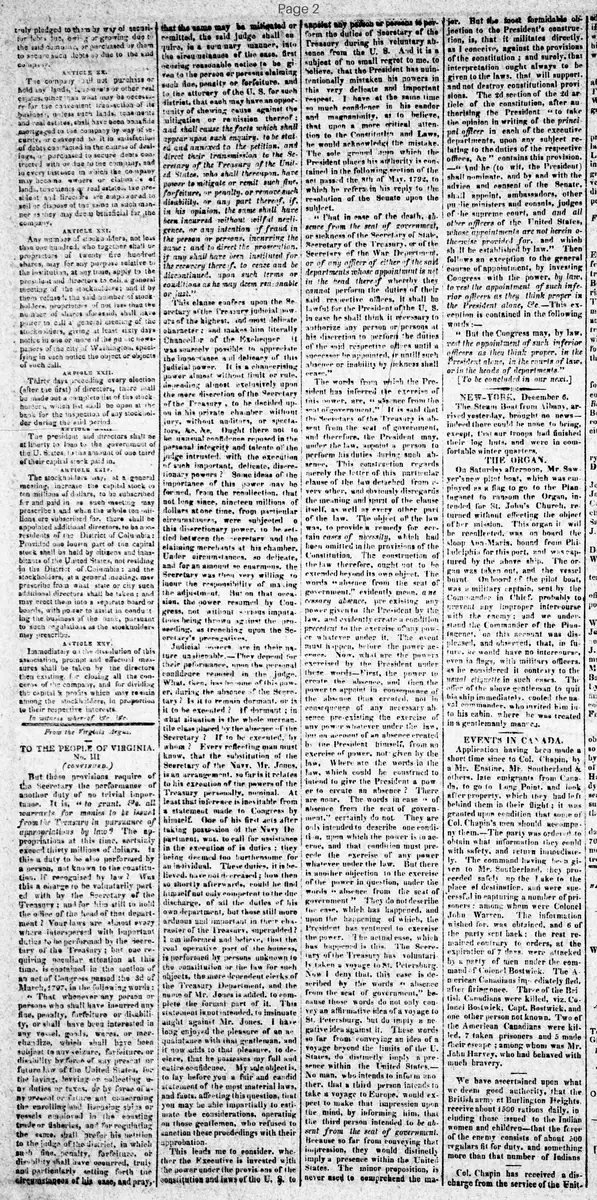
From the Virginia Argus.
TO THE PEOPLE OF VIRGINIA.
No. III
(CONTINUED.)
But those provisions require of the Secretary the performance of another duty of no trivial importance. It is, "to grant, &c. all warrants for monies to be issued from the Treasury in pursuance of appropriations by law?" The appropriations at this time, certainly exceed thirty millions of dollars. Is this- a duty to be also performed by a person, not known to the constitution, if recognised by law? Was this a charge to be voluntarily parted with by the Secretary of the Treasury: and for him still to hold the office of the head of the department? Your laws are almost every where interspersed with important duties to be performed by the Secretary of the Treasury: but one requiring peculiar attention at this time, is contained in the section of an act of Congress passed the 3d of March, 1797, in the following words:
"That whenever any person or persons who shall have incurred any fine, penalty, forfeiture or disability, or shall have been interested in any vessel, goods, wares, or merchandise, which shall have been subject to any seizure, forfeiture, or disability by force of any present or future law of the United States, for the laying, levying or collecting any duties or taxes, or by force of any present or future law concerning the enrolling and licensing sloop or vessels employed in the coasting trade or fisheries, and for regulating the same, shall prefer his petition to the judge of the district, in which such fine, penalty, forfeiture, or disability shall have occurred, truly and particularly setting forth the circumstances of his case, and pray, that the same may be mitigated or remitted, the said judge shall enquire, in a summary manner, into the circumstances of the case, first giving reasonable notice to be given to the person or persons claiming such fine, penalty or forfeiture, and to the attorney of the U. S. for such district, that each may have opportunity of shewing cause against the mitigation or remission thereof: and shall cause the facts which shall appear upon such enquiry, to be stated and annexed to the petition, and direct their transmission to the Secretary of the Treasury of the United States, who shall thereupon, have power to mitigate or remit such fine, forfeiture, or penalty, or remove such disability, or any part thereof, if in his opinion, the same shall have been incurred without wilful negligence, or any intention of fraud in the person or persons incurring the same: and to direct the prosecution, if any shall have been instituted for the recovery thereof, to cease and be discontinued, upon such terms or conditions as he may deem reasonable or just."
This clause confers upon the Secretary of the Treasury judicial powers of the highest, and most delicate character; and makes him literally Chancellor of the Exchequer it was scarcely possible to appropriate the importance and delicacy of this judicial power. It is a chastening power almost without limit or rule, depending almost exclusively upon the mere discretion of the Secretary of the Treasury, to be decided upon in his private chamber without jury, without auditors, or spectators, &c. &c. Ought there not to be unusual confidence reposed in the personal integrity and talents of the judge intrusted, with the execution of such important, delicate, discretionary powers? Some ideas of the importance of this power may be formed, from the recollection, that not long since, nineteen millions of dollars at one time, from particular circumstances, were subjected to this discretionary power, to be settled between the Secretary and the claiming merchants at his chamber. Under circumstances, so delicate, and for an amount so enormous, the Secretary was then very willing to incur the responsibility of making the adjustment. But on that occasion, the power resumed by Congress, not without some serious imputations being thrown against the proceeding, as trenching upon the Secretary's prerogatives.
Judicial powers, are in their nature unalienable.-They depend for their performance, upon the personal confidence reposed in the judge. What, then, must have been the case of this power, during the absence of the Secretary? Is it to remain dormant, or is it to be executed? if dormant; in what situation is the whole mercantile class placed by the absence of the Secretary? If to be executed, by whom? Every reflecting man must know, that the substitution of the Secretary of the Navy, Mr. Jones, is an arrangement, so far as it relates to his execution of the powers of the Treasury personally, nominal. At least that inference is inevitable from a statement made to Congress by himself. One of his first acts after taking possession of the Navy Department, was, to call for assistance in the execution of its duties; they being deemed too burthensome for an individual. These duties, it is believed, have not decreased: how then so shortly afterwards, could he find himself not only competent to the due discharge, of all the duties of his own department, but those still more arduous and important in the character of the Treasury, superadded? I am informed and believe, that the real operative part of the business, is performed by persons unknown to the constitution or the law for such objects, the more dependent clerks of the Treasury Department, and the name of Mr. Jones is added, to complete the formal part of it. This statement is not intended, to insinuate aught against Mr. Jones. I have long enjoyed the pleasure of an acquaintance with that gentleman, and it now adds to that pleasure, to declare, that he possesses my full and entire confidence. My sole object is, to lay before you a fair and candid statement of the most material laws, and facts, affecting this question, that you may be able impartially to estimate the considerations, operating on those gentlemen, who refused to sanction these proceedings with their approbation.
This leads me to consider, whether the Executive is invested with the power under the provisions of the constitution and laws of the U. S. to appoint any person or persons to perform the duties of Secretary of the Treasury during his voluntary absence from the U. S. And it is a subject of no small regret to me, to believe, that the President has unintentionally mistaken his powers in this very delicate and important respect. I have, at the same time so much confidence in his candor and magnanimity, as to believe, that upon a more critical attention to the Constitution and Laws, he would acknowledge the mistake. The sole ground upon which the President places his authority is contained in the following section of the act passed the 8th of May, 1792, to which he refers in his reply to the resolution of the Senate upon the subject.
"That in case of the death, absence from the seat of government, or sickness of the Secretary of state, Secretary of the Treasury, or of the Secretary of the War Department, or of any officer of either of the said departments whose appointment is not in the head thereof whereby they cannot perform the duties of their said respective offices, it shall be lawful for the President of the U. S. in case he shall think it necessary to authorize any person or persons at his discretion to perform the duties of the said respective offices until a successor be appointed, or until such absence or inability by sickness shall cease."
The words from which the President has inferred the exercise of this power, are, "absence from the seat of government." It is granted that the Secretary of the Treasury is absent from the seat of government, and therefore, the President may, under the law, appoint a person to perform his duties during such absence. This construction regards merely the letter of this particular clause of the law detached from every other, and obviously disregards the meaning and spirit of the clause itself, as well as every other part of the law. The object of the law was, to provide a remedy for certain cases of necessity, which had been omitted in the provisions of the Constitution. The construction of the law therefore, ought not to be extended beyond its own object. The words "absence from the seat of government," evidently mean, a necessary absence, pre-existing any power given to the President by the law, and evidently create a condition precedent to the exercise of any power whatever under it. The event must happen, before the power accrues. Now, what are the powers exercised by the President under these words-First, the power to create the absence, and then the power to appoint in consequence of the absence thus created, not in consequence of any necessary absence pre-existing the exercise of any power whatever under the law, but on account of an absence created by the President himself, from an exercise of power, not given by the law. Where are the words in the law, which could be construed to intend to give the President a power to create an absence? There are none. The words in case "of absence from the seat of government," certainly do not. They are only intended to describe one condition, upon which the power is to accrue, and that condition must precede the exercise of any power whatever under the law. But there is another objection to the exercise of the power in question, under the words "absence from the seat of government" They do not describe the case, which has happened, and upon the happening of which, the President has ventured to exercise the power. The actual case, which has happened is this. The Secretary of the Treasury has voluntarily taken a voyage to St. Petersburg. Now I deny that, this case is described by the words absence from the seat of government," because those words do not only convey an affirmative idea of a voyage to St. Petersburg, but do imply a negative idea against it. These words so far from conveying an idea of a voyage beyond the limits of the U. States, do distinctly imply a presence within the United States.- No man, who intends to inform another, that a third person intends to take a voyage to Europe, would expect to make that impression upon the mind, by informing him, that the third person intended to be absent from the seat of government. Because so far from conveying that impression, they would distinctly imply a presence within the United States. The minor proposition, is never used to comprehend the major.
But the most formidable objection to the President's construction, is, that it militates directly, as I conceive, against the provisions of the constitution; and surely, that interpretation ought always to be given to the laws, that will support, and not destroy constitutional provisions. The 2d section of the 2d article of the constitution, after authorizing the President "to take the opinion in writing of the principal officer in each of the executive departments, upon any subject relating to the duties of the respective offices, do" contains this provision.- "And he (to wit, the President) shall nominate, and by and with the advice and consent of the Senate, shall appoint, ambassadors, other public ministers and consuls, judges of the supreme court, and all other officers of the United States, whose appointments are not herein otherwise provided for, and which shall be established by law." Then follows an exception to the general course of appointment, by investing Congress with the power, by law, to vest the appointment of such inferior officers as they think proper in the President alone, &c.-This exception is contained in the following words:-
"But the Congress may, by law, vest the appointment of such inferior officers as they think proper, in the President alone, in the courts of law, or in the heads of departments."
[To be concluded in our next.]
TO THE PEOPLE OF VIRGINIA.
No. III
(CONTINUED.)
But those provisions require of the Secretary the performance of another duty of no trivial importance. It is, "to grant, &c. all warrants for monies to be issued from the Treasury in pursuance of appropriations by law?" The appropriations at this time, certainly exceed thirty millions of dollars. Is this- a duty to be also performed by a person, not known to the constitution, if recognised by law? Was this a charge to be voluntarily parted with by the Secretary of the Treasury: and for him still to hold the office of the head of the department? Your laws are almost every where interspersed with important duties to be performed by the Secretary of the Treasury: but one requiring peculiar attention at this time, is contained in the section of an act of Congress passed the 3d of March, 1797, in the following words:
"That whenever any person or persons who shall have incurred any fine, penalty, forfeiture or disability, or shall have been interested in any vessel, goods, wares, or merchandise, which shall have been subject to any seizure, forfeiture, or disability by force of any present or future law of the United States, for the laying, levying or collecting any duties or taxes, or by force of any present or future law concerning the enrolling and licensing sloop or vessels employed in the coasting trade or fisheries, and for regulating the same, shall prefer his petition to the judge of the district, in which such fine, penalty, forfeiture, or disability shall have occurred, truly and particularly setting forth the circumstances of his case, and pray, that the same may be mitigated or remitted, the said judge shall enquire, in a summary manner, into the circumstances of the case, first giving reasonable notice to be given to the person or persons claiming such fine, penalty or forfeiture, and to the attorney of the U. S. for such district, that each may have opportunity of shewing cause against the mitigation or remission thereof: and shall cause the facts which shall appear upon such enquiry, to be stated and annexed to the petition, and direct their transmission to the Secretary of the Treasury of the United States, who shall thereupon, have power to mitigate or remit such fine, forfeiture, or penalty, or remove such disability, or any part thereof, if in his opinion, the same shall have been incurred without wilful negligence, or any intention of fraud in the person or persons incurring the same: and to direct the prosecution, if any shall have been instituted for the recovery thereof, to cease and be discontinued, upon such terms or conditions as he may deem reasonable or just."
This clause confers upon the Secretary of the Treasury judicial powers of the highest, and most delicate character; and makes him literally Chancellor of the Exchequer it was scarcely possible to appropriate the importance and delicacy of this judicial power. It is a chastening power almost without limit or rule, depending almost exclusively upon the mere discretion of the Secretary of the Treasury, to be decided upon in his private chamber without jury, without auditors, or spectators, &c. &c. Ought there not to be unusual confidence reposed in the personal integrity and talents of the judge intrusted, with the execution of such important, delicate, discretionary powers? Some ideas of the importance of this power may be formed, from the recollection, that not long since, nineteen millions of dollars at one time, from particular circumstances, were subjected to this discretionary power, to be settled between the Secretary and the claiming merchants at his chamber. Under circumstances, so delicate, and for an amount so enormous, the Secretary was then very willing to incur the responsibility of making the adjustment. But on that occasion, the power resumed by Congress, not without some serious imputations being thrown against the proceeding, as trenching upon the Secretary's prerogatives.
Judicial powers, are in their nature unalienable.-They depend for their performance, upon the personal confidence reposed in the judge. What, then, must have been the case of this power, during the absence of the Secretary? Is it to remain dormant, or is it to be executed? if dormant; in what situation is the whole mercantile class placed by the absence of the Secretary? If to be executed, by whom? Every reflecting man must know, that the substitution of the Secretary of the Navy, Mr. Jones, is an arrangement, so far as it relates to his execution of the powers of the Treasury personally, nominal. At least that inference is inevitable from a statement made to Congress by himself. One of his first acts after taking possession of the Navy Department, was, to call for assistance in the execution of its duties; they being deemed too burthensome for an individual. These duties, it is believed, have not decreased: how then so shortly afterwards, could he find himself not only competent to the due discharge, of all the duties of his own department, but those still more arduous and important in the character of the Treasury, superadded? I am informed and believe, that the real operative part of the business, is performed by persons unknown to the constitution or the law for such objects, the more dependent clerks of the Treasury Department, and the name of Mr. Jones is added, to complete the formal part of it. This statement is not intended, to insinuate aught against Mr. Jones. I have long enjoyed the pleasure of an acquaintance with that gentleman, and it now adds to that pleasure, to declare, that he possesses my full and entire confidence. My sole object is, to lay before you a fair and candid statement of the most material laws, and facts, affecting this question, that you may be able impartially to estimate the considerations, operating on those gentlemen, who refused to sanction these proceedings with their approbation.
This leads me to consider, whether the Executive is invested with the power under the provisions of the constitution and laws of the U. S. to appoint any person or persons to perform the duties of Secretary of the Treasury during his voluntary absence from the U. S. And it is a subject of no small regret to me, to believe, that the President has unintentionally mistaken his powers in this very delicate and important respect. I have, at the same time so much confidence in his candor and magnanimity, as to believe, that upon a more critical attention to the Constitution and Laws, he would acknowledge the mistake. The sole ground upon which the President places his authority is contained in the following section of the act passed the 8th of May, 1792, to which he refers in his reply to the resolution of the Senate upon the subject.
"That in case of the death, absence from the seat of government, or sickness of the Secretary of state, Secretary of the Treasury, or of the Secretary of the War Department, or of any officer of either of the said departments whose appointment is not in the head thereof whereby they cannot perform the duties of their said respective offices, it shall be lawful for the President of the U. S. in case he shall think it necessary to authorize any person or persons at his discretion to perform the duties of the said respective offices until a successor be appointed, or until such absence or inability by sickness shall cease."
The words from which the President has inferred the exercise of this power, are, "absence from the seat of government." It is granted that the Secretary of the Treasury is absent from the seat of government, and therefore, the President may, under the law, appoint a person to perform his duties during such absence. This construction regards merely the letter of this particular clause of the law detached from every other, and obviously disregards the meaning and spirit of the clause itself, as well as every other part of the law. The object of the law was, to provide a remedy for certain cases of necessity, which had been omitted in the provisions of the Constitution. The construction of the law therefore, ought not to be extended beyond its own object. The words "absence from the seat of government," evidently mean, a necessary absence, pre-existing any power given to the President by the law, and evidently create a condition precedent to the exercise of any power whatever under it. The event must happen, before the power accrues. Now, what are the powers exercised by the President under these words-First, the power to create the absence, and then the power to appoint in consequence of the absence thus created, not in consequence of any necessary absence pre-existing the exercise of any power whatever under the law, but on account of an absence created by the President himself, from an exercise of power, not given by the law. Where are the words in the law, which could be construed to intend to give the President a power to create an absence? There are none. The words in case "of absence from the seat of government," certainly do not. They are only intended to describe one condition, upon which the power is to accrue, and that condition must precede the exercise of any power whatever under the law. But there is another objection to the exercise of the power in question, under the words "absence from the seat of government" They do not describe the case, which has happened, and upon the happening of which, the President has ventured to exercise the power. The actual case, which has happened is this. The Secretary of the Treasury has voluntarily taken a voyage to St. Petersburg. Now I deny that, this case is described by the words absence from the seat of government," because those words do not only convey an affirmative idea of a voyage to St. Petersburg, but do imply a negative idea against it. These words so far from conveying an idea of a voyage beyond the limits of the U. States, do distinctly imply a presence within the United States.- No man, who intends to inform another, that a third person intends to take a voyage to Europe, would expect to make that impression upon the mind, by informing him, that the third person intended to be absent from the seat of government. Because so far from conveying that impression, they would distinctly imply a presence within the United States. The minor proposition, is never used to comprehend the major.
But the most formidable objection to the President's construction, is, that it militates directly, as I conceive, against the provisions of the constitution; and surely, that interpretation ought always to be given to the laws, that will support, and not destroy constitutional provisions. The 2d section of the 2d article of the constitution, after authorizing the President "to take the opinion in writing of the principal officer in each of the executive departments, upon any subject relating to the duties of the respective offices, do" contains this provision.- "And he (to wit, the President) shall nominate, and by and with the advice and consent of the Senate, shall appoint, ambassadors, other public ministers and consuls, judges of the supreme court, and all other officers of the United States, whose appointments are not herein otherwise provided for, and which shall be established by law." Then follows an exception to the general course of appointment, by investing Congress with the power, by law, to vest the appointment of such inferior officers as they think proper in the President alone, &c.-This exception is contained in the following words:-
"But the Congress may, by law, vest the appointment of such inferior officers as they think proper, in the President alone, in the courts of law, or in the heads of departments."
[To be concluded in our next.]
What sub-type of article is it?
Constitutional
Legal Reform
What keywords are associated?
Constitutional Powers
Treasury Duties
Presidential Appointment
Absence Abroad
Judicial Discretion
Executive Authority
What entities or persons were involved?
Secretary Of The Treasury
President Of The United States
Secretary Of The Navy (Mr. Jones)
Congress
Editorial Details
Primary Topic
Critique Of Presidential Authority To Appoint Acting Secretary Of The Treasury During Voluntary Foreign Absence
Stance / Tone
Critical Of Executive Overreach, Arguing Unconstitutionality
Key Figures
Secretary Of The Treasury
President Of The United States
Secretary Of The Navy (Mr. Jones)
Congress
Key Arguments
Secretary Of The Treasury Holds Critical Duties Including Granting Money Warrants And Exercising Discretionary Judicial Powers Over Fines And Forfeitures That Require Personal Integrity And Cannot Be Easily Delegated
Substitution By Secretary Of The Navy Is Nominal, With Actual Work Done By Clerks
1792 Law Allows Appointment Only For Necessary Absence From Seat Of Government, Not Voluntary Absence Abroad Like To St. Petersburg
Such Interpretation Conflicts With Constitutional Provisions On Appointments Of Principal Officers
Law Intended For Pre Existing Necessities, Not To Enable Creation Of Absence By Executive Action