Thank you for visiting SNEWPapers!
Sign up free
The Citizen Republican
Scotland, Parkston, Bon Homme County, Hutchinson County, South Dakota
What is this article about?
Article discusses Persia's precarious position in WWI, with Turkish sympathizers among tribesmen nearing Suez and Egypt. Highlights historical tensions with Russia and Britain, Shuster's dismissal, and young Shah Ahmed Mirza's nominal rule amid foreign spheres of influence.
Clipping
OCR Quality
Full Text
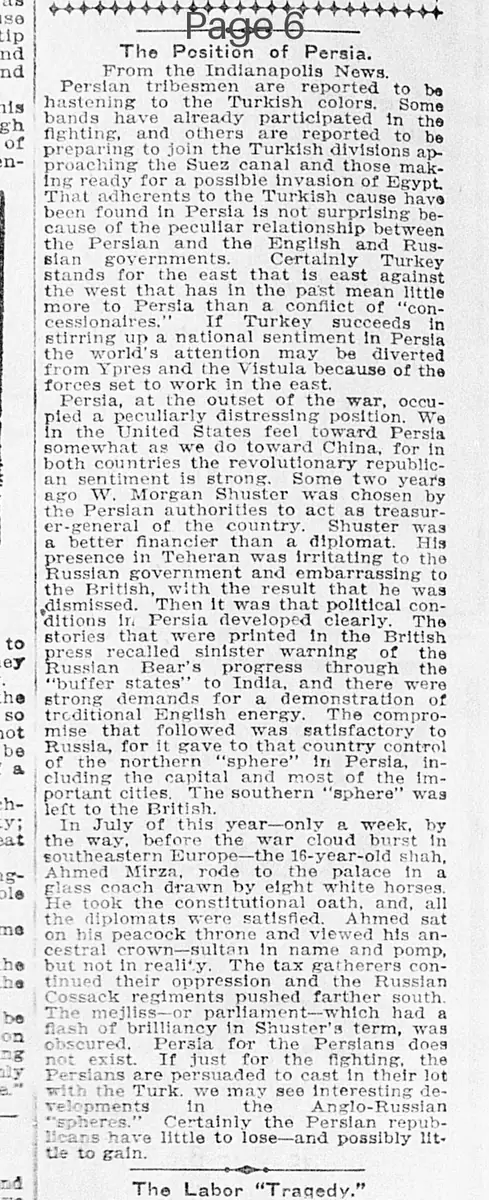
From the Indianapolis News.
Persian tribesmen are reported to be hastening, bands have already participated in the fighting, and others are reported to be preparing approaching the Suez canal and those making ready for possible invasion of Egypt.
That adherents to the Turkish cause have been found in Persia is not surprising because of the peculiar relationship between the Persian and the English and Russian governments.
Certainly Turkey stands for the east the west that has in the past mean little more to Persia than a conflict of "concessionaires."
If Turkey succeeds in stirring up a national sentiment in Persia the world's attention may be diverted from Ypres and the Vistula because of the forces set to work in the east.
Persia, at the outset of the war, occupied a peculiarly distressing position. We in the United States feel toward Persia somewhat as we do toward China, for in both countries the revolutionary republican sentiment is strong. Some two years ago W. Morgan Shuster was chosen by the Persian authorities to act as treasurer-general of the country. Shuster was a better financier than a diplomat. His presence in Teheran was irritating to the Russian government and embarrassing to the British, with the result that he was dismissed. Then it was that political conditions in Persia developed clearly. The stories that were printed in the British press recalled sinister warning of the Russian Bear's progress through the "buffer states" to India, and there were strong demands for a demonstration of traditional English energy. The compromise that followed was satisfactory to Russia, for it gave to that country control of the northern "sphere" in Persia, including the capital and most of the important cities. The southern "sphere" was left to the British.
In July of this year—only a week, by the way, before the war cloud burst in southeastern Europe—the 16-year-old shah, Ahmed Mirza, rode to the palace in a glass coach drawn by eight white horses. He took the constitutional oath, and, all the diplomats were satisfied. Ahmed sat on his peacock throne and viewed his ancestral crown—sultan in name and pomp, but not in reality. The tax gatherers continued their oppression and the Russian Cossack regiments pushed farther south. The mejliss—or parliament—which had a flash of brilliancy in Shuster's term, was obscured. Persia for the Persians does not exist. If just for the fighting, the Persians are persuaded to cast in their lot with the Turk, we may see interesting developments in the Anglo-Russian "spheres."
Certainly the Persian republicans have little to lose—and possibly little to gain.
What sub-type of article is it?
What keywords are associated?
What entities or persons were involved?
Where did it happen?
Foreign News Details
Primary Location
Persia
Event Date
July Of This Year
Key Persons
Outcome
russian control of northern sphere including capital; british control of southern sphere; potential persian alignment with turkey diverting attention from western fronts
Event Details
Persian tribesmen support Turkish cause, approaching Suez Canal and preparing for Egypt invasion. Persia in distressing position due to Russian and British influences; Shuster dismissed two years ago; Shah Ahmed Mirza coronated in July; foreign spheres divide control; potential national sentiment stirred by Turkey could impact war.