Thank you for visiting SNEWPapers!
Sign up free
Edwardsville Spectator
Edwardsville, Madison County, Illinois
What is this article about?
Rev. William Meade reports to the American Colonization Society on his journey through southern states, forming auxiliary societies in Georgia, South Carolina, and North Carolina, raising $7-8,000 in subscriptions, opposing the slave trade, and finding support among free people of color for emigration to Africa.
Clipping
OCR Quality
Full Text
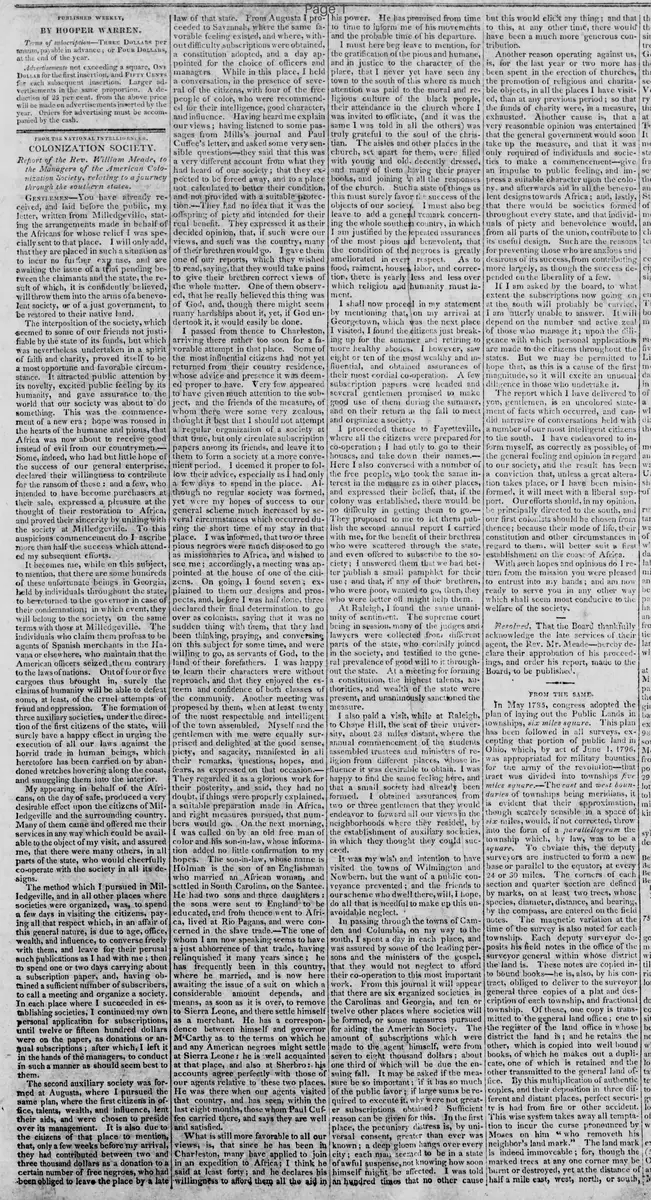
COLONIZATION SOCIETY.
Report of the Rev. William Meade, to the Managers of the American Colonization Society, relating to a journey through the southern states.
Gentlemen—You have already received, and laid before the public, my letter, written from Milledgeville, stating the arrangements made in behalf of the Africans for whose relief I was specially sent to that place. I will only add, that they are placed in such a situation as to incur no further expense, and are awaiting the issue of a trial pending between the claimants and the state, the result of which, it is confidently believed, will throw them into the arms of a benevolent society, or of a just government, to be restored to their native land.
The interposition of the society, which seemed to some of our friends not justifiable by the state of its funds, but which was nevertheless undertaken in a spirit of faith and charity, proved itself to be a most opportune and favorable circumstance. It attracted public attention by its novelty, excited public feeling by its humanity, and gave assurance to the world that our society was about to do something. This was the commencement of a new era; hope was roused in the hearts of the humane and pious, that Africa was now about to receive good instead of evil from our countrymen.—Some, indeed, who had but little hope of the success of our general enterprise, declared their willingness to contribute for the ransom of these: and a few, who intended to have become purchasers at their sale, expressed a pleasure at the thought of their restoration to Africa, and proved their sincerity by uniting with the society at Milledgeville. To this auspicious commencement do I ascribe more than half the success which attended my subsequent efforts.
It becomes me, while on this subject, to mention, that there are some hundreds of these unfortunate beings in Georgia, held by individuals throughout the state, to be returned to the governor in case of their condemnation; in which event, they will belong to the society, on the same terms with those at Milledgeville. The individuals who claim them profess to be agents of Spanish merchants in the Havana or elsewhere, who maintain that the American officers seized them contrary to the laws of nations. Out of four or five cargoes thus brought in, surely the claims of humanity will be able to defeat some, at least, of the cruel attempts of fraud and oppression. The formation of three auxiliary societies, under the direction of the first citizens of the state, will surely have a happy effect in urging the execution of all our laws against the horrid trade in human beings, which heretofore has been carried on by abandoned wretches hovering along the coast, and smuggling them into the interior.
My appearing in behalf of the Africans, on the day of sale, produced a very desirable effect upon the citizens of Milledgeville and the surrounding country. Many of them came and offered me their services in any way which could be available to the object of my visit, and assured me, that there were many others, in all parts of the state, who would cheerfully co-operate with the society in all its designs.
The method which I pursued in Milledgeville, and in all other places where societies were organized, was, to spend a few days in visiting the citizens, paying all that respect which, in an affair of this general nature, is due to age, office, wealth, and influence, to converse freely with them, and leave for their perusal such publications as I had with me; then to spend one or two days carrying about a subscription paper, and, having obtained a sufficient number of subscribers, to call a meeting and organize a society. In each place where I succeeded in establishing societies, I continued my own personal application for subscriptions, until twelve or fifteen hundred dollars were on the paper, as donations or annual subscriptions; after which, I left it in the hands of the managers, to conduct in such a manner as should seem best to them.
The second auxiliary society was formed at Augusta, where I pursued the same plan, where the first citizens in office, talents, wealth, and influence, lent their aids, and were chosen to preside over its management. It is also due to the citizens of that place to mention, that, only a few weeks before my arrival, they had contributed between two and three thousand dollars as a donation to a certain number of free negroes, who had been obliged to leave the place by a late law of that state. From Augusta I proceeded to Savannah, where the same favorable feeling existed, and where, without difficulty, subscriptions were obtained, a constitution adopted, and a day appointed for the choice of officers and managers. While in this place, I held a conversation, in the presence of several of the citizens, with four of the free people of color, who were recommended for their intelligence, good character, and influence. Having heard me explain our views; having listened to some passages from Mills's journal and Paul Cuffee's letter, and asked some very sensible questions—they said that this was a very different account from what they had heard of our society; that they expected to be forced away, and to a place not calculated to better their condition, and not provided with a suitable protection.—They had no idea that it was the offspring of piety and intended for their real benefit. They expressed it as their decided opinion, that, if such were our views, and such was the country, many of their brethren would go. I gave them one of our reports, which they wished to read, saying, that they would take pains to give their brethren correct views of the whole matter. One of them observed, that he really believed this thing was of God, and, though there might seem many hardships about it, yet, if God undertook it, it would easily be done.
I passed from thence to Charleston, arriving there rather too soon for a favorable attempt in that place. Some of the most influential citizens had not yet returned from their country residence, whose advice and presence it was deemed proper to have. Very few appeared to have given much attention to the subject, and the friends of the measure, of whom there were some very zealous, thought it best that I should not attempt a regular organization of a society at that time, but only circulate subscription papers among its friends, and leave it to them to form a society at a more convenient period. I deemed it proper to follow their advice, especially as I had only a few days to spend in the place. Although no regular society was formed, yet were my hopes of success to our general scheme much increased by several circumstances which occurred during the short time of my stay in that place. I was informed, that two or three pious negroes were much disposed to go as missionaries to Africa, and wished to see me; accordingly, a meeting was appointed at the house of one of the citizens. On going, I found seven; explained to them our designs and prospects, and, before I was half done, three declared their final determination to go over as colonists, saving that it was no sudden thing with them, that they had been thinking, praying, and conversing on this subject for some time, and were willing to go, as servants of God, to the land of their forefathers. I was happy to learn their characters were without reproach, and that they enjoyed the esteem and confidence of both classes of the community. Another meeting was proposed by them, when at least twenty of the most respectable and intelligent of the town assembled. Myself and the gentlemen with me were equally surprised and delighted at the good sense, piety, and sagacity, manifested in all their remarks, questions, hopes, and fears, as expressed on that occasion.—They regarded it as a glorious work for their posterity, and said, they had no doubt, if things were properly explained, a suitable preparation made in Africa, and right measures pursued, that numbers would go. On the next morning, I was called on by an old free man of color and his son-in-law, whose information added no little confirmation to my hopes. The son-in-law, whose name is Holman is the son of an Englishman who married an African woman, and settled in South Carolina, on the Santee. He had two sons and three daughters: the sons were sent to England to be educated, and from thence went to Africa, lived at Rio Pongas, and were concerned in the slave trade.—The one of whom I am now speaking seems to have a just abhorrence of that trade, having relinquished it many years since; he has frequently been in this country, where he married, and is now here awaiting the issue of a suit on which a considerable amount depends, and means, as soon as it is over, to remove to Sierra Leone, and there settle himself as a merchant. He has a correspondence between himself and governor M'Carthy as to the terms on which he and any American negroes might settle at Sierra Leone: he is well acquainted at that place, and also at Sherbro: his accounts agree perfectly with those of our agents relative to these two places. He was there when our agents visited that country, and has seen, within the last eight months, those whom Paul Cuffee carried there, and says they are well and satisfied.
What is still more favorable to all our views, is, that since he has been in Charleston, many have applied to join in an expedition to Africa; I think he said at least forty; and he declares his willingness to afford them all the aid in his power. He has promised from time to time to inform me of his movements and the probable time of his departure.
I must here beg leave to mention, for the gratification of the pious and humane, and in justice to the character of the place, that I never yet have seen any town to the south of this where as much attention was paid to the moral and religious culture of the black people. Their attendance in the church where I was invited to officiate, (and it was the same I was told in all the others) was truly grateful to the soul of the christian. The aisles and other places in the church, set apart for them, were filled with young and old, decently dressed, and many of them having their prayer books, and joining in all the responses of the church. Such a state of things as this must surely favor the success of the objects of our society. I must also beg leave to add a general remark concerning the whole southern country, in which I am justified by the repeated assurances of the most pious and benevolent, that the condition of the negroes is greatly ameliorated in every respect. As to food, raiment, houses labor, and correction, there is yearly less and less over which religion and humanity must lament.
I shall now proceed in my statement by mentioning that, on my arrival at Georgetown, which was the next place I visited, I found the citizens just breaking up for the summer and retiring to more healthy abodes. I however, saw eight or ten of the most wealthy and influential, and obtained assurances of their most cordial co-operation. A few subscription papers were headed and several gentlemen promised to make good use of them during the summer, and on their return in the fall to meet and organize a society.
I proceeded thence to Fayetteville, where all the citizens were prepared for co-operation; I had only to go to their houses, and take down their names.—Here I also conversed with a number of the free people, who took the same interest in the measure as in other places, and expressed their belief, that, if the colony was established, there would be no difficulty in getting them to go.—They proposed to me to let them publish the second annual report I carried with me, for the benefit of their brethren who were scattered through the state, and even offered to subscribe to the society: I answered them that we had better publish a small pamphlet for their use; and that, if any of their brethren, who were poor, wanted to go, then, they who were better off might help them.
At Raleigh, I found the same unanimity of sentiment. The supreme court being in session, many of the judges and lawyers were collected from different parts of the state, who cordially joined in the society, and testified to the general prevalence of good will to it throughout the state. At a meeting for forming a constitution, the highest talents, authorities, and wealth of the state were present, and unanimously sanctioned the measure.
I also paid a visit, while at Raleigh, to Chapel Hill, the seat of their university, about 28 miles distant, where the annual commencement of the students assembled trustees and ministers of religion from different places, whose influence it was desirable to obtain. I was happy to find the same feeling here, and that a small society had already been formed. I obtained assurances from two or three gentlemen that they would endeavor to forward all our views in the neighborhoods where they resided, by the establishment of auxiliary societies, in which they thought they could succeed.
It was my wish and intention to have visited the towns of Wilmington and Newbern, but the want of a public conveyance prevented; and the friends to our scheme who dwell there, will, I hope, do all that is needful to make up this unavoidable neglect.
In passing through the towns of Camden and Columbia, on my way to the south, I spent a day in each place, and was assured by some of the leading persons and the ministers of the gospel, that they would not neglect to afford their co-operation to this most important work. From this journal it will appear that there are six organized societies in the Carolinas and Georgia, and ten or twelve other places where societies will be formed, or some measures pursued for aiding the American Society. The amount of subscriptions which were made to the agent himself, were from seven to eight thousand dollars; about one third of which will be due the ensuing fall. It may be asked if the measure be so important: if it has so much of the public favor: if large sums be required to execute it, why were not greater subscriptions obtained? Sufficient reason can be given for this. In the first place, the pecuniary distress is, by universal consent, greater than ever was known; a deep gloom hangs over every city; each man seemed to be in a state of awful suspense, not knowing how soon himself might be affected. I was told an hundred times that no other cause but this would elicit any thing; and that to this, at any other time, there would have been a much more generous contribution.
Another reason operating against us, is, for the last year or two more has been spent in the erection of churches, the promotion of religious and charitable objects, in all the places I have visited, than at any previous period; so that the funds of charity were, in a measure, exhausted. Another cause is, that a very reasonable opinion was entertained that the general government would soon take up the measure, and that it was only required of individuals and societies to make a commencement—give an impulse to public feeling, and impress a suitable character upon the colony, and afterwards aid in all the benevolent designs towards Africa; and, lastly, that there would be societies formed throughout every state, and that individuals of piety and benevolence would, from all parts of the union, contribute to its useful design. Such are the reasons for preventing those who are anxious and desirous of its success, from contributing more largely, as though the success depended on the liberality of a few.
If I am asked by the board, to what extent the subscriptions now going on at the south will probably be carried, I am utterly unable to answer. It will depend on the number and active zeal of those who manage it; upon the diligence with which personal applications are made to the citizens throughout the states. But we may be permitted to hope that, as this is a cause of the first magnitude, so it will excite an unusual diligence in those who undertake it.
The report which I have delivered to you, gentlemen, is an uncolored statement of facts which occurred, and candid narrative of conversations held with a number of our most intelligent citizens to the south. I have endeavored to inform myself, as correctly as possible, of the general feeling and opinion in regard to our society, and the result has been a conviction that, unless a great alteration takes place, or I have been misinformed, it will meet with a liberal support. Our efforts should, in my opinion, be principally directed to the south, and our first colonists should be chosen from thence: because their mode of life, their constitution and other circumstances in regard to them, will better suit a first establishment on the coast of Africa.
With such hopes and opinions do I return from the mission you were pleased to entrust into my hands; and am now ready to serve you in any other way which shall seem most conducive to the welfare of the society.
Resolved, That the Board thankfully acknowledge the late services of their agent, the Rev. Mr. Meade—hereby declare their approbation of his proceedings, and order his report, made to the Board, to be published.
What sub-type of article is it?
What themes does it cover?
What keywords are associated?
What entities or persons were involved?
Where did it happen?
Story Details
Key Persons
Location
Southern States Including Georgia, South Carolina, North Carolina
Story Details
Rev. William Meade details his mission to promote the American Colonization Society, forming auxiliary societies in Milledgeville, Augusta, Savannah, Charleston, Georgetown, Fayetteville, Raleigh, and Chapel Hill; engaging free people of color interested in emigrating to Africa; raising subscriptions amid economic distress; and opposing illegal slave trade.