Thank you for visiting SNEWPapers!
Sign up free
The National Intelligencer And Washington Advertiser
Washington, District Of Columbia
What is this article about?
Reports on diplomatic negotiations between Britain and France, involving Mr. Merry and Talleyrand in Paris. Discussions expand to continental issues like Batavian Republic, Germany indemnities, Hanover, Hamburg, Lubeck, Naples, Sardinia, and Portugal. Bonaparte seeks naval armistice and colonial restorations; active communications via Otto and Hawkesbury suggest broader peace settlement.
Clipping
OCR Quality
Full Text
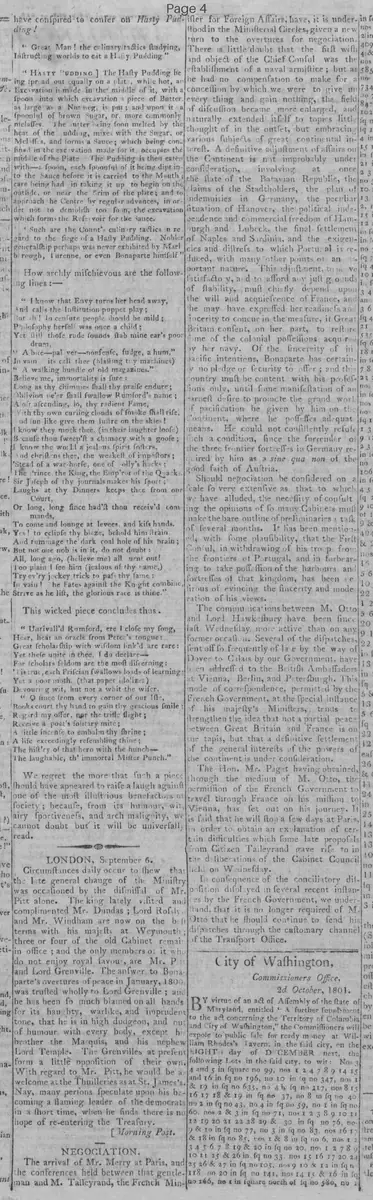
NEGOCIATION.
The arrival of Mr. Merry at Paris, and the conferences held between that gentleman and M. Talleyrand, the French Minister for Foreign Affairs, have, it is understood in the Ministerial Circles, given a new turn to the overtures for negotiation.
There is little doubt that the first wish and object of the Chief Consul was the establishment of a naval armistice; but as he had no compensation to make for a concession by which we were to give up every thing and gain nothing, the field of discussion became more enlarged, and naturally extended itself to topics little thought of in the outset, but embracing various subjects of great continental interest. A definitive adjustment of affairs on the Continent is not improbably under consideration, involving at once the state of the Batavian Republic, the claims of the Stadtholders, the plan of indemnities in Germany, the peculiar situation of Hanover, the political independence and commercial freedom of Hamburg and Lubeck, the final settlement of Naples and Sardinia, and the exigencies and distress to which Portugal is reduced, with many other points of an important nature. This adjustment, to prove satisfactory, and to afford any just grounds of stability, must chiefly depend upon the will and acquiescence of France, and she may have expressed her readiness and sincerity to concur in the measure, if Great Britain consent, on her part, to restore some of the colonial possessions acquired by her navy. Of the sincerity of his pacific intentions, Bonaparte has certainly no pledge or security to offer; and this country must be content with his professions only, until some manifestation of an earnest desire to promote the grand work of pacification be given by him on the Continent, where he possesses adequate means. He could not consistently refuse such a condition, since the surrender of the three frontier fortresses in Germany required by him as a sine qua non of the good faith of Austria.
Should negotiation be considered on a scale of very extensive as that to which we have alluded, the necessity of consulting the opinions of so many Cabinets must make the bare outline of preliminaries a task of several months. It has been mentioned, with some plausibility, that the First Consul, in withdrawing of his troops from the frontiers of Portugal, and in forbearing to take possession of the harbours and fortresses of that kingdom, has been desirous of evincing the sincerity and moderation of his views.
The communications between M. Otto and Lord Hawkesbury have been since last Wednesday more active than on any former occasion. Several of the dispatches, sent off so frequently of late by the way of Dover to Calais by our Government, have been addressed to the British Ambassadors at Vienna, Berlin, and Petersburg. This mode of correspondence, permitted by the French Government, at the special instance of his majesty's Ministers, tends to strengthen the idea that not a partial peace between Great Britain and France is on the tapis, but that a definitive settlement of the general interests of the powers of the continent is under consideration.
The Hon. Mr. Paget having obtained, through the medium of M. Otto, the permission of the French Government to travel through France on his mission to Vienna, has set out on his journey. It is said that he will stop a few days at Paris, in order to obtain an explanation of certain difficulties which some late proposals from Citizen Talleyrand gave rise to in the deliberations of the Cabinet Council held on Wednesday.
In consequence of the conciliatory disposition displayed in several recent instances by the French Government, we understand, that it is no longer required of M. Otto that he should continue to send his dispatches through the customary channel of the Transport Office.
What sub-type of article is it?
What keywords are associated?
What entities or persons were involved?
Where did it happen?
Foreign News Details
Primary Location
Paris
Key Persons
Outcome
ongoing negotiations potentially leading to continental adjustments, naval armistice, and restoration of some british colonial possessions; french withdrawal from portuguese frontiers as sign of sincerity.
Event Details
Arrival of Mr. Merry in Paris leads to conferences with Talleyrand, shifting negotiations toward broad continental settlement including Batavian Republic, Stadtholders' claims, German indemnities, Hanover, Hamburg, Lubeck, Naples, Sardinia, and Portugal. Bonaparte seeks naval armistice without compensation but offers continental pacification in exchange for colonial restorations. Active communications between Otto and Hawkesbury; Paget travels to Vienna via Paris. French conciliatory actions ease dispatch procedures.