Thank you for visiting SNEWPapers!
Sign up free
The Log Cabin Democrat
Conway, Faulkner County, Arkansas
What is this article about?
The editor of the Log Cabin Democrat in Conway, Arkansas, receives a detailed response from the Association of American Portland Cement Manufacturers on February 10, 1916, offering cost data, engineering advice, and a potential site visit for building narrow concrete roads in low-wealth Faulkner County, comparing costs to macadam and citing examples from Arkansas and elsewhere.
Merged-components note: Merged continuation of concrete roads article split across columns.
Clipping
OCR Quality
Full Text
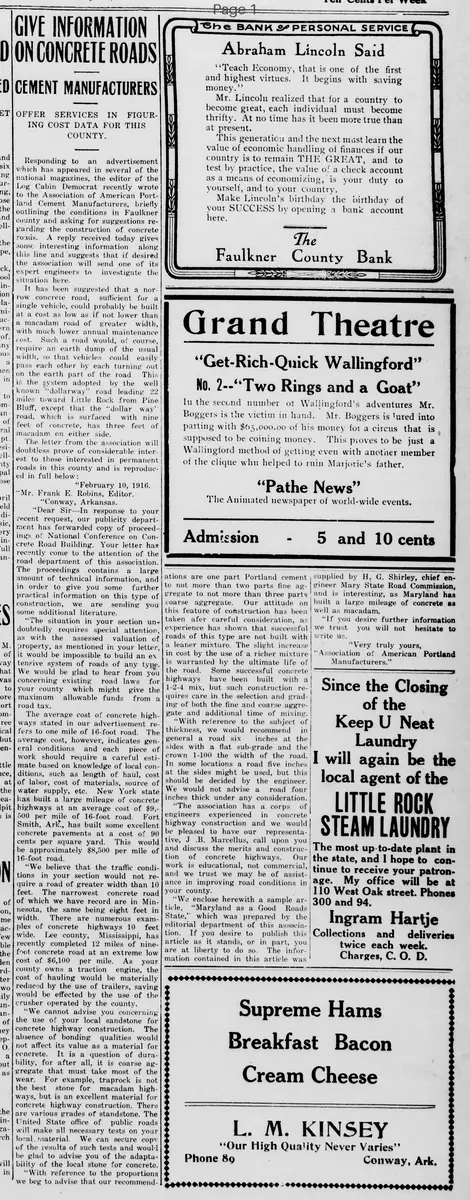
ON CONCRETE ROADS
CEMENT MANUFACTURERS
OFFER
SERVICES
IN
FIGURING
COST DATA FOR THIS
COUNTY.
Responding to an advertisement which has appeared in several of the national magazines, the editor of the Log Cabin Democrat recently wrote to the Association of American Portland Cement Manufacturers, briefly outlining the conditions in Faulkner county and asking for suggestions regarding the construction of concrete roads. A reply received today gives some interesting information along this line and suggests that if desired the association will send one of its expert engineers to investigate the situation here.
It has been suggested that a narrow concrete road, sufficient for a single vehicle, could probably be built at a cost as low as if not lower than a macadam road of greater width, with much lower annual maintenance cost. Such a road would, of course, require an earth dump of the usual width, so that vehicles could easily pass each other by each turning out on the earth part of the road. This is the system adopted by the well known "dollarway" road leading 22 miles toward Little Rock from Pine Bluff, except that the "dollar way" road, which is surfaced with nine feet of concrete, has three feet of macadam on either side.
The letter from the association will doubtless prove of considerable interest to those interested in permanent roads in this county and is reproduced in full below:
"February 10, 1916.
"Mr. Frank E. Robins, Editor.
"Conway, Arkansas.
"Dear Sir--In response to your recent request, our publicity department has forwarded copy of proceedings of National Conference on Concrete Road Building. Your letter has recently come to the attention of the road department of this association. The proceedings contains a large amount of technical information, and in order to give you some further practical information on this type of construction, we are sending you some additional literature.
"The situation in your section undoubtedly requires special attention, as with the assessed valuation of property, as mentioned in your letter, it would be impossible to build an extensive system of roads of any type. We would be glad to hear from you concerning existing road laws for your county which might give the maximum allowable funds from a road tax.
The average cost of concrete high-
ways stated in our advertisement re-
fers to one mile of 16-foot road. The
average cost, however, indicates gen-
eral conditions and each piece of
work should require a careful esti-
mate based on knowledge of local con-
ditions, such as length of haul, cost
of labor, cost of materials, source of
water supply, etc. New York state
has built a large mileage of concrete
highways at an average cost of $9,
500 per mile of 16-foot road. Fort
Smith, Ark., has built some excellent
concrete pavements at a cost of 90
cents per square yard. This would
be approximately $8,500 per mile of
16-foot road.
"We believe that the traffic condi-
tions in your section would not re-
quire a road of greater width than 10
feet. The narrowest concrete road
of which we have record are in Min-
nesota, the same being eight feet in
width. There are numerous exam-
ples of concrete highways 10 feet
wide. Lee county, Mississippi, has
recently completed 12 miles of nine-
foot concrete road at an extreme low
cost of $6,100 per mile. As your
county owns a traction engine, the
cost of hauling would be materially
reduced by the use of trailers, saving
would be effected by the use of the
crusher operated by the county.
"We cannot advise you concerning
the use of your local sandstone for
concrete highway construction. The
absence of bonding qualities would
not affect its value as a material for
concrete. It is a question of dura-
bility, for after all, it is coarse ag-
gregate that must take most of the
wear. For example, traprock is not
the best stone for macadam high-
ways, but is an excellent material for
concrete highway construction. There
are various grades of sandstone. The
United State office of public roads
will make all necessary tests on your
local, material. We can secure copy
of the results of such tests and would
be glad to advise you of the adapta-
bility of the local stone for concrete.
"With reference to the proportions
we beg to advise that our recommend-
ations are one part Portland cement
to not more than two parts fine ag-
gregate to not more than three parts
coarse aggregate. Our attitude on
this feature of construction has been
taken afer careful consideration, as
experience has shown that successful
roads of this type are not built with
a leaner mixture. The slight increase
in cost by the use of a richer mixture
is warranted by the ultimate life of
the road. Some successful concrete
highways have been built with a
1-2-4 mix. but such construction re-
quires care in the selection and grad-
ing of both the fine and coarse aggre-
gate and additional time of mixing.
"With reference to the subject of
thickness, we would recommend in
general a road six inches at the
sides with a flat sub-grade and the
crown 1-100 the width of the road.
In some locations a road five inches
at the sides might be used, but this
should be decided by the engineer.
We would not advise a road four
inches thick under any consideration.
"The association has a corps of
engineers experienced in concrete
highway construction and we would
be pleased to have our representa-
tive, J .B. Marcellus, call upon you
and discuss the merits and construc-
tion of concrete highways. Our
work is educational, not commercial,
and we trust we may be of assist-
ance in improving road conditions in
your county.
"We enclose herewith a sample ar-
ticle, "Maryland as a Good Roads
State," which was prepared by the
editorial department of this associa-
tion. If you desire to publish this
article as it stands, or in part, you
are at liberty to do so. The infor-
mation contained in this article was
supplied by H. G. Shirley, chief en-
gineer Maryland State Road Commission,
and is interesting, as Maryland has
built a large mileage of concrete as
well as macadam,
"If you desire further information
we trust you will not hesitate to
write us.
"Very truly yours,
"Association of American Portland
Manufacturers."
What sub-type of article is it?
What keywords are associated?
What entities or persons were involved?
Where did it happen?
Domestic News Details
Primary Location
Faulkner County, Arkansas
Event Date
February 10, 1916
Key Persons
Outcome
association offers to send expert engineer j. b. marcellus for consultation and provides detailed cost estimates, construction recommendations, and literature on concrete roads suitable for low-wealth areas.
Event Details
Editor Frank E. Robins inquires about concrete road construction for Faulkner County; Association responds with advice on narrow roads (8-10 feet wide), costs ($6,100-$9,500 per mile for 16-foot, lower for narrower), mix proportions (1-2-3 cement to aggregates), thickness (5-6 inches), local material testing, and offers engineering visit.