Thank you for visiting SNEWPapers!
Sign up free
Editorial
February 3, 1837
Burlington Free Press
Burlington, Chittenden County, Vermont
What is this article about?
Editorial criticizes 'log-rolling' in the US Senate during debate on the Land Bill, highlighting threats by Senator Sevier and others to reduce the Tariff or support the Distribution Bill unless western interests are favored, contrasting with Arkansas practices and questioning the decency of such tactics.
Clipping
OCR Quality
98%
Excellent
Full Text
LOG-ROLLING.
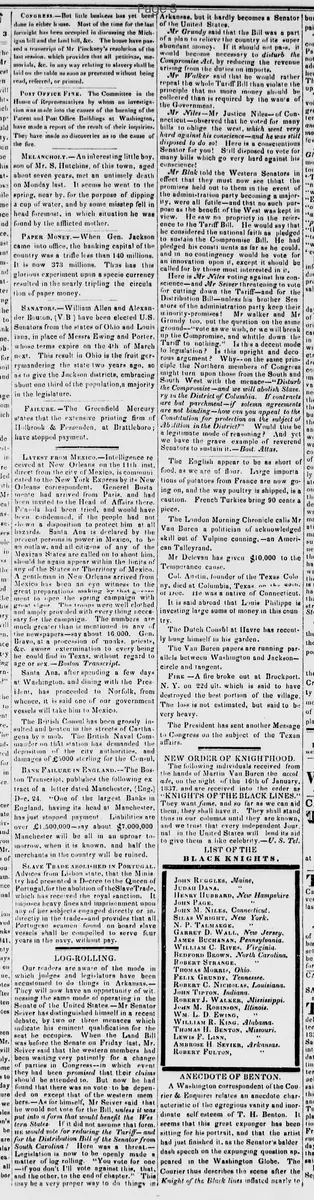
Our readers are aware of the mode in which judges and legislators have been accustomed to do things in Arkansas. They will now have an opportunity of witnessing the same mode of operating in the Senate of the United States. Mr. Senator Sevier has distinguished himself in a recent debate, by two or three menaces which indicate his eminent qualification for the seat he occupies. When the Land Bill was before the Senate on Friday last, Mr. Sevier said that the western members had been waiting very patiently for a change of parties in Congress—in which event they had been promised that their claims should be attended to. But now he had found that there was no vote to be depended on except that of the western members.—As for himself, Mr. Sevier said that he would not vote for the Bill, unless it was put into a form that would benefit the Western States. If it did not assume that form, he would vote for reducing the Tariff—and for the Distribution Bill of the Senator from South Carolina! Here was a threat.—Legislation is now to be openly made a matter of log rolling. 'You vote for one—if you don't I'll vote against this, that, and the other, to the end of the chapter.' This may be a very proper way to do things in Arkansas, but it hardly becomes a Senator of the United States.
Mr. Grundy said that the Bill was a part of a plan to relieve the country of its superabundant money. If it should not pass, it would become necessary to disturb the Compromise Act, by reducing the revenue arising from the duties on imports.
Mr. Walker said that he would rather repeal the whole Tariff Bill than violate the principle that no more money should be collected than is required by the wants of the Government.
Mr. Niles—Mr. Justice Niles—of Connecticut—observed that he voted for many bills to oblige the west, which went very hard against his conscience—and he was still disposed to do so! Here is a conscientious Senator for you! Still disposed to vote for many bills which go very hard against his conscience!
Mr. Black told the Western Senators in effect that they must now see that the promises held out to them in the event of the administration party becoming a majority, were all futile—and that no such purpose as the benefit of the West was kept in view. He saw no propriety in the reference to the Tariff Bill. He would say that he considered the national faith as pledged to sustain the Compromise Bill. He had pledged his constituents as far as he could, and in no contingency would he vote for an innovation upon it, except it should be called for by those most interested in it.
Here is Mr. Niles voting against his conscience—and Mr. Sevier threatening to vote for cutting down the Tariff—and for the Distribution Bill—unless his brother Senators of the administration party keep their minority-promises! Mr. Walker and Mr. Grundy too, put the question on the same ground—'vote as we wish, or we will break up the Compromise, and whittle down the Tariff to nothing.' Is this a decent mode to legislation? Is this upright and decorous argument? Why—on the same principle the Northern members of Congress might turn upon those from the South and South West with the menace—'Disturb the Compromise—and we will abolish Slavery in the District of Columbia. If contracts are but parchment—if solemn agreements are not binding—how can you appeal to the Constitution for protection on the subject of Abolition in the District?' Would this be a legitimate mode of reasoning? And yet we have the grave example of reverend Senators to sustain it.—Bost. Atlas.
Our readers are aware of the mode in which judges and legislators have been accustomed to do things in Arkansas. They will now have an opportunity of witnessing the same mode of operating in the Senate of the United States. Mr. Senator Sevier has distinguished himself in a recent debate, by two or three menaces which indicate his eminent qualification for the seat he occupies. When the Land Bill was before the Senate on Friday last, Mr. Sevier said that the western members had been waiting very patiently for a change of parties in Congress—in which event they had been promised that their claims should be attended to. But now he had found that there was no vote to be depended on except that of the western members.—As for himself, Mr. Sevier said that he would not vote for the Bill, unless it was put into a form that would benefit the Western States. If it did not assume that form, he would vote for reducing the Tariff—and for the Distribution Bill of the Senator from South Carolina! Here was a threat.—Legislation is now to be openly made a matter of log rolling. 'You vote for one—if you don't I'll vote against this, that, and the other, to the end of the chapter.' This may be a very proper way to do things in Arkansas, but it hardly becomes a Senator of the United States.
Mr. Grundy said that the Bill was a part of a plan to relieve the country of its superabundant money. If it should not pass, it would become necessary to disturb the Compromise Act, by reducing the revenue arising from the duties on imports.
Mr. Walker said that he would rather repeal the whole Tariff Bill than violate the principle that no more money should be collected than is required by the wants of the Government.
Mr. Niles—Mr. Justice Niles—of Connecticut—observed that he voted for many bills to oblige the west, which went very hard against his conscience—and he was still disposed to do so! Here is a conscientious Senator for you! Still disposed to vote for many bills which go very hard against his conscience!
Mr. Black told the Western Senators in effect that they must now see that the promises held out to them in the event of the administration party becoming a majority, were all futile—and that no such purpose as the benefit of the West was kept in view. He saw no propriety in the reference to the Tariff Bill. He would say that he considered the national faith as pledged to sustain the Compromise Bill. He had pledged his constituents as far as he could, and in no contingency would he vote for an innovation upon it, except it should be called for by those most interested in it.
Here is Mr. Niles voting against his conscience—and Mr. Sevier threatening to vote for cutting down the Tariff—and for the Distribution Bill—unless his brother Senators of the administration party keep their minority-promises! Mr. Walker and Mr. Grundy too, put the question on the same ground—'vote as we wish, or we will break up the Compromise, and whittle down the Tariff to nothing.' Is this a decent mode to legislation? Is this upright and decorous argument? Why—on the same principle the Northern members of Congress might turn upon those from the South and South West with the menace—'Disturb the Compromise—and we will abolish Slavery in the District of Columbia. If contracts are but parchment—if solemn agreements are not binding—how can you appeal to the Constitution for protection on the subject of Abolition in the District?' Would this be a legitimate mode of reasoning? And yet we have the grave example of reverend Senators to sustain it.—Bost. Atlas.
What sub-type of article is it?
Partisan Politics
Economic Policy
Taxation
What keywords are associated?
Log Rolling
Senate Debate
Land Bill
Tariff Reduction
Compromise Act
Western Interests
Partisan Threats
What entities or persons were involved?
Mr. Sevier
Mr. Grundy
Mr. Walker
Mr. Niles
Mr. Black
Western Senators
Senate Of The United States
Editorial Details
Primary Topic
Criticism Of Log Rolling In Senate Over Land Bill And Tariff Threats
Stance / Tone
Critical Of Senatorial Threats And Log Rolling Tactics
Key Figures
Mr. Sevier
Mr. Grundy
Mr. Walker
Mr. Niles
Mr. Black
Western Senators
Senate Of The United States
Key Arguments
Log Rolling Legislation Through Threats Is Improper For The Us Senate
Senator Sevier Threatens To Reduce Tariff And Support Distribution Bill Unless Land Bill Benefits West
Promises To Western Members Upon Party Change In Congress Are Unfulfilled
National Faith Is Pledged To Sustain The Compromise Act
Threats To Disturb Compromise Act Undermine Solemn Agreements
Such Tactics Could Justify Reciprocal Threats Like Abolishing Slavery In Dc