Thank you for visiting SNEWPapers!
Sign up free
Literary
March 4, 1851
The Republic
Washington, District Of Columbia
What is this article about?
In this installment of Agricultural Geology, Josiah Holbrook discusses mica's composition, including oxides from quartz and feldspar plus manganese and magnesia silicate. He highlights its role in producing affordable epsom salts and chrome yellow, benefiting agriculture, chemistry, and daily life. Mica's presence in granite, gneiss, and mica slate aids in rock formation for building and farming. Examples from Washington, D.C., and an experiment on feldspar and quartz hardness are included.
Clipping
OCR Quality
98%
Excellent
Full Text
Agricultural Geology—No. 5.
By Josiah Holbrook.
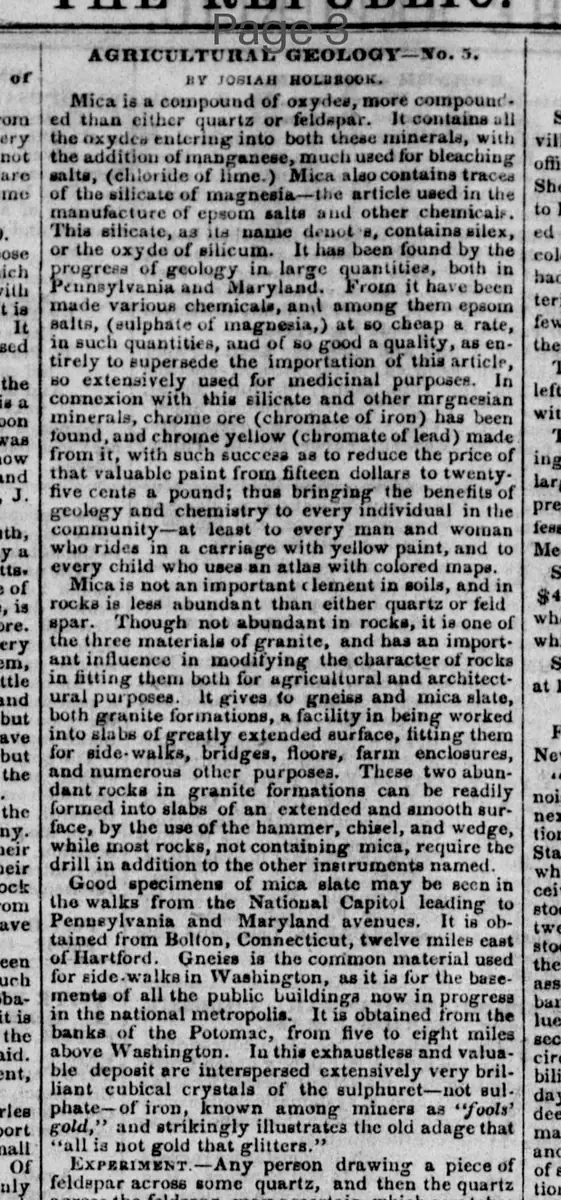
Mica is a compound of oxydes, more compound than either quartz or feldspar. It contains all the oxydes entering into both these minerals, with the addition of manganese, much used for bleaching salts, (chloride of lime.) Mica also contains traces of the silicate of magnesia—the article used in the manufacture of epsom salts and other chemicals.
This silicate, as its name denotes, contains silex, or the oxyde of silicum. It has been found by the progress of geology in large quantities, both in Pennsylvania and Maryland. From it have been made various chemicals, and among them epsom salts, (sulphate of magnesia,) at so cheap a rate, in such quantities, and of so good a quality, as entirely to supersede the importation of this article, so extensively used for medicinal purposes. In connexion with this silicate and other magnesian minerals, chrome ore (chromate of iron) has been found, and chrome yellow (chromate of lead) made from it, with such success as to reduce the price of that valuable paint from fifteen to twenty-five cents a pound; thus bringing the benefits of geology and chemistry to every individual in the community—at least to every man and woman who rides in a carriage with yellow paint, and to every child who uses an atlas with colored maps.
Mica is not an important element in soils, and in rocks is less abundant than either quartz or feldspar. Though not abundant in rocks, it is one of the three materials of granite, and has an important influence in modifying the character of rocks in fitting them both for agricultural and architectural purposes. It gives to gneiss and mica slate, both granite formations, a facility in being worked into slabs of greatly extended surface, fitting them for side-walks, bridges, floors, farm enclosures, and numerous other purposes.
These two abundant rocks in granite formations can be readily formed into slabs of an extended and smooth surface, by the use of the hammer, chisel, and wedge, while most rocks, not containing mica, require the drill in addition to the other instruments named.
Good specimens of mica slate may be seen in the walks from the National Capitol leading to Pennsylvania and Maryland avenues. It is obtained from Bolton, Connecticut, twelve miles east of Hartford. Gneiss is the common material used for side-walks in Washington, as it is for the basements of all the public buildings now in progress in the national metropolis. It is obtained from the banks of the Potomac, from five to eight miles above Washington. In this exhaustless and valuable deposit are interspersed extensively very brilliant cubical crystals of the sulphuret—not sulphate—of iron, known among miners as "fools' gold," and strikingly illustrates the old adage that "all is not gold that glitters."
Experiment.—Any person drawing a piece of feldspar across some quartz, and then the quartz across the feldspar, may ascertain which scratches the other, and of course the comparative hardness of these two essential elements of soils, the oldest friends and the strongest "unionists" upon our globe.
By Josiah Holbrook.
Mica is a compound of oxydes, more compound than either quartz or feldspar. It contains all the oxydes entering into both these minerals, with the addition of manganese, much used for bleaching salts, (chloride of lime.) Mica also contains traces of the silicate of magnesia—the article used in the manufacture of epsom salts and other chemicals.
This silicate, as its name denotes, contains silex, or the oxyde of silicum. It has been found by the progress of geology in large quantities, both in Pennsylvania and Maryland. From it have been made various chemicals, and among them epsom salts, (sulphate of magnesia,) at so cheap a rate, in such quantities, and of so good a quality, as entirely to supersede the importation of this article, so extensively used for medicinal purposes. In connexion with this silicate and other magnesian minerals, chrome ore (chromate of iron) has been found, and chrome yellow (chromate of lead) made from it, with such success as to reduce the price of that valuable paint from fifteen to twenty-five cents a pound; thus bringing the benefits of geology and chemistry to every individual in the community—at least to every man and woman who rides in a carriage with yellow paint, and to every child who uses an atlas with colored maps.
Mica is not an important element in soils, and in rocks is less abundant than either quartz or feldspar. Though not abundant in rocks, it is one of the three materials of granite, and has an important influence in modifying the character of rocks in fitting them both for agricultural and architectural purposes. It gives to gneiss and mica slate, both granite formations, a facility in being worked into slabs of greatly extended surface, fitting them for side-walks, bridges, floors, farm enclosures, and numerous other purposes.
These two abundant rocks in granite formations can be readily formed into slabs of an extended and smooth surface, by the use of the hammer, chisel, and wedge, while most rocks, not containing mica, require the drill in addition to the other instruments named.
Good specimens of mica slate may be seen in the walks from the National Capitol leading to Pennsylvania and Maryland avenues. It is obtained from Bolton, Connecticut, twelve miles east of Hartford. Gneiss is the common material used for side-walks in Washington, as it is for the basements of all the public buildings now in progress in the national metropolis. It is obtained from the banks of the Potomac, from five to eight miles above Washington. In this exhaustless and valuable deposit are interspersed extensively very brilliant cubical crystals of the sulphuret—not sulphate—of iron, known among miners as "fools' gold," and strikingly illustrates the old adage that "all is not gold that glitters."
Experiment.—Any person drawing a piece of feldspar across some quartz, and then the quartz across the feldspar, may ascertain which scratches the other, and of course the comparative hardness of these two essential elements of soils, the oldest friends and the strongest "unionists" upon our globe.
What sub-type of article is it?
Essay
What themes does it cover?
Agriculture Rural
Commerce Trade
What keywords are associated?
Mica
Agricultural Geology
Epsom Salts
Chrome Yellow
Gneiss
Mica Slate
Feldspar
Quartz
What entities or persons were involved?
By Josiah Holbrook.
Literary Details
Title
Agricultural Geology—No. 5.
Author
By Josiah Holbrook.
Key Lines
Mica Is A Compound Of Oxydes, More Compound Than Either Quartz Or Feldspar.
Thus Bringing The Benefits Of Geology And Chemistry To Every Individual In The Community—At Least To Every Man And Woman Who Rides In A Carriage With Yellow Paint, And To Every Child Who Uses An Atlas With Colored Maps.
It Gives To Gneiss And Mica Slate, Both Granite Formations, A Facility In Being Worked Into Slabs Of Greatly Extended Surface, Fitting Them For Side Walks, Bridges, Floors, Farm Enclosures, And Numerous Other Purposes.
In This Exhaustless And Valuable Deposit Are Interspersed Extensively Very Brilliant Cubical Crystals Of The Sulphuret—Not Sulphate—Of Iron, Known Among Miners As "Fools' Gold," And Strikingly Illustrates The Old Adage That "All Is Not Gold That Glitters."
Experiment.—Any Person Drawing A Piece Of Feldspar Across Some Quartz, And Then The Quartz Across The Feldspar, May Ascertain Which Scratches The Other, And Of Course The Comparative Hardness Of These Two Essential Elements Of Soils, The Oldest Friends And The Strongest "Unionists" Upon Our Globe.