Thank you for visiting SNEWPapers!
Sign up free
Literary
February 28, 1839
Watchman Of The South
Richmond, Virginia
What is this article about?
A satirical fable from the Hartford Watchman about a bird seized by the 'spirit of the age' who abandons her nest for grand philanthropic pursuits, lecturing idle birds on abstract nest-building and attempting to free caged birds through moral influence, ultimately failing. Ends with a biblical moral against wandering from one's place.
Clipping
OCR Quality
98%
Excellent
Full Text
From the Hartford Watchman.
THE WANDERING BIRD.
A FABLE.
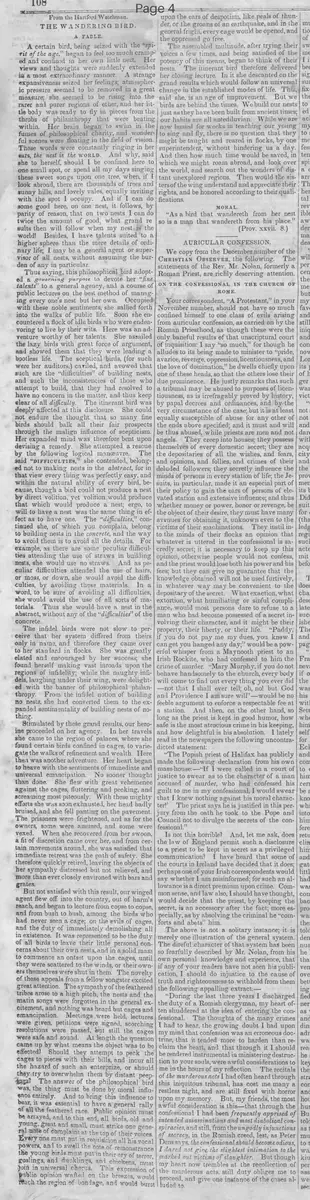
A certain bird, being seized with the "spirit of the age," began to feel too much cramped and confined in her own little nest. Her views and thoughts were suddenly extended in a most extraordinary manner. A strange expansiveness seized her feelings; atmospheric pressure seemed to be removed in a great measure: she seemed to be rising into the rarer and purer regions of ether, and her little body was ready to fly in pieces from the throbs of philanthropy that were beating within. Her brain began to swim in the fumes of philosophical charity, and wonderful scenes were floating in the field of vision. These words were constantly ringing in her ears, the nest is the WORLD. And why, said she to herself, should I be confined here to one small spot, or spend all my days singing these sweet songs upon one tree, when, if I look abroad, there are thousands of trees and sunny hills, and lovely vales, equally inviting with the spot I occupy. And if I can do some good here, on one nest, it follows, by parity of reason, that on two nests I can do twice the amount of good. What grand results then will follow when my nest is the world! Besides, I have talents suited to a higher sphere than the mere details of ordinary life; I may be a general agent or supervisor of all nests, without assuming the burden of any in particular.
Thus saying, this philosophical bird adopted a governing purpose to devote her "fine talents" to a general agency, and a course of public lectures on the best method of managing every one's nest but her own. Occupied with these noble sentiments, she sallied forth into the walks of public life. Soon she encountered a flock of idle birds who were endeavoring to live by their wits. Here was an adventure worthy of her talents. She assailed the lazy birds with great force of argument, and showed them that they were leading a bootless life. The sceptical birds (for such were her auditors) caviled, and avowed that such are the "difficulties" of building nests, and such the inconsistencies of those who attempt to build, that they had resolved to have no concern in the matter, and thus keep clear of all difficulty. The itinerant bird was deeply affected at this disclosure. She could not endure the thought that so many fine birds should balk all their fair prospects through the malign influence of scepticism. Her expanded mind was therefore bent upon devising a remedy. She attempted a rescue by the following logical manœuvre. The said "difficulties," she contended, belonged not to making nests in the abstract, for in that view every thing was perfectly easy, and within the natural ability of every bird, because, though a bird could not produce a nest by direct volition, yet volition would produce that which would produce a nest: ergo, to will to have a nest was the same thing in effect as to have one. The "difficulties," continued she, of which you complain, belong to building nests in the concrete, and the way to avoid them is to avoid all the details. For example, as there are some peculiar difficulties attending the use of straws in building nests, she would use no straws. And as peculiar difficulties attended the use of hairs, or moss, or down, she would avoid the difficulties, by avoiding these materials. In a word, to be sure of avoiding all difficulties, she would avoid the use of all sorts of materials. Thus she would have a nest in the abstract, without any of the "difficulties" of the concrete.
The infidel birds were not slow to perceive that her system differed from theirs only in name, and therefore they came over to her standard in flocks. She was greatly elated and encouraged by her success; she found herself making vast inroads upon the regions of infidelity: while the naughty infidels, laughing under their wing, were delighted with the banner of philosophical philanthropy. From the infidel notion of building no nests, she had converted them to the expanded sentimentality of building nests of nothing.
Stimulated by these grand results, our heroine proceeded on her agency. In her travels she came to the region of palaces, where she found certain birds confined in cages, to variegate the walks of refinement and wealth. Here was another adventure. Her heart began to heave with the sentiments of immediate and universal emancipation. No sooner thought than done. She flew with great vehemence against the cages, fluttering and pecking, and screaming most piteously. With these mighty efforts she was soon exhausted, her head badly bruised, and she fell panting on the pavement. The prisoners were frightened, and as for the owners, some were amused, and some were vexed. When she recovered from her swoon, a fit of discretion came over her, and from certain movements around, she was satisfied that immediate retreat was the path of safety. She therefore quickly retired, leaving the objects of her sympathy distressed but not relieved, and more than ever closely environed with bars and grates.
But not satisfied with this result, our winged agent flew off into the country, out of harm's reach, and began to lecture from copse to copse, and from bush to bush, among the birds who had never seen a cage; on the evils of cages, and the duty of immediately demolishing all in existence. It was represented to be the duty of all birds to leave their little personal concerns about their own nests, and in a solid mass to commence an onset upon the cages, until they were scattered to the winds, or their owners themselves were shut in them. The novelty of these appeals from a fellow songster excited great attention. The sympathy of the feathered tribes arose to a high pitch, the nests and the matin songs were forgotten in the general excitement, and nothing was heard but cages and emancipation. Meetings were held, lectures were given, petitions were signed, scorching resolutions were passed, but still the cages were safe and sound. At length the question came up by what means the object was to be effected? Should they attempt to peck the cages to pieces with their bills, and incur all the hazard of such an enterprize, or should they try to overwhelm them by distant peepings? The answer of the philosophical bird was, the thing must be done by moral influence entirely. And to bring this influence to bear, it was essential to have a general rally of all the feathered race. Public opinion must be arrayed, and to this end, all birds, old and young, great and small, must strike one general note of complaint at the top of their voices. Every one must put in requisition all his vocal powers, and to swell the note of remonstrance the young birds must put in their cry of terror, goslings, and ducklings, and chickens, must join in universal chorus. This expression of public opinion wafted on the breezes, would reach the region of bondage, and would burst upon the ears of despotism, like peals of thunder, or the groans of an earthquake, and in the general fright, every cage would be opened, and the oppressed go free.
The assembled multitude, after trying their voices a few times, and being satisfied of the potency of this means, began to think of their nests. The itinerant bird therefore delivered her closing lecture. In it she descanted on the grand results which would follow an universal change in the established modes of life. This said she, is an age of improvement. But we birds are behind the times. We build our nests just as they have been built from ancient times; our habits are all antediluvian. While we are now busied for weeks in teaching our young to sing and fly, there is no question that they might be taught and reared in flocks, by one superintendent, without hindering us a day. And then how much time would be saved, in which we might roam abroad, and look over the world, and search out the wonders of distant unexplored regions. Then would the sisters of the wing understand and appreciate their rights, and be honored according to their qualifications.
MORAL.
"As a bird that wandereth from her nest so is a man that wandereth from his place."
(Prov. xxvii. 8.)
THE WANDERING BIRD.
A FABLE.
A certain bird, being seized with the "spirit of the age," began to feel too much cramped and confined in her own little nest. Her views and thoughts were suddenly extended in a most extraordinary manner. A strange expansiveness seized her feelings; atmospheric pressure seemed to be removed in a great measure: she seemed to be rising into the rarer and purer regions of ether, and her little body was ready to fly in pieces from the throbs of philanthropy that were beating within. Her brain began to swim in the fumes of philosophical charity, and wonderful scenes were floating in the field of vision. These words were constantly ringing in her ears, the nest is the WORLD. And why, said she to herself, should I be confined here to one small spot, or spend all my days singing these sweet songs upon one tree, when, if I look abroad, there are thousands of trees and sunny hills, and lovely vales, equally inviting with the spot I occupy. And if I can do some good here, on one nest, it follows, by parity of reason, that on two nests I can do twice the amount of good. What grand results then will follow when my nest is the world! Besides, I have talents suited to a higher sphere than the mere details of ordinary life; I may be a general agent or supervisor of all nests, without assuming the burden of any in particular.
Thus saying, this philosophical bird adopted a governing purpose to devote her "fine talents" to a general agency, and a course of public lectures on the best method of managing every one's nest but her own. Occupied with these noble sentiments, she sallied forth into the walks of public life. Soon she encountered a flock of idle birds who were endeavoring to live by their wits. Here was an adventure worthy of her talents. She assailed the lazy birds with great force of argument, and showed them that they were leading a bootless life. The sceptical birds (for such were her auditors) caviled, and avowed that such are the "difficulties" of building nests, and such the inconsistencies of those who attempt to build, that they had resolved to have no concern in the matter, and thus keep clear of all difficulty. The itinerant bird was deeply affected at this disclosure. She could not endure the thought that so many fine birds should balk all their fair prospects through the malign influence of scepticism. Her expanded mind was therefore bent upon devising a remedy. She attempted a rescue by the following logical manœuvre. The said "difficulties," she contended, belonged not to making nests in the abstract, for in that view every thing was perfectly easy, and within the natural ability of every bird, because, though a bird could not produce a nest by direct volition, yet volition would produce that which would produce a nest: ergo, to will to have a nest was the same thing in effect as to have one. The "difficulties," continued she, of which you complain, belong to building nests in the concrete, and the way to avoid them is to avoid all the details. For example, as there are some peculiar difficulties attending the use of straws in building nests, she would use no straws. And as peculiar difficulties attended the use of hairs, or moss, or down, she would avoid the difficulties, by avoiding these materials. In a word, to be sure of avoiding all difficulties, she would avoid the use of all sorts of materials. Thus she would have a nest in the abstract, without any of the "difficulties" of the concrete.
The infidel birds were not slow to perceive that her system differed from theirs only in name, and therefore they came over to her standard in flocks. She was greatly elated and encouraged by her success; she found herself making vast inroads upon the regions of infidelity: while the naughty infidels, laughing under their wing, were delighted with the banner of philosophical philanthropy. From the infidel notion of building no nests, she had converted them to the expanded sentimentality of building nests of nothing.
Stimulated by these grand results, our heroine proceeded on her agency. In her travels she came to the region of palaces, where she found certain birds confined in cages, to variegate the walks of refinement and wealth. Here was another adventure. Her heart began to heave with the sentiments of immediate and universal emancipation. No sooner thought than done. She flew with great vehemence against the cages, fluttering and pecking, and screaming most piteously. With these mighty efforts she was soon exhausted, her head badly bruised, and she fell panting on the pavement. The prisoners were frightened, and as for the owners, some were amused, and some were vexed. When she recovered from her swoon, a fit of discretion came over her, and from certain movements around, she was satisfied that immediate retreat was the path of safety. She therefore quickly retired, leaving the objects of her sympathy distressed but not relieved, and more than ever closely environed with bars and grates.
But not satisfied with this result, our winged agent flew off into the country, out of harm's reach, and began to lecture from copse to copse, and from bush to bush, among the birds who had never seen a cage; on the evils of cages, and the duty of immediately demolishing all in existence. It was represented to be the duty of all birds to leave their little personal concerns about their own nests, and in a solid mass to commence an onset upon the cages, until they were scattered to the winds, or their owners themselves were shut in them. The novelty of these appeals from a fellow songster excited great attention. The sympathy of the feathered tribes arose to a high pitch, the nests and the matin songs were forgotten in the general excitement, and nothing was heard but cages and emancipation. Meetings were held, lectures were given, petitions were signed, scorching resolutions were passed, but still the cages were safe and sound. At length the question came up by what means the object was to be effected? Should they attempt to peck the cages to pieces with their bills, and incur all the hazard of such an enterprize, or should they try to overwhelm them by distant peepings? The answer of the philosophical bird was, the thing must be done by moral influence entirely. And to bring this influence to bear, it was essential to have a general rally of all the feathered race. Public opinion must be arrayed, and to this end, all birds, old and young, great and small, must strike one general note of complaint at the top of their voices. Every one must put in requisition all his vocal powers, and to swell the note of remonstrance the young birds must put in their cry of terror, goslings, and ducklings, and chickens, must join in universal chorus. This expression of public opinion wafted on the breezes, would reach the region of bondage, and would burst upon the ears of despotism, like peals of thunder, or the groans of an earthquake, and in the general fright, every cage would be opened, and the oppressed go free.
The assembled multitude, after trying their voices a few times, and being satisfied of the potency of this means, began to think of their nests. The itinerant bird therefore delivered her closing lecture. In it she descanted on the grand results which would follow an universal change in the established modes of life. This said she, is an age of improvement. But we birds are behind the times. We build our nests just as they have been built from ancient times; our habits are all antediluvian. While we are now busied for weeks in teaching our young to sing and fly, there is no question that they might be taught and reared in flocks, by one superintendent, without hindering us a day. And then how much time would be saved, in which we might roam abroad, and look over the world, and search out the wonders of distant unexplored regions. Then would the sisters of the wing understand and appreciate their rights, and be honored according to their qualifications.
MORAL.
"As a bird that wandereth from her nest so is a man that wandereth from his place."
(Prov. xxvii. 8.)
What sub-type of article is it?
Fable
Satire
Prose Fiction
What themes does it cover?
Moral Virtue
Social Manners
Liberty Freedom
What keywords are associated?
Wandering Bird
Philanthropy
Nest Building
Emancipation
Moral Influence
Infidelity
Public Lectures
Social Reform
What entities or persons were involved?
From The Hartford Watchman.
Literary Details
Title
The Wandering Bird.
Author
From The Hartford Watchman.
Subject
A Fable.
Key Lines
The Nest Is The World.
To Will To Have A Nest Was The Same Thing In Effect As To Have One.
The Thing Must Be Done By Moral Influence Entirely.
This Said She, Is An Age Of Improvement.
"As A Bird That Wandereth From Her Nest So Is A Man That Wandereth From His Place." (Prov. Xxvii. 8.)