Thank you for visiting SNEWPapers!
Sign up free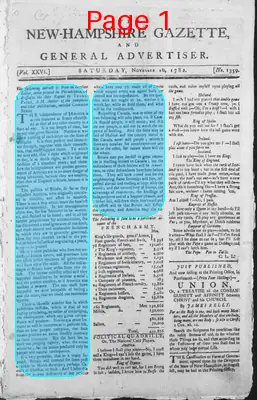
Editorial
November 16, 1782
The New Hampshire Gazette And General Advertiser
Portsmouth, Exeter, Rockingham County, New Hampshire
What is this article about?
Extract from Thomas Paine's letter to Abbe Raynal defends the stability of American independence despite its recency, critiques Britain's irrational war policies and ignorance of human nature, and argues that Canada and Halifax will inevitably align with or be lost to America in any peace treaty.
Clipping
OCR Quality
80%
Good
Full Text
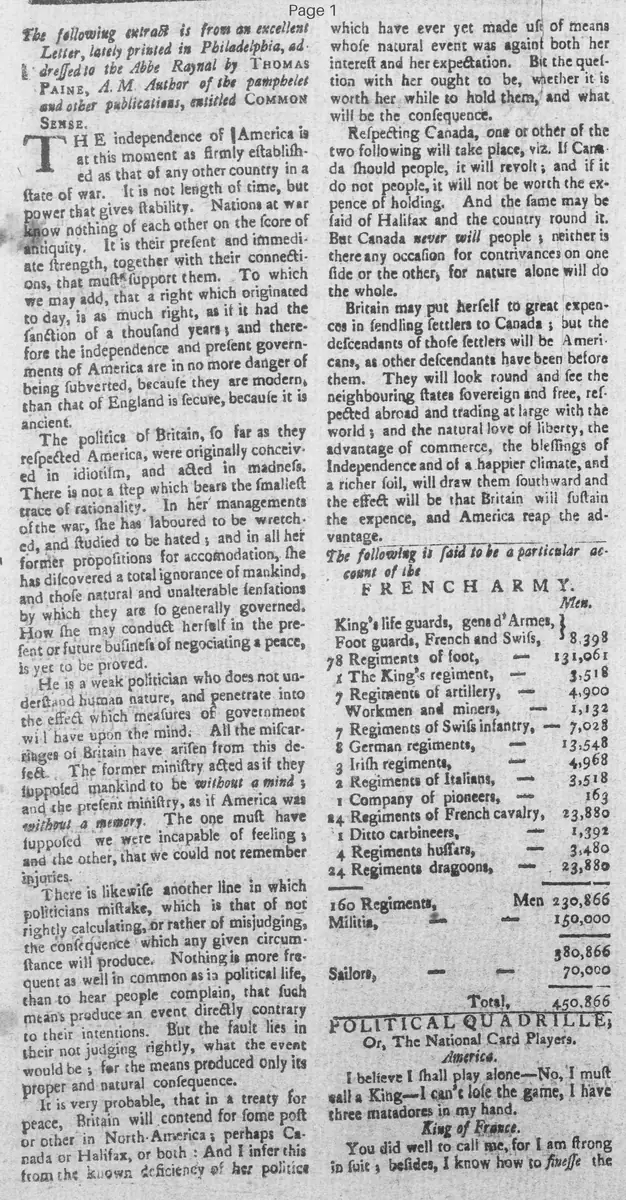
The following extract is from an excellent Letter, lately printed in Philadelphia, addressed to the Abbe Raynal by Thomas PAINE. A. M. Author of the pamphlet and other publications, entitled Common SENSE.
The independence of America is at this moment as firmly established as that of any other country in a state of war. It is not length of time, but power that gives stability. Nations at war antiquity. It is their present and immediate strength, together with their connections, that must support them. To which sanction of a thousand years; and therefore to day, is as much right, as if it had the we may add, that a right which originated before the independence and present governments of America are in no more danger of being subverted, because they are modern, than that of England is secure, because it is ancient. The politics of Britain, so far as they respected America, were originally conceived in idiotism, and acted in madness. There is not a step which bears the smallest trace of rationality. In her managements of the war, she has laboured to be wretched, and studied to be hated; and in all her former propositions for accommodation, she has discovered a total ignorance of mankind, and those natural and unalterable sensations by which they are so generally governed. How she may conduct herself in the present or future business of negotiating a peace, is yet to be proved. He is a weak politician who does not understand human nature, and penetrate into the effect which measures of government will have upon the mind: All the miscarriages of Britain have arisen from this defect. The former ministry acted as if they supposed mankind to be without a mind; and the present ministry, as if America was without a memory. The one must have supposed we were incapable of feeling: and the other, that we could not remember injuries. There is likewise another line in which politicians mistake, which is that of not rightly calculating, or rather of misjudging, the consequence which any given circumstance will produce. Nothing is more frequent as well in common as in political life, than to hear people complain, that means produce an event directly contrary to their intentions. But the fault lies in their not judging rightly, what the event would be; for the means produced only its proper and natural consequence. It is very probable, that in a treaty for peace, Britain will contend for some post or other in North-America; perhaps Canada or Halifax, or both: And I infer this from the known deficiency of her politics which have ever yet made use of means whose natural event was against both her interest and her expectation. But the question with her ought to be, whether it is worth her while to hold them, and what will be the consequence. Respecting Canada, one or other of the two following will take place, viz. If Canada should people, it will revolt; and if it do not people, it will not be worth the expense of holding. And the same may be said of Halifax and the country round it. But Canada never will people; neither is there any occasion for contrivances on one side or the other, for nature alone will do the whole. Britain may put herself to great expense in sending settlers to Canada: but the descendants of those settlers will be Americans, as other descendants have been before them. They will look round and see the neighbouring states sovereign and free, respected abroad and trading at large with the world; and the natural love of liberty, the advantage of commerce, the blessings of Independence and of a happier climate, and a richer soil, will draw them southward and the effect will be that Britain will sustain the expense, and America reap the advantage.
The independence of America is at this moment as firmly established as that of any other country in a state of war. It is not length of time, but power that gives stability. Nations at war antiquity. It is their present and immediate strength, together with their connections, that must support them. To which sanction of a thousand years; and therefore to day, is as much right, as if it had the we may add, that a right which originated before the independence and present governments of America are in no more danger of being subverted, because they are modern, than that of England is secure, because it is ancient. The politics of Britain, so far as they respected America, were originally conceived in idiotism, and acted in madness. There is not a step which bears the smallest trace of rationality. In her managements of the war, she has laboured to be wretched, and studied to be hated; and in all her former propositions for accommodation, she has discovered a total ignorance of mankind, and those natural and unalterable sensations by which they are so generally governed. How she may conduct herself in the present or future business of negotiating a peace, is yet to be proved. He is a weak politician who does not understand human nature, and penetrate into the effect which measures of government will have upon the mind: All the miscarriages of Britain have arisen from this defect. The former ministry acted as if they supposed mankind to be without a mind; and the present ministry, as if America was without a memory. The one must have supposed we were incapable of feeling: and the other, that we could not remember injuries. There is likewise another line in which politicians mistake, which is that of not rightly calculating, or rather of misjudging, the consequence which any given circumstance will produce. Nothing is more frequent as well in common as in political life, than to hear people complain, that means produce an event directly contrary to their intentions. But the fault lies in their not judging rightly, what the event would be; for the means produced only its proper and natural consequence. It is very probable, that in a treaty for peace, Britain will contend for some post or other in North-America; perhaps Canada or Halifax, or both: And I infer this from the known deficiency of her politics which have ever yet made use of means whose natural event was against both her interest and her expectation. But the question with her ought to be, whether it is worth her while to hold them, and what will be the consequence. Respecting Canada, one or other of the two following will take place, viz. If Canada should people, it will revolt; and if it do not people, it will not be worth the expense of holding. And the same may be said of Halifax and the country round it. But Canada never will people; neither is there any occasion for contrivances on one side or the other, for nature alone will do the whole. Britain may put herself to great expense in sending settlers to Canada: but the descendants of those settlers will be Americans, as other descendants have been before them. They will look round and see the neighbouring states sovereign and free, respected abroad and trading at large with the world; and the natural love of liberty, the advantage of commerce, the blessings of Independence and of a happier climate, and a richer soil, will draw them southward and the effect will be that Britain will sustain the expense, and America reap the advantage.
What sub-type of article is it?
War Or Peace
Foreign Affairs
Constitutional
What keywords are associated?
American Independence
British Politics
Peace Negotiations
Canada
Halifax
Human Nature
What entities or persons were involved?
Thomas Paine
Abbe Raynal
Britain
America
Canada
Halifax
Editorial Details
Primary Topic
Stability Of American Independence And Critique Of British Policy
Stance / Tone
Defensive Of American Independence, Critical Of British Irrationality
Key Figures
Thomas Paine
Abbe Raynal
Britain
America
Canada
Halifax
Key Arguments
American Independence Is Stable Due To Power, Not Antiquity
British Politics Towards America Conceived In Idiotism And Acted In Madness
Britain Ignorant Of Human Nature And Consequences Of Actions
In Peace Treaty, Britain Likely To Demand Canada Or Halifax Unwisely
Canada Will Either Revolt If Populated Or Be Worthless If Not
Settlers In Canada Will Naturally Become Americans Drawn By Liberty And Prosperity