Thank you for visiting SNEWPapers!
Sign up free
Story
December 2, 1848
The Cecil Whig
Elkton, Cecil County, Maryland
What is this article about?
Historical overview of the evolution of the American press from slow, limited publications a century ago to rapid, widespread newspapers in 1848, contrasting with heavy taxation and censorship in Britain and France, including 1838 circulation statistics.
Clipping
OCR Quality
95%
Excellent
Full Text
MONTGOMERY.
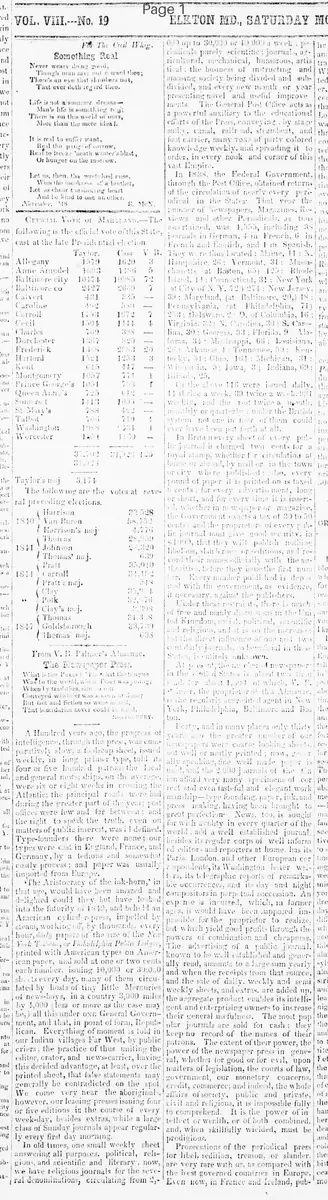
A Hundred years ago, the progress of intelligence, through the press, was comparatively slow: a foolscap sheet, issued weekly, in long primer type, told it. four or five hundred patrons the local and general news: ships, on the average, were six or eight weeks in crossing the Atlantic: the principal roads, were bad during the greater part of the year; post offices were few and far between: and the right to speak the truth, even on matters of public interest, was ill defined.
Type-founders there were none; our types were cast in England, France, and Germany, by a tedious and somewhat costive process; and paper was usually imported from Europe.
The Aristocracy of the ink-horn,' in that age, would have been amazed and delighted could they but have looked into the futurity of 1848, and beheld an American cylinder-press, impelled by steam, working off, by thousands, every hour, daily papers of the size of the New York Tribune, or Philadelphia Public Ledger, printed with American types on American paper, and sold at one or two cents each number, issuing 10,000 or 30,000 sheets every day, many of them circulated by hosts of tiny little Mercuries of news-boys, in a country 3,000 miles by 1,000 (less or more as the case may be,) all this under one General Government, and that, in point of form, Republican. Everything of moment is told in our Indian villages Far West, by public criers: the practice of thus uniting the editor, orator, and news-carrier, having this decided advantage, at least, over the printed sheet, that false statements may generally be contradicted on the spot. We come very near the aboriginal—however, our leading presses issuing four or five editions in the course of every week-day, besides extras, while a large class of Sunday journals appear regularly every first day morning.
In old times, one small weekly sheet answering all purposes, political, religious, and scientific and literary, now, we have religious journals for the several denominations, circulating from 2,000 to 30,000 or 60,000 a week: periodicals purely scientific: journals, agricultural, mechanical, humorous, artistic, the business of instructing and amusing society being divided and sub-divided, and every new month or year presenting novel and useful improvements: The General Post Office acts as a powerful auxiliary to the educational efforts of the Press, conveying, by stage, sulky, canal, railroad, steamboat, and foot carrier, many tons of party colored knowledge weekly, and spreading it to order, in every nook and corner of this vast Empire.
In 1838, the Federal Government, through the Post Office, obtained returns of the circulation of nearly every periodical in the States. That year the number of Newspapers, Magazines, Reviews and other Periodicals, as thus ascertained, was 1,555, including 39 papers in German, 1 in French, 6 in French and English, and 1 in Spanish. They were thus located: Maine, 113; New Hampshire, 92; Vermont, 31; Massachusetts (at Boston, 65) 125; Rhode Island, 11; Connecticut, 31; New York (at City of N. Y. 72) 274; New Jersey, 34; Maryland, (at Baltimore, 20,) 48; Pennsylvania, (at Philadelphia, 71) 263; Delaware, 2; D. of Columbia, 16; Virginia, 52; N. Carolina, 30; S. Carolina, 30; Georgia, 33; Florida, 9; Alabama, 31; Mississippi, 66; Louisiana, 2; Arkansas 1; Tennessee, 50; Kentucky, 31; Ohio, 161; Michigan, 31; Wisconsin, 5; Iowa, 3; Indiana, 69; Illinois, 25.
Of the above 116 were issued daily, 148 three times a week, 301 weekly, 50 semi-weekly, and the rest twice a month, monthly or quarterly: under the British system—not one in four of them could ever have been put forth at all.
In Britain every sheet of every public journal is charged two cents for a revenue stamp, whether for circulation at home or abroad, by mail or in the town ordinarily where published: also, every pound of paper it is printed on is taxed 6 cents: for every advertisement, long or short, and for every time it is inserted, whether in a newspaper or magazine, the Government exacts a tax of 30 to 50 cents: and the proprietors of every public journal must give good security, in $1,000, that they will publish nothing libelous, seditious or treasonable, and record their names officially with the authorities, before they issue the first number. Every number published is deposited with the government, as evidence, if necessary, against the publishers.
Under these restraints, there is much of free and manly discussion in the United Kingdom, social, political, scientific and religious, and it is on the increase: but the direct influence of one and two cent daily journals, so beneficial in these States, is entirely unknown.
At present the number of newspapers in the United States is about two thousand, and for about 1,000 of which, V. B. Palmer is the regularly accredited agent in N. York, Philadelphia, Baltimore and Boston.
Forty, and in many places only thirty years ago, the greater number of our newspapers were coarse looking sheets, not well or neatly printed; now, generally speaking, fine well made paper is used, and the 2,000 journals of the Union afford very many specimens of correct and even tasteful and elegant workmanship—type-founding, paper, ink, and press making, having been brought to great perfection. News, too, is sought for with avidity in every quarter of the world, and a well established journal besides its regular corps of well informed editors and reporters at home, has its Paris, London, and other European correspondents, its Washington letter writers, its telegraph reports of remarkable occurrences, and its day and night compositors in perpetual succession. An expense is incurred, which, in former ages, it would have been supposed impossible for the proprietor to realize, but which yield good profits through the powers of combination and cheapness.
The advertising of a public journal, known to be well established and generally read, amounts to a large sum yearly, and when the receipts from that source, and the sale of daily, weekly and semi-weekly sheets, and extras, are added up, the aggregate product enables its intelligent and enterprising owners to increase their general usefulness. The most popular journals are sold for cash; they keep no record of the names of their patrons. The extent of their power, the power of the newspaper press in general, whether for good or for evil, upon matters of legislation, the courts of law, government, our monetary concerns, credit, commerce; and indeed, the whole affairs of society, public and private, civil and religious, it is impossible fully to comprehend. It is the power of intellect or wealth, or of both combined, and, when skillfully wielded, must be prodigious.
Prosecutions of the periodical press for libel, sedition, treason, or slander are very rare with us, as compared with the best governed countries in Europe. Even now, in France and Ireland, public journals are frequently suppressed, and their conductors imprisoned and transported, or fined and banished.
When the battle of Trafalgar annihilated the French and Spanish naval power, 'so completely did Napoleon succeed in veiling that disaster in obscurity that previously to the Restoration of Louis XVIII.—a period of nine years—it was not mentioned by any public paper throughout the French Empire.' He couldn't have done as much in the United States. Napoleon wrote much for the Moniteur, and our leading men and those of England write a great deal in the journals known to express their sentiments; there is this difference, however, between our usages and his, that none dared contradict him. 'Resolved,' says Fouché, his Minister of Police, in his Memoirs, 'to restrain the licentiousness of the Press, I determined upon a decisive blow: I at one stroke of my pen suppressed eleven of the most popular journals among the Jacobins and Royalists. I caused their presses to be seized: and even arrested the authors, whom I accused of sowing dissension among the citizens, and of blasting private character.' It is the duty of every good citizen to guard his country from the immoral and unprincipled state of society which required a Fouché by encouraging and prizing honest and able journalists, and none other.
Louis Philippe's Government never ceased to war against the Press. The Paris Commerce has calculated, that during the last seventeen years no less than 1,129 prosecutions were directed against the journals, in the name of a King who had inaugurated his accession to the throne by a formal promise that no State prosecution should be in future instituted against them. During that period 82 journals were obliged to suspend publication, in consequence of the severity of the penalties. The writers were sentenced to 3,141 years' imprisonment, and the journals to 7,110,000 francs fine.
A Hundred years ago, the progress of intelligence, through the press, was comparatively slow: a foolscap sheet, issued weekly, in long primer type, told it. four or five hundred patrons the local and general news: ships, on the average, were six or eight weeks in crossing the Atlantic: the principal roads, were bad during the greater part of the year; post offices were few and far between: and the right to speak the truth, even on matters of public interest, was ill defined.
Type-founders there were none; our types were cast in England, France, and Germany, by a tedious and somewhat costive process; and paper was usually imported from Europe.
The Aristocracy of the ink-horn,' in that age, would have been amazed and delighted could they but have looked into the futurity of 1848, and beheld an American cylinder-press, impelled by steam, working off, by thousands, every hour, daily papers of the size of the New York Tribune, or Philadelphia Public Ledger, printed with American types on American paper, and sold at one or two cents each number, issuing 10,000 or 30,000 sheets every day, many of them circulated by hosts of tiny little Mercuries of news-boys, in a country 3,000 miles by 1,000 (less or more as the case may be,) all this under one General Government, and that, in point of form, Republican. Everything of moment is told in our Indian villages Far West, by public criers: the practice of thus uniting the editor, orator, and news-carrier, having this decided advantage, at least, over the printed sheet, that false statements may generally be contradicted on the spot. We come very near the aboriginal—however, our leading presses issuing four or five editions in the course of every week-day, besides extras, while a large class of Sunday journals appear regularly every first day morning.
In old times, one small weekly sheet answering all purposes, political, religious, and scientific and literary, now, we have religious journals for the several denominations, circulating from 2,000 to 30,000 or 60,000 a week: periodicals purely scientific: journals, agricultural, mechanical, humorous, artistic, the business of instructing and amusing society being divided and sub-divided, and every new month or year presenting novel and useful improvements: The General Post Office acts as a powerful auxiliary to the educational efforts of the Press, conveying, by stage, sulky, canal, railroad, steamboat, and foot carrier, many tons of party colored knowledge weekly, and spreading it to order, in every nook and corner of this vast Empire.
In 1838, the Federal Government, through the Post Office, obtained returns of the circulation of nearly every periodical in the States. That year the number of Newspapers, Magazines, Reviews and other Periodicals, as thus ascertained, was 1,555, including 39 papers in German, 1 in French, 6 in French and English, and 1 in Spanish. They were thus located: Maine, 113; New Hampshire, 92; Vermont, 31; Massachusetts (at Boston, 65) 125; Rhode Island, 11; Connecticut, 31; New York (at City of N. Y. 72) 274; New Jersey, 34; Maryland, (at Baltimore, 20,) 48; Pennsylvania, (at Philadelphia, 71) 263; Delaware, 2; D. of Columbia, 16; Virginia, 52; N. Carolina, 30; S. Carolina, 30; Georgia, 33; Florida, 9; Alabama, 31; Mississippi, 66; Louisiana, 2; Arkansas 1; Tennessee, 50; Kentucky, 31; Ohio, 161; Michigan, 31; Wisconsin, 5; Iowa, 3; Indiana, 69; Illinois, 25.
Of the above 116 were issued daily, 148 three times a week, 301 weekly, 50 semi-weekly, and the rest twice a month, monthly or quarterly: under the British system—not one in four of them could ever have been put forth at all.
In Britain every sheet of every public journal is charged two cents for a revenue stamp, whether for circulation at home or abroad, by mail or in the town ordinarily where published: also, every pound of paper it is printed on is taxed 6 cents: for every advertisement, long or short, and for every time it is inserted, whether in a newspaper or magazine, the Government exacts a tax of 30 to 50 cents: and the proprietors of every public journal must give good security, in $1,000, that they will publish nothing libelous, seditious or treasonable, and record their names officially with the authorities, before they issue the first number. Every number published is deposited with the government, as evidence, if necessary, against the publishers.
Under these restraints, there is much of free and manly discussion in the United Kingdom, social, political, scientific and religious, and it is on the increase: but the direct influence of one and two cent daily journals, so beneficial in these States, is entirely unknown.
At present the number of newspapers in the United States is about two thousand, and for about 1,000 of which, V. B. Palmer is the regularly accredited agent in N. York, Philadelphia, Baltimore and Boston.
Forty, and in many places only thirty years ago, the greater number of our newspapers were coarse looking sheets, not well or neatly printed; now, generally speaking, fine well made paper is used, and the 2,000 journals of the Union afford very many specimens of correct and even tasteful and elegant workmanship—type-founding, paper, ink, and press making, having been brought to great perfection. News, too, is sought for with avidity in every quarter of the world, and a well established journal besides its regular corps of well informed editors and reporters at home, has its Paris, London, and other European correspondents, its Washington letter writers, its telegraph reports of remarkable occurrences, and its day and night compositors in perpetual succession. An expense is incurred, which, in former ages, it would have been supposed impossible for the proprietor to realize, but which yield good profits through the powers of combination and cheapness.
The advertising of a public journal, known to be well established and generally read, amounts to a large sum yearly, and when the receipts from that source, and the sale of daily, weekly and semi-weekly sheets, and extras, are added up, the aggregate product enables its intelligent and enterprising owners to increase their general usefulness. The most popular journals are sold for cash; they keep no record of the names of their patrons. The extent of their power, the power of the newspaper press in general, whether for good or for evil, upon matters of legislation, the courts of law, government, our monetary concerns, credit, commerce; and indeed, the whole affairs of society, public and private, civil and religious, it is impossible fully to comprehend. It is the power of intellect or wealth, or of both combined, and, when skillfully wielded, must be prodigious.
Prosecutions of the periodical press for libel, sedition, treason, or slander are very rare with us, as compared with the best governed countries in Europe. Even now, in France and Ireland, public journals are frequently suppressed, and their conductors imprisoned and transported, or fined and banished.
When the battle of Trafalgar annihilated the French and Spanish naval power, 'so completely did Napoleon succeed in veiling that disaster in obscurity that previously to the Restoration of Louis XVIII.—a period of nine years—it was not mentioned by any public paper throughout the French Empire.' He couldn't have done as much in the United States. Napoleon wrote much for the Moniteur, and our leading men and those of England write a great deal in the journals known to express their sentiments; there is this difference, however, between our usages and his, that none dared contradict him. 'Resolved,' says Fouché, his Minister of Police, in his Memoirs, 'to restrain the licentiousness of the Press, I determined upon a decisive blow: I at one stroke of my pen suppressed eleven of the most popular journals among the Jacobins and Royalists. I caused their presses to be seized: and even arrested the authors, whom I accused of sowing dissension among the citizens, and of blasting private character.' It is the duty of every good citizen to guard his country from the immoral and unprincipled state of society which required a Fouché by encouraging and prizing honest and able journalists, and none other.
Louis Philippe's Government never ceased to war against the Press. The Paris Commerce has calculated, that during the last seventeen years no less than 1,129 prosecutions were directed against the journals, in the name of a King who had inaugurated his accession to the throne by a formal promise that no State prosecution should be in future instituted against them. During that period 82 journals were obliged to suspend publication, in consequence of the severity of the penalties. The writers were sentenced to 3,141 years' imprisonment, and the journals to 7,110,000 francs fine.
What sub-type of article is it?
Historical Essay
Journalism Overview
What themes does it cover?
Triumph
Justice
What keywords are associated?
Press Evolution
Newspaper Circulation
Freedom Of Press
European Censorship
Periodical Statistics
Steam Press
Postal System
What entities or persons were involved?
Napoleon
Fouché
Louis Philippe
V. B. Palmer
Where did it happen?
United States, Britain, France
Story Details
Key Persons
Napoleon
Fouché
Louis Philippe
V. B. Palmer
Location
United States, Britain, France
Event Date
1848
Story Details
The article contrasts the slow, limited press of a hundred years prior with the advanced, steam-powered, affordable newspapers of 1848 in America, highlights 1838 periodical statistics, and compares favorably to British taxes and French censorship under Napoleon and Louis Philippe.