Thank you for visiting SNEWPapers!
Sign up free
Alexandria Gazette & Daily Advertiser
Alexandria, Virginia
What is this article about?
U.S. ship Franklin arrives at Villa da Praya, St. Jago, Cape de Verdes on March 27, 1820, receives special treatment but faces accidental fire from Portuguese batteries while departing, leading to apologies, officer releases, and a new policy allowing warships to leave freely.
Clipping
OCR Quality
Full Text
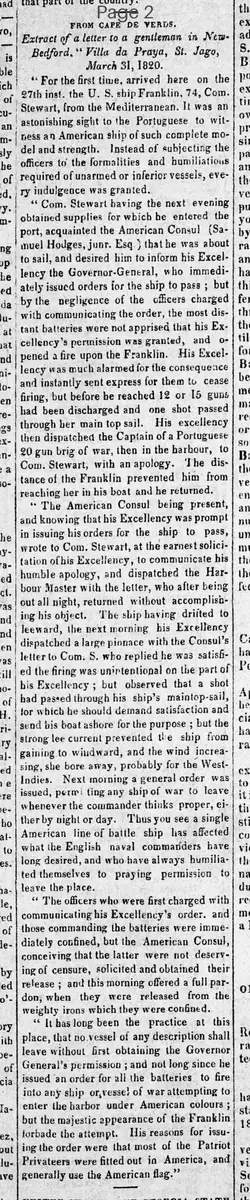
Extract of a letter to a gentleman in New-Bedford. "Villa da Praya, St. Jago, March 31, 1820.
"For the first time, arrived here on the 27th inst. the U. S. ship Franklin, 74, Com. Stewart, from the Mediterranean. It was an astonishing sight to the Portuguese to witness an American ship of such complete model and strength. Instead of subjecting the officers to the formalities and humiliations required of unarmed or inferior vessels, every indulgence was granted.
"Com. Stewart having the next evening obtained supplies for which he entered the port, acquainted the American Consul (Samuel Hughes, junr. Esq.) that he was about to sail, and desired him to inform his Excellency the Governor-General, who immediately issued orders for the ship to pass ; but by the negligence of the officers charged with communicating the order, the most distant batteries were not apprised that his Excellency's permission was granted, and opened a fire upon the Franklin. His Excellency was much alarmed for the consequence and instantly sent express for them to cease firing, but before he reached 12 or 15 guns had been discharged and one shot passed through her main top sail. His excellency then dispatched the Captain of a Portuguese 20 gun brig of war, then in the harbour, to Com. Stewart, with an apology. The distance of the Franklin prevented him from reaching her in his boat and he returned.
"The American Consul being present, and knowing that his Excellency was prompt in issuing his orders for the ship to pass, wrote to Com. Stewart, at the earnest solicitation of his Excellency, to communicate his humble apology, and dispatched the Harbour Master with the letter, who after being out all night, returned without accomplishing his object. The ship having drifted to leeward, the next morning his Excellency dispatched a large pinnace with the Consul's letter to Com. S. who replied he was satisfied the firing was unintentional on the part of his Excellency; but observed that a shot had passed through his ship's maintop-sail, for which he should demand satisfaction and send his boat ashore for the purpose ; but the strong lee current prevented the ship from gaining to windward, and the wind increasing, she bore away, probably for the West-Indies. Next morning a general order was issued, permitting any ship of war to leave whenever the commander thinks proper, either by night or day. Thus you see a single American line of battle ship has affected what the English naval commanders have long desired, and who have always humiliated themselves to praying permission to leave the place.
"The officers who were first charged with communicating his Excellency's order, and those commanding the batteries were immediately confined, but the American Consul, conceiving that the latter were not deserving of censure, solicited and obtained their release ; and this morning offered a full pardon, when they were released from the weighty irons which they were confined.
"It has long been the practice at this place, that no vessel of any description shall leave without first obtaining the Governor General's permission ; and not long since he issued an order for all the batteries to fire into any ship or vessel of war attempting to enter the harbor under American colours ; but the majestic appearance of the Franklin forbade the attempt. His reasons for issuing the order were that most of the Patriot Privateers were fitted out in America, and generally use the American flag."
What sub-type of article is it?
What keywords are associated?
What entities or persons were involved?
Where did it happen?
Foreign News Details
Primary Location
Villa Da Praya, St. Jago
Event Date
March 27 31, 1820
Key Persons
Outcome
one shot passed through the main top sail; no casualties reported. officers confined then released; new general order issued permitting warships to leave freely.
Event Details
U.S. ship Franklin arrived on March 27, received special treatment. While departing after obtaining supplies, Portuguese batteries fired 12-15 shots due to communication negligence, despite Governor-General's permission. Apologies sent via captain, consul's letter, and pinnace. Stewart accepted unintentional nature but demanded satisfaction; ship departed for West Indies. Officers punished then pardoned; policy changed to allow free departure for warships.