Thank you for visiting SNEWPapers!
Sign up free
Herald Of The Times
Newport, Newport County, Rhode Island
What is this article about?
A June 1830 letter from Dumfries, Virginia, warns of the 1832 comet approaching within 13,000 leagues of Earth, potentially blocking sunlight and causing extreme heat. The Philadelphia Gazette reassures readers that comets are low-density and pose no threat, dismissing the heat hypothesis.
Clipping
OCR Quality
Full Text
To the Editor of the Virginia Herald:
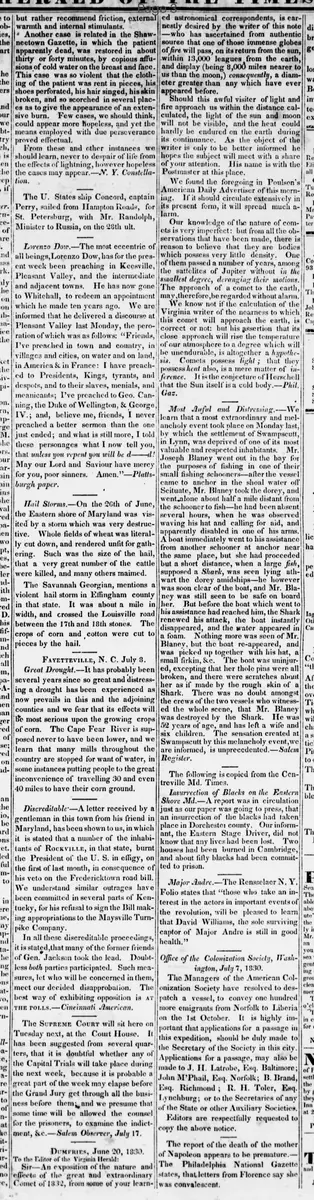
Sir—An exposition of the nature and effects of the great and extraordinary Comet of 1832, from some of your learned astronomical correspondents, is earnestly desired by the writer of this note—who has ascertained from authentic source that one of those immense globes of fire will pass, on its return from the sun, within 13,000 leagues from the earth, and display (being 8,000 miles nearer to us than the moon,) consequently, a diameter greater than any which have ever appeared before.
Should this awful visiter of light and fire approach us within the distance calculated, the light of the sun and moon will not be visible, and the heat could hardly be endured on the earth during its continuance. As the object of the writer is only to be better informed he hopes the subject will meet with a share of your attention. His name is with the Postmaster at this place.
We found the foregoing in Poulson's American Daily Advertiser of this morning. If it should circulate extensively in its present form, it will spread much alarm.
Our knowledge of the nature of comets is very imperfect: but from all the observations that have been made, there is reason to believe that they are bodies which possess very little density. One of them passed a number of years, among the satellites of Jupiter without in the smallest degree, deranging their motions. The approach of a comet to the earth, may,therefore,be regarded without alarm. We know not if the calculation of the Virginia writer of the nearness to which this comet will approach the earth, is correct or not: but his assertion that its close approach will rise the temperature of our atmosphere to a degree which will be unendurable, is altogether a hypothesis. Comets possess light; that they possess heat also, is a mere matter of inference. It is the conjecture of Herschell that the Sun itself is a cold body.—Phil. Gaz.
What sub-type of article is it?
What themes does it cover?
What keywords are associated?
What entities or persons were involved?
Where did it happen?
Story Details
Key Persons
Location
Dumfries, Virginia; Philadelphia
Event Date
June 20, 1830; Comet Of 1832
Story Details
An anonymous writer in Dumfries requests information on the 1832 comet, warning of its close approach causing darkness and extreme heat. The Philadelphia Gazette publishes and reassures that comets are low-density, passed near Jupiter harmlessly, and any heat effect is hypothetical.