Thank you for visiting SNEWPapers!
Sign up free
The Oskaloosa Herald
Oskaloosa, Mahaska County, Iowa
What is this article about?
On December 24, 1900, envoys of foreign powers signed a joint note in Peking outlining severe demands on China for Boxer Rebellion atrocities, including punishments, indemnities, and territorial concessions. Chinese officials expected to accept terms soon, paving way for peace negotiations.
Clipping
OCR Quality
Full Text
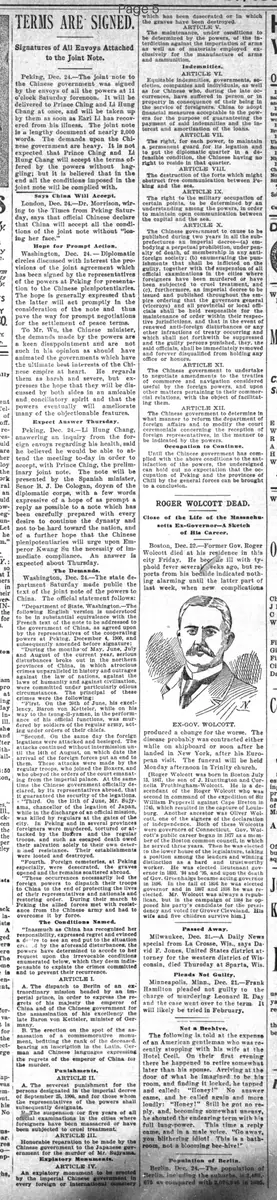
Signatures of All Envoys Attached to the Joint Note.
Peking, Dec. 24.—The joint note to the Chinese government was signed by the envoys of all the powers at 11 o'clock Saturday forenoon. It will be delivered to Prince Ching and Li Hung Chang at once, and will be taken up by them as soon as Earl Li has recovered from his illness. The joint note is a lengthy document of nearly 2,000 words. The demands upon the Chinese government are heavy. It is not expected that Prince Ching and Li Hung Chang will accept the terms offered by the powers without haggling; but it is believed that in the end all the conditions imposed in the joint note will be complied with.
Says China Will Accept.
London, Dec. 24.—Dr. Morrison, writing to the Times from Peking Saturday, says that official Chinese declare that China will accept all the conditions of the joint note without "losing her face."
Hope for Prompt Action.
Washington, Dec. 24.—Diplomatic circles discussed with interest the provisions of the joint agreement which has been signed by the representatives of the powers at Peking for presentation to the Chinese plenipotentiaries. The hope is generally expressed that the latter will act promptly in the consideration of the note and thus pave the way for prompt negotiations for the settlement of peace terms.
To Mr. Wu, the Chinese minister, the demands made by the powers are a keen disappointment and are not such in his opinion as should have animated the governments which have the ultimate best interests of the Chinese empire at heart. He regards them as harsh and severe, but expresses the hope that they will be discussed by both sides in an amicable and conciliatory spirit and that the powers eventually will ameliorate many of the objectionable features.
Expect Answer Thursday.
Peking, Dec. 24.—Li Hung Chang, answering an inquiry from the foreign envoys regarding his health, said he believed he would be able to attend the meeting to-day in order to accept, with Prince Ching, the preliminary joint note. The note will be presented by the Spanish minister, Senor B. J. De Cologan, doyen of the diplomatic corps, with a few words expressive of a hope of as prompt a reply as possible to a note which has been carefully prepared with every desire to continue the dynasty and not to be hard toward the nation, and of a further hope that the Chinese plenipotentiaries will urge upon Emperor Kwang Su the necessity of immediate compliance. An answer is expected about Thursday.
The Demands.
Washington, Dec. 24.—The state department Saturday made public the text of the joint note of the powers to China. The official statement follows:
"Department of State, Washington.—The following English version is understood to be in substantial equivalence with the French text of the note to be addressed to the government of China, as agreed upon by the representatives of the cooperating powers at Peking, December 4, 1900, and subsequently amended before signature:
"During the months of May, June, July and August of the current year, serious disturbances broke out in the northern provinces of China, in which atrocious crimes unparalleled in history and outrages against the law of nations, against the laws of humanity and against civilization, were committed under particularly odious circumstances. The principal of these crimes were the following:
"First. On the 20th of June, his excellency, Baron von Ketteler, while on his way to the tsung-li-yamen, in the performance of his official functions, was murdered by soldiers of the regular army, acting under orders of their chiefs.
"Second. On the same day the foreign legations were attacked and besieged. The attacks continued without intermission until the 14th of August, on which date the arrival of the foreign forces put an end to them. These attacks were made by the regular troops, who joined the Boxers, and who obeyed the orders of the court emanating from the imperial palace. At the same time the Chinese government officially declared, by its representatives abroad, that it guaranteed the security of the legations.
Third. On the 11th of June, Mr. Sugiyama, chancellor of the legation of Japan, while in the discharge of an official mission, was killed by regulars at the gates of the city. In Peking and in several provinces foreigners were murdered, tortured or attacked by the Boxers and the regular troops, and such as escaped death owed their salvation solely to their own determined resistance. Their establishments were looted and destroyed.
"Fourth. Foreign cemeteries, at Peking especially, were desecrated, the graves opened and the remains scattered abroad.
"These occurrences necessarily led the foreign powers to dispatch their troops to China to the end of protecting the lives of their representatives and nationals and restoring order. During their march to Peking the allied forces met with resistance from the Chinese army and had to overcome it by force.
The Conditions Named
"Inasmuch as China has recognized her responsibility, expressed regret and evinced a desire to see an end put to the situation created by the aforesaid disturbances, the powers have determined to accede to her request upon the irrevocable conditions enumerated below, which they deem indispensable to expiate the crimes committed and to prevent their recurrence.
ARTICLE I.
A. The dispatch to Berlin of an extraordinary mission headed by an imperial prince, in order to express the regrets of his majesty the emperor of China and of the Chinese government for the assassination of his excellency the late Baron von Ketteler, minister of Germany.
B. The erection on the spot of the assassination of a commemorative monument, befitting the rank of the deceased, bearing an inscription in the Latin, German and Chinese languages expressing the regrets of the emperor of China for the murder.
Punishments.
ARTICLE II.
A. The severest punishment for the persons designated in the imperial decree of September 25, 1900, and for those whom the representatives of the powers shall subsequently designate.
B. The suspension for five years of all official examinations in the cities where foreigners have been massacred or have been subjected to cruel treatment.
ARTICLE III.
Honorable reparation to be made by the Chinese government to the Japanese government for the murder of Mr. Sugiyama.
Expiatory Monuments.
ARTICLE IV
An expiatory monument to be erected by the Imperial Chinese government in every foreign or international cemetery which has been desecrated or in which the graves have been destroyed.
ARTICLE V.
The maintenance, under conditions to be determined by the powers, of the interdiction against the importation of arms as well as of materials employed exclusively for the manufacture of arms and ammunition.
Indemnities.
ARTICLE VI
Equitable indemnities, governments, societies, companies and individuals, as well as for Chinese who, during the late occurrences, have suffered in person or in property in consequence of their being in the service of foreigners. China to adopt financial measures acceptable to the powers for the purpose of guaranteeing the payment of said indemnities and the interest and amortization of the loans.
ARTICLE VII
The right, for each power, to maintain a permanent guard for its legation and to put the diplomatic quarter in a defensible condition, the Chinese having no right to reside in that quarter.
ARTICLE VIII.
The destruction of the forts which might obstruct free communication between Peking and the sea.
ARTICLE IX.
The right to the military occupation of certain points, to be determined by an understanding among the powers, in order to maintain open communication between the capital and the sea.
ARTICLE X.
The Chinese government to cause to be published during two years in all the sub-prefectures an imperial decree—(a) embodying a perpetual prohibition, under penalty of death, of membership in any anti-foreign society; (b) enumerating the punishments that shall be inflicted on the guilty, together with the suspension of all official examinations in the cities where foreigners have been murdered or have been subjected to cruel treatment, and (c), furthermore, an imperial decree to be issued and published throughout the empire ordering that the governors general (viceroys) and all provincial or local officials shall be held responsible for the maintenance of order within their respective jurisdictions, and that in the event of renewed anti-foreign disturbances or any other infractions of treaty occurring and which shall not forthwith be suppressed and the guilty persons punished, they, the said officials, shall be immediately removed and forever disqualified from holding any office or honors.
ARTICLE XI.
The Chinese government to undertake to negotiate amendments to the treaties of commerce and navigation considered useful by the foreign powers, and upon other matters pertaining to their commercial relations, with the object of facilitating them.
ARTICLE XII.
The Chinese government to determine in what manner to reform the department of foreign affairs and to modify the court ceremonials concerning the reception of foreign representatives, in the manner to be indicated by the powers.
Occupation to Continue.
Until the Chinese government has complied with the above conditions to the satisfaction of the powers, the undersigned can hold out no expectation that the occupation of Peking and the provinces of Chili by the general forces can be brought to a conclusion.
What sub-type of article is it?
What keywords are associated?
What entities or persons were involved?
Where did it happen?
Foreign News Details
Primary Location
Peking
Event Date
Dec. 24, 1900
Key Persons
Outcome
joint note signed with demands for punishments, monuments, indemnities, military occupations, and reforms; expected chinese acceptance leading to peace settlement; continued occupation until compliance.
Event Details
Envoys signed a joint note on December 22, 1900, presenting heavy demands to China for Boxer Rebellion crimes, including assassination regrets, severe punishments, indemnities, legation guards, fort destruction, and treaty amendments. Chinese plenipotentiaries anticipated to accept soon, with hopes for amicable negotiations.