Thank you for visiting SNEWPapers!
Sign up free
Commercial
June 17, 1846
American Republican And Baltimore Daily Clipper
Baltimore, Maryland
What is this article about?
Opposition to a House bill reducing tariffs, arguing it would harm U.S. manufacturing by favoring foreign monopolies. Highlights benefits of 1842 Tariff Act in Baltimore County, with new factories and villages like Woodbury providing employment and boosting local economy.
Clipping
OCR Quality
98%
Excellent
Full Text
Effects of the Tariff.
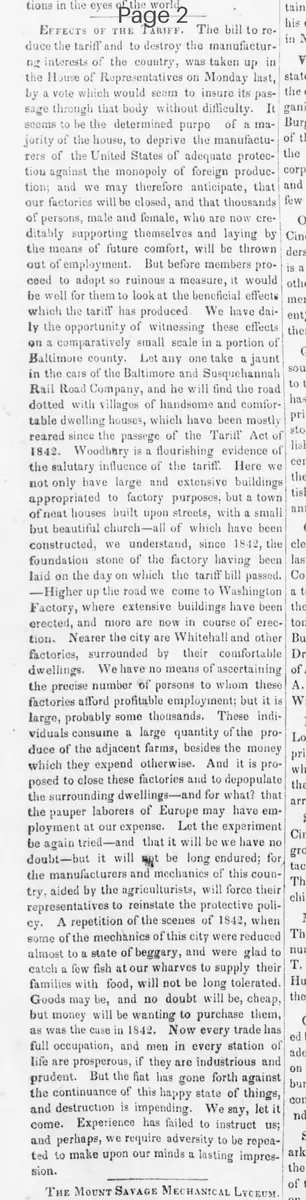
The bill to reduce the tariff and to destroy the manufacturing interests of the country, was taken up in the House of Representatives on Monday last, by a vote which would seem to insure its passage through that body without difficulty. It seems to be the determined purpose of a majority of the house, to deprive the manufacturers of the United States of adequate protection against the monopoly of foreign production; and we may therefore anticipate, that our factories will be closed, and that thousands of persons, male and female, who are now creditably supporting themselves and laying by the means of future comfort, will be thrown out of employment. But before members proceed to adopt so ruinous a measure, it would be well for them to look at the beneficial effects which the tariff has produced. We have daily the opportunity of witnessing these effects on a comparatively small scale in a portion of Baltimore county. Let any one take a jaunt in the cars of the Baltimore and Susquehannah Rail Road Company, and he will find the road dotted with villages of handsome and comfortable dwelling houses, which have been mostly reared since the passage of the Tariff Act of 1842. Woodbury is a flourishing evidence of the salutary influence of the tariff. Here we not only have large and extensive buildings appropriated to factory purposes, but a town of neat houses built upon streets, with a small but beautiful church—all of which have been constructed, we understand, since 1842, the foundation stone of the factory having been laid on the day on which the tariff bill passed.—Higher up the road we come to Washington Factory, where extensive buildings have been erected, and more are now in course of erection. Nearer the city are Whitehall and other factories, surrounded by their comfortable dwellings. We have no means of ascertaining the precise number of persons to whom these factories afford profitable employment; but it is large, probably some thousands. These individuals consume a large quantity of the produce of the adjacent farms, besides the money which they expend otherwise. And it is proposed to close these factories and to depopulate the surrounding dwellings—and for what? that the pauper laborers of Europe may have employment at our expense. Let the experiment be again tried—and that it will be we have no doubt—but it will not be long endured; for the manufacturers and mechanics of this country, aided by the agriculturists, will force their representatives to reinstate the protective policy. A repetition of the scenes of 1842, when some of the mechanics of this city were reduced almost to a state of beggary, and were glad to catch a few fish at our wharves to supply their families with food, will not be long tolerated. Goods may be, and no doubt will be, cheap, but money will be wanting to purchase them, as was the case in 1842. Now every trade has full occupation, and men in every station of life are prosperous, if they are industrious and prudent. But the fiat has gone forth against the continuance of this happy state of things, and destruction is impending. We say, let it come. Experience has failed to instruct us; and perhaps, we require adversity to be repeated to make upon our minds a lasting impression.
The bill to reduce the tariff and to destroy the manufacturing interests of the country, was taken up in the House of Representatives on Monday last, by a vote which would seem to insure its passage through that body without difficulty. It seems to be the determined purpose of a majority of the house, to deprive the manufacturers of the United States of adequate protection against the monopoly of foreign production; and we may therefore anticipate, that our factories will be closed, and that thousands of persons, male and female, who are now creditably supporting themselves and laying by the means of future comfort, will be thrown out of employment. But before members proceed to adopt so ruinous a measure, it would be well for them to look at the beneficial effects which the tariff has produced. We have daily the opportunity of witnessing these effects on a comparatively small scale in a portion of Baltimore county. Let any one take a jaunt in the cars of the Baltimore and Susquehannah Rail Road Company, and he will find the road dotted with villages of handsome and comfortable dwelling houses, which have been mostly reared since the passage of the Tariff Act of 1842. Woodbury is a flourishing evidence of the salutary influence of the tariff. Here we not only have large and extensive buildings appropriated to factory purposes, but a town of neat houses built upon streets, with a small but beautiful church—all of which have been constructed, we understand, since 1842, the foundation stone of the factory having been laid on the day on which the tariff bill passed.—Higher up the road we come to Washington Factory, where extensive buildings have been erected, and more are now in course of erection. Nearer the city are Whitehall and other factories, surrounded by their comfortable dwellings. We have no means of ascertaining the precise number of persons to whom these factories afford profitable employment; but it is large, probably some thousands. These individuals consume a large quantity of the produce of the adjacent farms, besides the money which they expend otherwise. And it is proposed to close these factories and to depopulate the surrounding dwellings—and for what? that the pauper laborers of Europe may have employment at our expense. Let the experiment be again tried—and that it will be we have no doubt—but it will not be long endured; for the manufacturers and mechanics of this country, aided by the agriculturists, will force their representatives to reinstate the protective policy. A repetition of the scenes of 1842, when some of the mechanics of this city were reduced almost to a state of beggary, and were glad to catch a few fish at our wharves to supply their families with food, will not be long tolerated. Goods may be, and no doubt will be, cheap, but money will be wanting to purchase them, as was the case in 1842. Now every trade has full occupation, and men in every station of life are prosperous, if they are industrious and prudent. But the fiat has gone forth against the continuance of this happy state of things, and destruction is impending. We say, let it come. Experience has failed to instruct us; and perhaps, we require adversity to be repeated to make upon our minds a lasting impression.
What sub-type of article is it?
Policy
Manufacturing
Economic
What keywords are associated?
Tariff Reduction
Manufacturing Protection
Baltimore Factories
Economic Impact
Protective Policy
What entities or persons were involved?
House Of Representatives
Baltimore And Susquehannah Rail Road Company
Woodbury
Washington Factory
Whitehall
Where did it happen?
Baltimore County
Commercial Details
Location
Baltimore County
Event Date
1842
Key Figures
House Of Representatives
Baltimore And Susquehannah Rail Road Company
Woodbury
Washington Factory
Whitehall
Notable Details
Bill To Reduce Tariff
Passage Of Tariff Act Of 1842
Factories Closing Anticipated
Thousands Employed
Comparison To 1842 Economic Distress