Thank you for visiting SNEWPapers!
Sign up free
Story
June 4, 1808
Alexandria Daily Advertiser
Alexandria, Virginia
What is this article about?
In April 1808, Capt. Jasper Parish reports on a council at Buffalo Creek where the Six Nations and Caughnawaga delegates unanimously decide to remain neutral in any impending war between Britain and the US, rejecting a British war belt and citing faithful US treaties.
Clipping
OCR Quality
95%
Excellent
Full Text
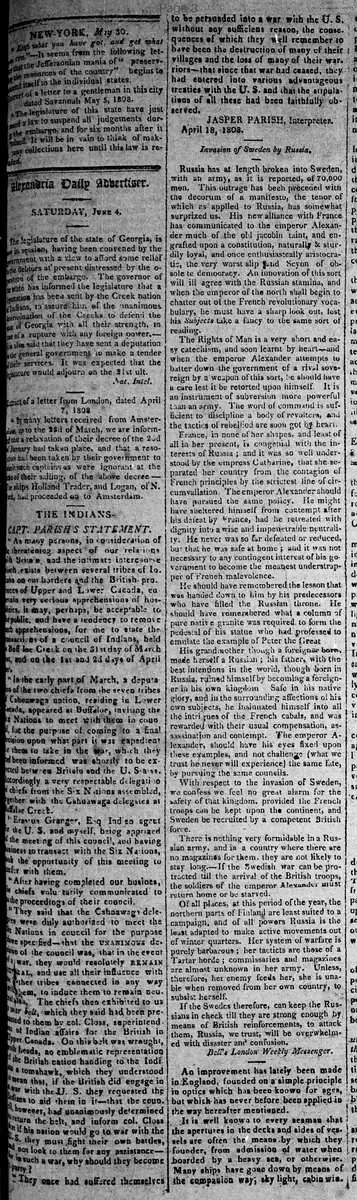
THE INDIANS—
CAPT. PARISH'S STATEMENT.
"As many persons, in consideration of the threatening aspect of our relations with Britain and the intimate intercourse which exists between several tribes of Indians on our borders and the British professors of Upper and Lower Canada, entertain very serious apprehensions of hostilities, it may, perhaps, be acceptable to the public, and have a tendency to remove such apprehensions, for me to state the transactions of a council of Indians, held at Buffalo Creek on the 31st day of March last, and on the 1st and 2d days of April next.
"In the early part of March, a deputation of the two chiefs from the seven tribes of the Caughnawaga nation, residing in Lower Canada, appeared at Buffalo, inviting the Six Nations to meet with them in council, for the purpose of coming to a final decision upon what part it was expedient for them to take in the war, which they had been informed was shortly to be expected between Britain and the U. States. Accordingly a very respectable delegation of chiefs from the Six Nations assembled, together with the Caughnawaga delegates at Buffalo Creek.
"Erastus Granger, Esq. Indian agent for the U. S. and myself, being apprised of the meeting of this council, and having business to transact with the Six Nations, took the opportunity of this meeting to confer with them.
"After having completed our business, the chiefs voluntarily communicated to us the proceedings of their council.
"They said that the Caughnawaga delegates were duly authorized to meet the Six Nations in council for the purpose above specified—that the unanimous decision of the council was, that in the event of war, they would resolutely REMAIN Neutral, and use all their influence with other tribes connected in any way with them, to induce them to remain neutral. The chiefs then exhibited to us a war belt, which they said had been presented to them by Col. Closs, superintendent of Indian affairs for the British in Upper Canada. On this belt was wrought, in beads, an emblematic representation of the British nation handing to the Indians a tomahawk, which they understood to mean that, if the British did engage in war with the U. S. they requested the Indians to aid them in it—that the council, however, had unanimously determined to return the belt, and inform Col. Closs that if his nation would go to war with the U. S. they must fight their own battles, and not look to them for any assistance—that in such a war, why should they become party? They once had suffered themselves to be persuaded into a war with the U. S. without any sufficient reason, the consequences of which they well remember to have been the destruction of many of their villages and the loss of many of their warriors that since that war had ceased they had entered into various advantageous treaties with the U. S. and that the stipulations of all these had been faithfully observed."
JASPER PARISH, Interpreter
April 18, 1808.
CAPT. PARISH'S STATEMENT.
"As many persons, in consideration of the threatening aspect of our relations with Britain and the intimate intercourse which exists between several tribes of Indians on our borders and the British professors of Upper and Lower Canada, entertain very serious apprehensions of hostilities, it may, perhaps, be acceptable to the public, and have a tendency to remove such apprehensions, for me to state the transactions of a council of Indians, held at Buffalo Creek on the 31st day of March last, and on the 1st and 2d days of April next.
"In the early part of March, a deputation of the two chiefs from the seven tribes of the Caughnawaga nation, residing in Lower Canada, appeared at Buffalo, inviting the Six Nations to meet with them in council, for the purpose of coming to a final decision upon what part it was expedient for them to take in the war, which they had been informed was shortly to be expected between Britain and the U. States. Accordingly a very respectable delegation of chiefs from the Six Nations assembled, together with the Caughnawaga delegates at Buffalo Creek.
"Erastus Granger, Esq. Indian agent for the U. S. and myself, being apprised of the meeting of this council, and having business to transact with the Six Nations, took the opportunity of this meeting to confer with them.
"After having completed our business, the chiefs voluntarily communicated to us the proceedings of their council.
"They said that the Caughnawaga delegates were duly authorized to meet the Six Nations in council for the purpose above specified—that the unanimous decision of the council was, that in the event of war, they would resolutely REMAIN Neutral, and use all their influence with other tribes connected in any way with them, to induce them to remain neutral. The chiefs then exhibited to us a war belt, which they said had been presented to them by Col. Closs, superintendent of Indian affairs for the British in Upper Canada. On this belt was wrought, in beads, an emblematic representation of the British nation handing to the Indians a tomahawk, which they understood to mean that, if the British did engage in war with the U. S. they requested the Indians to aid them in it—that the council, however, had unanimously determined to return the belt, and inform Col. Closs that if his nation would go to war with the U. S. they must fight their own battles, and not look to them for any assistance—that in such a war, why should they become party? They once had suffered themselves to be persuaded into a war with the U. S. without any sufficient reason, the consequences of which they well remember to have been the destruction of many of their villages and the loss of many of their warriors that since that war had ceased they had entered into various advantageous treaties with the U. S. and that the stipulations of all these had been faithfully observed."
JASPER PARISH, Interpreter
April 18, 1808.
What sub-type of article is it?
Historical Event
What themes does it cover?
Moral Virtue
Justice
What keywords are associated?
Indian Council
Six Nations
Caughnawaga
Neutrality
British War Belt
Buffalo Creek
Us Treaties
What entities or persons were involved?
Jasper Parish
Erastus Granger
Col. Closs
Where did it happen?
Buffalo Creek
Story Details
Key Persons
Jasper Parish
Erastus Granger
Col. Closs
Location
Buffalo Creek
Event Date
31st March 1808, 1st And 2nd April 1808
Story Details
A council of the Six Nations and Caughnawaga delegates at Buffalo Creek unanimously decides to remain neutral in any war between Britain and the US, rejects a British war belt invitation to join the fight, and resolves to influence other tribes to stay neutral, citing past destructive wars and faithful US treaties.